
Composite vs ESD Worktops: How to Choose the Right Surface for Your Workshop
Who Needs to Make This Choice?
Facilities managers and production engineers in electronics assembly, automotive parts manufacturing, hardware mold factories, and maintenance testing labs frequently face a specific procurement question: should the next batch of workbenches use composite worktops or ESD (electrostatic discharge) worktops? The answer is rarely about which material is universally better. It is about matching the worktop to the actual tasks, load conditions, and environmental controls already present on the shop floor.
Guang'ErMei Precision Components supplies both composite and ESD-configured workbenches as part of a broader workstation equipment family. The two options share the same structural frames and accessory ecosystems but diverge sharply in surface behavior and appropriate use cases.
Signal Checklist: When to Lean Toward Composite
Composite worktops—typically high-density polymer or laminated wood-core surfaces—are the default choice when the primary demands are mechanical durability and heavy load-bearing. Consider composite if your operation matches three or more of these signals:
- Heavy tooling or fixtures are placed directly on the surface (vices, press tools, large calipers).
- Impact resistance matters more than surface resistivity; dropped metal parts are routine.
- General assembly, machining support, or mold maintenance defines the daily workflow.
- Static control is managed elsewhere in the facility through flooring, wrist straps, or ionizers.
- Budget allocation favors structural capacity over specialized surface properties.
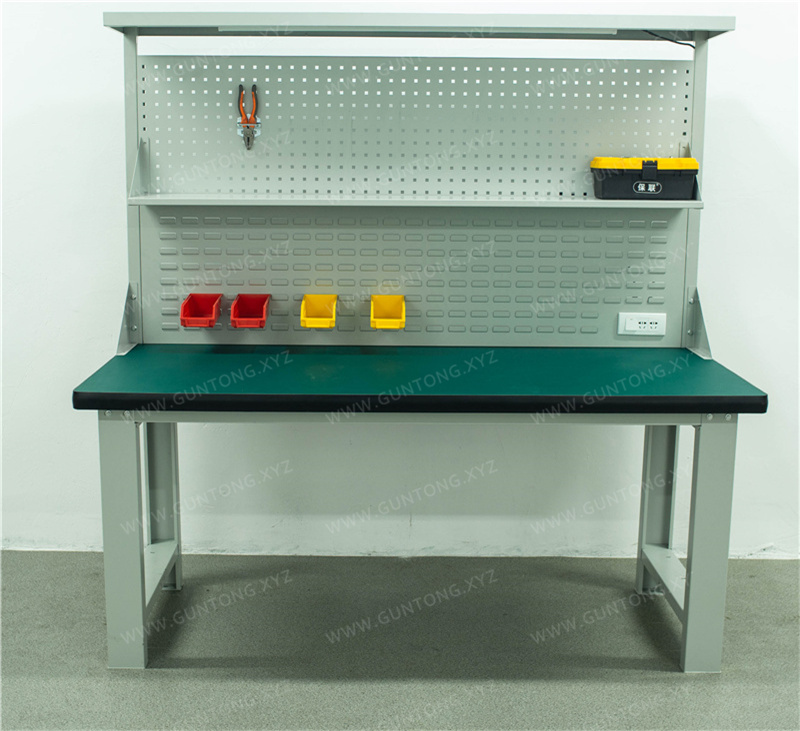
A representative composite configuration from Guang'ErMei's standard range uses a 50mm thick green composite desktop mounted on 100×50×1.5mm C-section steel legs, delivering an overall load capacity of approximately 1,000 kg. Standard lengths of 1,500mm, 1,800mm, and 2,100mm (all at 750mm depth and 800mm height) cover most single-operator and dual-operator bays.
Signal Checklist: When ESD Worktops Are Non-Negotiable
ESD worktops incorporate a conductive or dissipative surface layer that channels static charges to a controlled ground path. They become mandatory when:
- Semiconductor components, PCB assemblies, or sensitive sensors are handled without secondary packaging.
- Product quality standards or customer audits require documented static control at every touchpoint.
- The facility lacks comprehensive ESD flooring, making the worktop the primary discharge surface.
- Rework and inspection stations involve prolonged contact with bare circuit boards.
An ESD worktop alone does not create a compliant workstation. Grounding cords, wrist strap monitors, and verified earth connections must be confirmed before the bench enters service. Guang'ErMei's workstation planning service addresses these supporting conditions during on-site layout design.
Side-by-Side Evaluation Criteria
| Criterion | Composite Worktop | ESD Worktop |
|---|---|---|
| Primary strength | Impact and abrasion resistance | Controlled surface resistivity |
| Typical load rating | Up to ~1,000 kg (frame-dependent) | Varies; often lower than heavy-duty composite |
| Surface hardness | High; tolerates clamping and vice mounting | Moderate; requires care with sharp metal edges |
| Static dissipation | Not designed for ESD control | Engineered for charge decay within defined timeframes |
| Common industries | Automotive, mold shops, general assembly, warehousing | Electronics, semiconductor, precision instrument testing |
| Maintenance | Wipe clean; resistant to oils and solvents | Requires periodic surface resistance verification |
| Accessory compatibility | Full range: pegboards, drawer cabinets, shelf tiers | Same frame accessories; grounding hardware added |
Configuration Options That Apply to Both
Regardless of surface type, the underlying workstation can be configured with accessories that solve specific storage and workflow problems:
- Pegboard panels (single or double) for frequently accessed hand tools, reducing reach time.
- Drawer cabinets (two, three, or four drawers) for calibrated instruments or small parts kits. Drawer units with single-rail slides typically open to 85% of their depth and support around 80 kg per drawer.
- Lower shelf tiers or cross-brace shelves for bulkier items like power supplies or material bins.
- Lean pipe racks integrated above or beside the bench for kitting and line-side material flow.
These accessories mount to the same C-frame structure, meaning a facility can standardize on one frame family while varying only the worktop surface across different departments.
Risks and Boundaries to Watch
- Over-specifying ESD surfaces. Installing ESD worktops in areas where no static-sensitive components are handled adds cost and maintenance overhead without measurable quality benefit. The surface resistance must be verified periodically, and grounding infrastructure must be maintained.
- Under-specifying composite for heavy work. If a maintenance bay routinely mounts a 60 kg bench vice and absorbs hammering impacts, a thinner or lighter-duty surface will delaminate or crack. Confirm the 50mm composite thickness and 1,000 kg frame rating against your actual worst-case load, not the average load.
- Ignoring dimensional fit. Standard lengths (1,500 / 1,800 / 2,100 mm) suit most bays, but narrow aisles or existing conveyor clearances may require non-standard widths. Guang'ErMei supports non-standard customization for these edge cases, but lead times and structural recalculation apply.
- Assuming ESD compliance is complete at delivery. An ESD worktop is one link in a chain. Without verified grounding, operator wrist straps, and ESD-safe flooring or mats, the worktop cannot deliver its rated performance.
Practical Next Steps
- Audit your current stations. List which benches handle static-sensitive items and which handle heavy mechanical work. Most facilities need a mix, not a single standard.
- Confirm load data. Record the heaviest fixture or tool that will sit on each bench. Compare against the ~1,000 kg composite rating or request a specific ESD model rating.
- Map grounding infrastructure. Before ordering ESD benches, verify that earth points exist at each planned location.
- Request a layout proposal. Guang'ErMei provides on-site workstation planning that accounts for load-bearing design, 6S adaptation, and accessory selection across both composite and ESD zones.
For facilities in Huizhou, Guangdong Province, and nationwide, the team can supply standardized units from stock dimensions or engineer non-standard sizes to match your floor plan. Reach out with your station count, load requirements, and ESD zones to receive a configuration proposal.
When selecting between composite and ESD worktops, it is important to note that both options belong to the same primary product family, with ESD being one of the surface and workstation configuration attributes. Standard heavy-duty models are available in lengths of 1,500mm, 1,800mm, and 2,100mm (all at 750mm depth and 800mm height), featuring approximately 50mm thick composite desktops mounted on 100×50×1.5mm C-section steel frames with an overall load capacity of 1,000 kg. For configurations involving drawers, such as the horizontal three-drawer composite worktop, each drawer supports up to 80 kg and opens to 85% extension on a single rail. Always verify specific parameters against the confirmed model and drawings before procurement.