
Can You Just Use an ESD Mat on a Workbench? Practical Configuration Guide for Electronics Workshops
Direct Answer: Yes, But With Clear Boundaries
You can place an ESD (electrostatic discharge) mat on a standard workbench to protect sensitive electronic components during light assembly, inspection, or repair tasks. The mat, connected to a verified ground point via a grounding cord, will dissipate static charges from the work surface. However, this approach only addresses surface static. It does not solve grounding for tools, operator wrist straps, shelving, or underlying frame conductivity. For electronics manufacturers, testing labs, and maintenance facilities handling high-value or highly sensitive components, a mat-only setup often falls short of reliable ESD control.
When an ESD Mat Alone Is Sufficient
A standalone ESD mat on a conventional workbench is acceptable under these conditions:
- Low-sensitivity components: You are handling robust consumer electronics or sub-assemblies with higher ESD tolerance.
- Light-duty tasks: The work involves inspection, soldering, or minor repair without heavy equipment or impact loads.
- Temporary or flexible workstations: You need a quick, portable ESD surface for field service or training environments.
- Supplementary protection: The mat is one layer in a broader ESD program that includes ionizers, grounded flooring, and operator wrist straps.
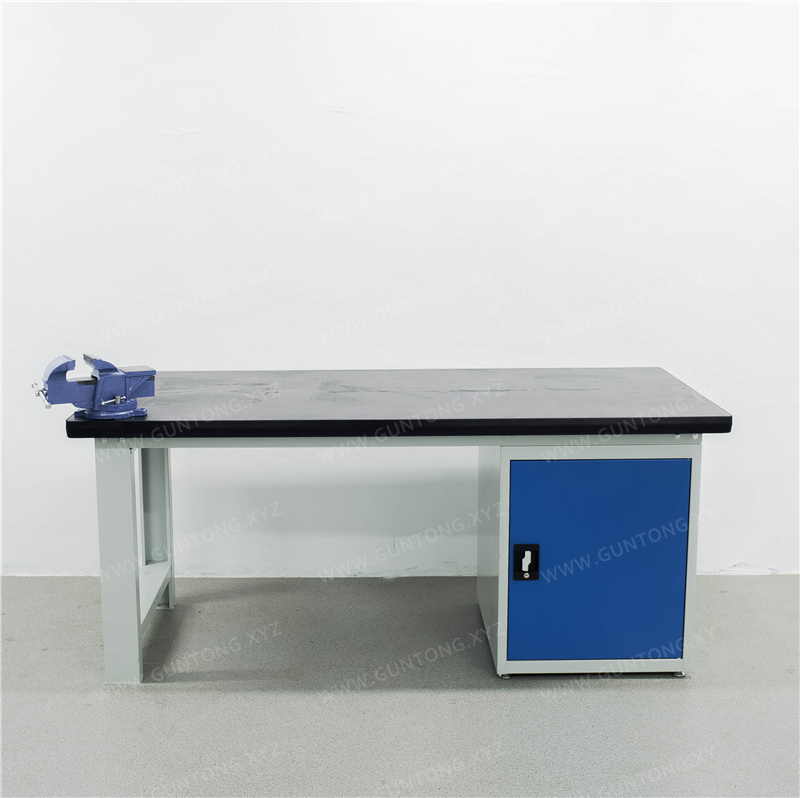
In these scenarios, a standard steel plate workbench or composite-top workbench can serve as the base structure. For example, Guang'ErMei's steel plate workbenches feature a 5mm raw steel plate composite desktop with high-density fiberboard core, providing a stable, flat foundation for ESD mat placement.
When an ESD Mat Is Not Enough
Relying solely on a mat becomes risky when your operation involves:
- Highly sensitive microelectronics: Components rated below 100V HBM (Human Body Model) require a fully controlled ESD workstation, not just a surface mat.
- Heavy equipment or dynamic loads: If your workbench must support testing instruments, oscilloscopes, or pneumatic tools, the mat may shift, tear, or lose ground contact under load.
- Multi-operator stations: When several technicians share a bench, each needs an independent ground path. A single mat cannot guarantee equal potential across all positions.
- Regulated production environments: Automotive electronics (IATF 16949), aerospace, or medical device assembly often require documented ESD workstation validation per ANSI/ESD S20.20 or IEC 61340-5-1.
Practical Configuration: From Mat to Full ESD Workstation
Step 1: Verify the Base Workbench Structure
Before adding any ESD surface, confirm the workbench frame and desktop can handle your actual load. Guang'ErMei workbenches use C-type cold-rolled steel frames rated for up to 1000kg total load capacity on heavy-duty models, and 300kg on light-duty configurations. A stable frame prevents mat displacement and maintains consistent ground contact.
Step 2: Select the Right ESD Surface
You have two primary options:
- ESD mat on standard desktop: A 2mm or 3mm dissipative mat laid over a steel or composite top. The mat must be connected to a verified earth ground via a 1MΩ resistor grounding cord.
- Integrated ESD desktop: A purpose-built anti-static workbench with a conductive or dissipative surface layer bonded directly to the frame. This eliminates mat shifting and provides a more reliable ground path through the steel frame to adjustable grounding foot cups.
For stainless steel workbenches used in cleanroom or corrosion-sensitive environments, an ESD mat is often necessary because bare stainless steel is conductive but not consistently dissipative across its surface.
Step 3: Establish a Verified Ground Path
The most common failure in mat-only setups is an unverified or high-resistance ground connection. Your configuration must include:
- A dedicated ESD ground bus bar or common point ground connected to building earth.
- Grounding cords with built-in 1MΩ resistors for both the mat and operator wrist straps.
- Periodic verification using a surface resistance tester (target: 10^6 to 10^9 ohms for dissipative surfaces).
Step 4: Configure Accessories for Full-Scope Protection
A complete ESD workstation typically integrates:
- Pegboards and tool racks: For storing ESD-safe tools within reach. Guang'ErMei workbenches support square-hole pegboards and configurable hanging cabinets.
- Drawers and cabinets: For organized storage of sensitive components in shielded bags or bins. The 4-drawer tiered design allows separation by component sensitivity class.
- Power and lighting: Pre-drilled power holes at desk corners facilitate clean installation of ESD-safe outlets and task lighting without compromising the ground path.
Load Capacity and Material Considerations
When converting a standard workbench to an ESD station, do not overlook structural specifications:
| Parameter | Light-Duty Workbench | Heavy-Duty Workbench |
|---|---|---|
| Load Capacity | Up to 300 kg | Up to 1000 kg |
| Frame Material | 40×40×1.2mm square tube | C-type cold-rolled steel |
| Desktop Options | Composite, polymer, ESD laminate | 5mm steel plate + HDF core |
| ESD Mat Compatibility | Yes (surface layover) | Yes (surface layover or integrated) |
Standard dimensions (1500×750×800mm, 1800×750×800mm, 2100×750×800mm) accommodate most single-operator ESD layouts. For dual-operator or inline assembly stations, custom lengths and widths are available through non-standard customization.
Common Mistakes to Avoid
- Skipping ground verification: A mat without a measured ground path provides false security.
- Using non-ESD casters or foot cups: Mobility accessories can break the ground chain if they are insulative.
- Overloading the mat: Heavy test equipment can compress or puncture thin mats, exposing the non-dissipative desktop beneath.
- Ignoring operator grounding: The mat protects the surface, not the person. Wrist straps and ESD footwear remain essential.
Next Steps for Workshop Buyers
If you are evaluating whether to retrofit existing workbenches with ESD mats or invest in purpose-built anti-static workstations, start by documenting your component sensitivity levels, operator count per station, and actual load requirements. For electronics assembly, testing institutions, and vocational training centers in Guangdong and nationwide, Guang'ErMei provides both standardized ESD workbenches and custom-configured solutions with integrated grounding, pegboards, drawers, and 6S-compliant layouts. Contact our engineering team for an on-site workstation assessment and load-bearing design review.