
Best Stainless Steel Grades for Industrial Workbenches: Selection & Configuration Guide
Why Stainless Steel Grade Selection Fails in Workshop Procurement
Many manufacturing facilities specify "stainless steel workbenches" without defining the exact grade, only to discover premature surface rust, pitting, or chemical etching within months of deployment. This failure typically stems from treating stainless steel as a single material category rather than a family of alloys with distinct corrosion resistance, mechanical strength, and cost profiles. For workshop managers and procurement teams evaluating workstation equipment, understanding the practical differences between common grades—particularly 201 and 304 stainless steel—is essential to avoid costly replacements and production downtime.
Guang'ErMei Precision Components manufactures stainless steel workbenches with configurable desktop structures, and this guide addresses the most frequent configuration questions we receive from electronics manufacturers, automotive parts producers, and maintenance testing institutions.
201 vs. 304 Stainless Steel: Core Performance Differences
Corrosion Resistance and Environmental Suitability
201 stainless steel contains lower nickel content and higher manganese, making it more susceptible to corrosion in humid, saline, or chemically aggressive environments. It performs adequately in dry indoor workshops with controlled temperature and minimal exposure to acids, alkalis, or salt spray.
304 stainless steel (18/8 chromium-nickel composition) offers significantly higher resistance to oxidation, organic acids, and alkaline solutions. It is the standard choice for food processing, pharmaceutical cleanrooms, marine-adjacent facilities, and any workshop where workbenches contact corrosive solvents or cleaning agents.
Load-Bearing Capacity and Structural Design
Both grades can achieve comparable structural strength when paired with appropriate frame designs. Guang'ErMei's stainless steel workbenches typically feature:
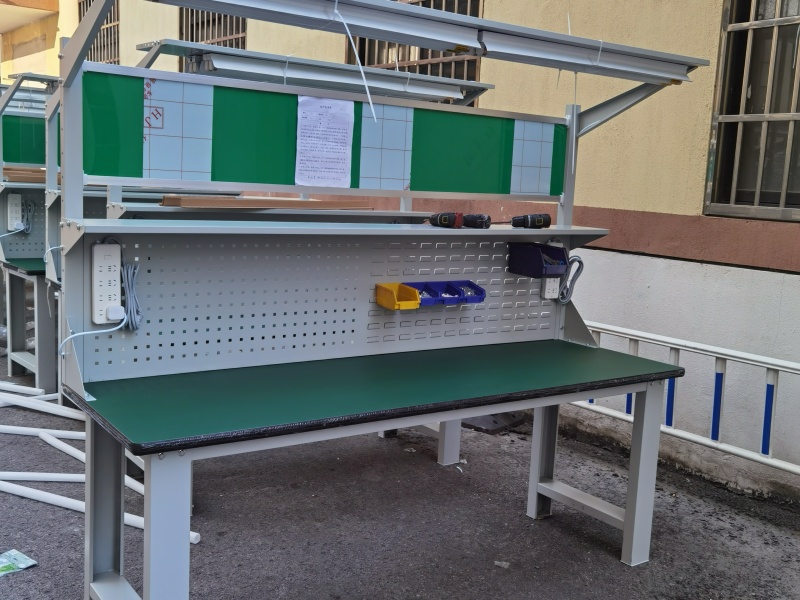
- Desktop structure: 1.0mm or 2.0mm stainless steel sheet bonded to 48–49mm high-density fiberboard substrate, yielding a total thickness of approximately 50mm
- Frame material: C-type cold-rolled steel or 3.0mm square tube construction
- Load capacity: Up to 1000kg for heavy-duty configurations, 500kg for standard square tube frames
- Surface treatment: Acid washing, phosphating, and anti-static powder coating at 250°C for frame components
The stainless steel grade primarily affects surface durability rather than structural load capacity. A 201 stainless top with proper composite backing can support the same static loads as a 304 top of identical thickness.
Cost and Budget Trade-Offs
201 stainless steel typically costs 30–40% less than 304 grade at equivalent thickness. For facilities deploying dozens of workbenches across dry assembly lines, this difference represents substantial budget savings. However, the lifecycle cost calculation must account for:
- Expected exposure to moisture, chemicals, or temperature cycling
- Cleaning frequency and sanitization protocols
- Replacement lead times and production disruption costs
Application Scenarios: Which Grade Fits Your Workshop?
| Environment | Recommended Grade | Rationale |
|---|---|---|
| Electronics assembly (ESD-controlled, climate-controlled) | 201 stainless | Low corrosion risk; budget optimization |
| Automotive parts machining (coolant exposure, metal shavings) | 304 stainless | Resistance to cutting fluids and alkaline cleaners |
| Food processing and packaging | 304 stainless | FDA-compliant corrosion resistance; frequent washdown |
| Hardware mold maintenance (hydraulic oil, rust inhibitors) | 201 or 304 | Depends on chemical exposure intensity |
| Warehousing and logistics (dry storage, general packing) | 201 stainless | Minimal environmental stressors |
| Pharmaceutical or cleanroom environments | 304 stainless | Mandatory for sanitization protocols |
Configuration Checklist for Stainless Steel Workbenches
Before requesting a quotation, define these parameters to ensure accurate specification:
- Primary environmental stressors: List all chemicals, solvents, or moisture sources the workbench will encounter
- Load requirements: Maximum static load per workbench and whether dynamic impact (e.g., dropping heavy molds) is expected
- Standard dimensions: Common configurations include 1500×750×800mm, 1800×750×800mm, and 2100×750×800mm; custom sizes require fabrication lead time
- Accessory integration: Drawer units, pegboard back panels, tool racks, or lean pipe frames may affect desktop cutout requirements
- Grounding and ESD needs: Stainless steel is conductive; verify whether anti-static grounding straps or isolated surfaces are required for electronics work
Common Specification Mistakes to Avoid
- Assuming all stainless steel is non-magnetic: 201 grade exhibits slight magnetic properties after cold working; this may interfere with sensitive testing equipment
- Ignoring edge sealing: Exposed composite substrate edges absorb moisture and swell, even with stainless tops; specify full five-face wrapping or PVC edge banding
- Overlooking frame corrosion: A 304 stainless top on a poorly coated mild steel frame creates galvanic corrosion at contact points; request insulated mounting or matched stainless frames for harsh environments
- Confusing surface finish with grade: A polished 201 surface may initially resemble 304, but performance diverges under chemical exposure
Next Steps for Workbench Procurement
If your facility requires stainless steel workbenches, gather the environmental and load data outlined above before contacting suppliers. Guang'ErMei Precision Components provides on-site workstation planning, load-bearing design verification, and 6S adaptation consulting for manufacturing customers in Huizhou, Guangdong Province, and nationwide. Our standard stainless steel workbench series supports both 201 and 304 configurations with composite desktop structures, and we offer non-standard customization for specialized dimensions or accessory integration.
Request a configuration review by sharing your workshop layout, environmental conditions, and target deployment timeline. Our engineering team will recommend the appropriate grade, frame specification, and accessory package based on your actual use case—not generic catalog assumptions.