
Beech Wood vs. Composite Top Workbenches: How to Choose the Right Desktop for Your Workshop
Beech Wood vs. Composite Top Workbenches: How to Choose the Right Desktop for Your Workshop
Workbench surfaces fail in predictable ways. Beech tops dent under heavy vise pressure, swell when exposed to cutting fluids, or generate static that damages electronic assemblies. Composite steel tops scratch soft workpieces, delaminate at the edges after repeated impact, or fail ESD audits in electronics bays. These failures rarely stem from poor manufacturing quality; they result from a mismatch between the desktop material and the actual task performed on it.
For manufacturing enterprises, automotive parts suppliers, hardware mold factories, and vocational training centers, the decision between beech wood and composite top workbenches is a functional one. It depends on load paths, surface hardness, chemical exposure, and whether the workstation must dissipate static electricity. This comparison uses verified configuration data from Guang'ErMei Precision Components to clarify where each material performs well and where it reaches its limits.
Where Beech Wood Workbench Tops Perform Well
Beech finger-joint boards provide a naturally hard, warm surface that protects finished parts from scratches during handling and assembly. The wood grain offers slight cushioning that prevents marring on polished or painted components, making it a common choice for general fitting, light mechanical assembly, and vocational training workshops.
Typical beech workbench configuration:
- Desktop: 50 mm beech finger-joint board
- Frame: 1.5 mm cold-rolled steel, acid-washed, phosphated, and powder-coated at 250°C
- Standard dimensions: 1500 × 750 × 800 mm, 1800 × 750 × 800 mm, 2100 × 750 × 800 mm
- Load capacity: up to 1000 kg total when paired with a reinforced frame
Beech tops are frequently specified in environments where operators handle delicate components, perform hand-fitting tasks, or require a non-reflective surface for visual inspection. School practical training centers and hardware mold factories often select beech for general-purpose benches that serve multiple task types.
Boundaries to verify before ordering:
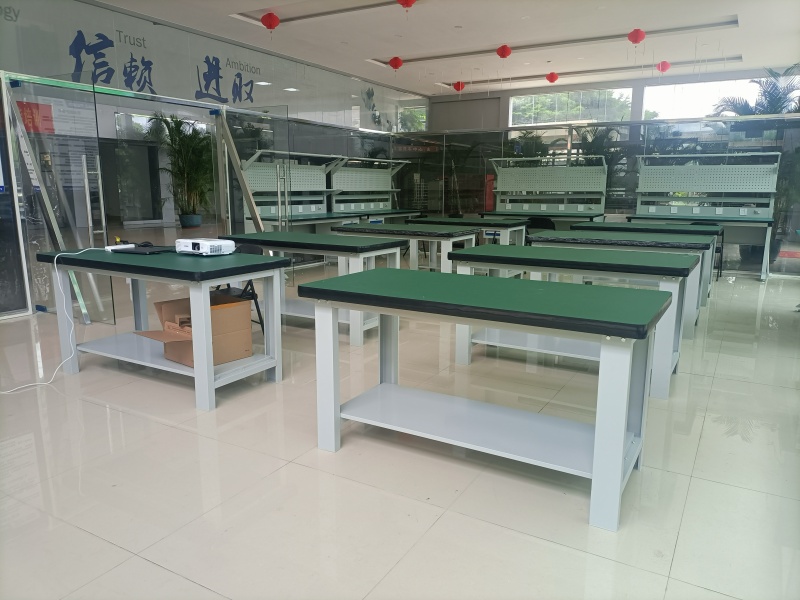
- Beech absorbs moisture and swells if exposed to water-based coolants or frequent wet cleaning.
- Surface hardness is lower than steel-composite laminates, making it unsuitable for heavy hammering, press operations, or direct vise mounting without protective plates.
- Anti-static performance is not inherent; electronics assembly requires additional ESD matting or a dedicated anti-static composite top.
Where Composite Workbench Tops Outperform
Composite workbench tops address the weaknesses of solid wood in demanding industrial environments. A typical heavy-duty composite desktop consists of a 5 mm raw steel plate bonded over 45 mm high-density fiberboard with black PVC edge banding, yielding approximately 50 mm total thickness. The steel surface distributes point loads from heavy fixtures, resists cutting fluids and lubricants, and provides a stable magnetic base for tool holders and fixturing jigs.
Typical composite workbench configuration:
- Desktop: 5 mm raw steel plate + 45 mm high-density fiberboard + PVC edge banding
- Frame: C-type cold-rolled steel
- Load capacity: up to 1000 kg total
- Standard dimensions: 1500 × 750 × 800+500 mm, 1800 × 750 × 800+500 mm, 2100 × 750 × 800+500 mm (with back panel height)
Composite steel tops are specified in automotive parts manufacturing, heavy hardware assembly, and maintenance bays where dies, molds, or components are placed directly on the surface. The steel face supports bench vises, magnetic fixtures, and clamping systems without additional reinforcement plates.
Boundaries to verify before ordering:
- Steel surfaces can mar soft, polished, or painted workpieces unless protective rubber mats or sacrificial layers are added.
- Standard steel-composite tops do not provide static dissipation; electronics testing and assembly require a dedicated anti-static composite top or ESD overlay.
- PVC edge banding must be inspected after delivery and installation, as impact damage to edges can expose the fiberboard core to moisture ingress.
Common Failure Modes and Corrective Actions
| Failure Mode | Likely Cause | Corrective Action |
|---|---|---|
| Surface denting under vise or press load | Beech top used for heavy mechanical work | Switch to 5 mm steel-composite top; verify frame load rating matches fixture weight |
| Edge swelling or delamination | Moisture ingress into fiberboard core or beech joints | Specify intact PVC edge banding; avoid direct water cleaning on composite tops |
| Static discharge damaging PCBs or sensors | Standard beech or steel top without ESD grounding path | Specify anti-static composite top or add grounded ESD mat overlay |
| Frame deflection under sustained heavy loads | Undersized frame or uneven floor contact | Confirm C-type frame specification; request on-site leveling during installation |
| Surface scratching on finished workpieces | Steel-composite top used without protective layer | Add rubber mat or sacrificial MDF sheet for finish-sensitive tasks |
Selection Checklist for Procurement Teams
Before requesting a quotation, confirm the following parameters with your workstation supplier:
- Primary task type: Is the bench used for heavy impact work, precision assembly, general fitting, or training exercises?
- Maximum static load: Include the weight of fixtures, vises, and the heaviest workpiece that will rest on the surface simultaneously.
- ESD requirement: Does the workstation handle static-sensitive components such as PCBs, sensors, or electronic modules?
- Chemical exposure: Will cutting fluids, solvents, lubricants, or water-based coolants contact the desktop surface?
- Accessory integration: Will a bench vise, square-hole pegboard, tool cabinet, or power rail be mounted? Verify mounting hole patterns and load transfer paths.
- Dimensional constraints: Standard lengths of 1500, 1800, and 2100 mm cover most workshop bays; confirm depth, aisle clearance, and back panel height for tool cart access and operator ergonomics.
Configuration Examples by Application Scenario
- Automotive parts fitting and turnover: 2100 × 750 mm steel-composite top, 4-drawer under-bench cabinet, square-hole pegboard back panel for torque tools and gauges.
- Electronics assembly and testing: 1800 × 750 mm anti-static composite top, grounded C-type frame, integrated power rail, and ESD-safe drawer liners.
- Hardware mold maintenance: 1500 × 750 mm steel-composite top with reinforced frame for vise mounting, positioned adjacent to a mold rack for die storage.
- Vocational training workshop: 1800 × 750 mm beech top for general fitting exercises, paired with a mobile 4-drawer tool cart for student tool kits.
Next Steps
If your current workbenches show surface wear, edge damage, or fail ESD audits, the desktop material is likely mismatched to the task. Guang'ErMei Precision Components provides on-site workstation planning, load-bearing design, and 6S adaptation for manufacturing workshops across Guangdong Province and nationwide. Share your task profile, load requirements, and dimensional constraints to receive a configuration recommendation with verified specifications.