
Beech Top Workbench – Single Pegboard, Dual Drawers & Bottom Rail: A Practical Guide to Cost and Value
When evaluating a single pegboard workbench with dual drawers and a bottom rail, purchasing managers often focus on upfront pricing. However, the true metric remains cost and value across the asset lifecycle. For manufacturing enterprises, electronics assemblers, and automotive parts handlers, workstation configuration directly dictates floor efficiency, tool retrieval time, and long-term durability. Understanding how structural parameters translate into operational ROI is essential before committing to procurement.
Technical Principles and Parameter Meaning
The foundation of this configuration lies in its composite desktop engineering. Rather than relying on a single solid material, a layered construction distributes point loads evenly, preventing localized deformation during repetitive assembly tasks. Standard industrial frames typically utilize reinforced cold-rolled steel capable of supporting total loads ranging from 500 kg to 1000 kg, depending on leg spacing and cross-bracing. Common footprints like 1500×750×800 mm balance workspace area with factory floor efficiency, ensuring adequate reach without compromising aisle clearance.
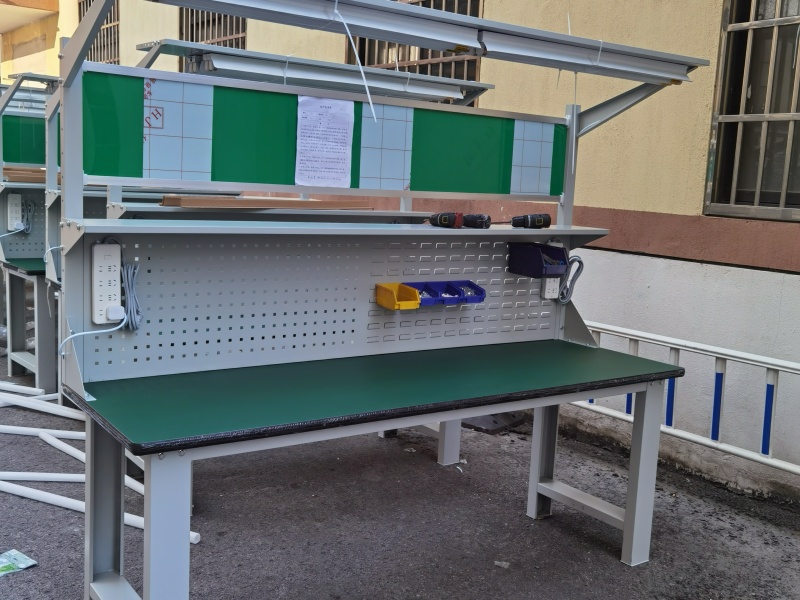
The single pegboard panel maximizes vertical storage without expanding the machine footprint, while the integrated bottom rail serves a dual purpose: it reinforces frame torsional rigidity and provides a dedicated channel for cable management or lightweight material staging. This combination reduces floor clutter and aligns with lean manufacturing principles by keeping high-frequency items within arm’s reach.
Selection Criteria and Application Scenarios
This layout aligns closely with 6S workplace standards. The dual drawers allow strict categorization of fasteners, measuring instruments, and hand tools, reducing search time on the shop floor. The open pegboard zone accommodates frequently used jigs or torque wrenches, enabling quick visual audits during shift changes.
In electronics manufacturing, where ESD compliance and clean surfaces are mandatory, the beech top finish provides a durable, scratch-resistant surface that simplifies wipe-down sanitation and resists micro-abrasions from static-safe components. For hardware mold factories and maintenance testing labs, the bottom rail prevents accidental tripping hazards and keeps work zones uncluttered during complex repairs. Vocational training centers also benefit from standardized dimensions, which mirror industry-grade setups used in professional environments.
Implementation Boundaries and Risk Mitigation
It is critical to define operational boundaries before procurement. While composite desktops excel in general assembly and light-to-medium machining, they are not designed for direct impact welding, grinding sparks, or continuous exposure to aggressive solvents. If your workflow involves heavy stamping or requires specialized anti-static coatings, the base model may need material upgrades or protective overlays.
Additionally, load capacity varies by shelf depth, drawer slide rating, and frame gauge. Specifications such as desktop thickness, pegboard hole spacing, and foot levelers must be validated against your facility’s floor flatness and vibration requirements. All final configurations should be verified against approved engineering drawings rather than generic catalog listings, as custom modifications can alter weight distribution and safety margins.
Next Steps for Procurement Teams
To accurately calculate the cost and value for your specific line, start by mapping your current tool inventory, peak daily throughput, and required clearances. Our engineering team can provide load distribution analysis and 6S layout simulations before fabrication begins. Contact our project consultation desk to request a customized workstation proposal or review our detailed specifications for related equipment.
Standard configurations typically adhere to established dimensions such as 1500×750×800 mm, ensuring optimal space utilization without disrupting aisle flow. Structural reliability is maintained through heavy-duty framing, where reinforced cold-rolled steel supports up to 1000 kg, while 3.0 square tubing variants handle loads around 500 kg. To withstand rigorous industrial environments, frames undergo pickling, phosphating, and powder electrostatic spraying for enhanced durability. For facilities requiring tailored layouts, bespoke manufacturing options allow precise adaptation to specific workflow demands and storage configurations.