
Beech Top Workbench – Single Pegboard, Dual Drawers & Bottom Rail: Cost and Value Decisions That Matter
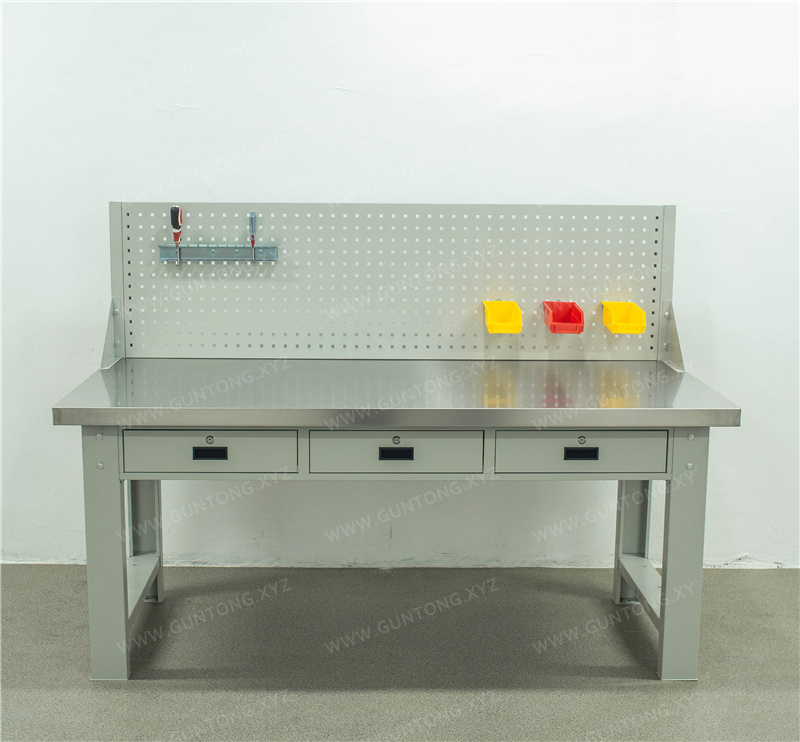
In manufacturing environments, selecting a single pegboard workbench with dual drawers and a bottom rail requires balancing initial procurement costs against long-term operational value. For electronics assembly lines, automotive parts staging areas, and hardware mold repair stations, the workstation is not merely furniture; it is a fixed asset that dictates workflow rhythm, tool accessibility, and 6S compliance. Evaluating cost and value begins with understanding how material selection, structural rigidity, and modular design intersect with your specific production demands.
Preparation: Defining Scope and Configuration Boundaries
Before committing to a specification, clarify the primary function of the workstation. High-frequency assembly tasks benefit from a composite desktop that resists wear while providing a comfortable working surface, whereas heavy-duty fitting or mold maintenance may require reinforced steel or cast-iron surfaces. Guang’ErMei Precision Components designs workbenches to accommodate both standardized configurations and non-standard customizations, allowing you to match desktop thickness, drawer depth, and pegboard density to actual usage patterns rather than theoretical maximums.
Cost optimization starts with accurate load and space assessment. Over-specifying frame thickness or adding unnecessary storage modules increases upfront expenditure without improving throughput. Conversely, under-engineering leads to premature deformation, frequent part replacements, and unplanned downtime. When planning, define the exact weight distribution per zone, the type of tools or components stored in the dual drawers, and the required reach radius for the single pegboard. This prevents costly retrofits and ensures the bottom rail provides adequate base stability without excessive material waste.
Implementation: Layout Planning and Structural Integration
Proper installation determines whether a workstation delivers its intended value over years of operation. The bottom rail must be anchored to level flooring to prevent lateral sway during torque-intensive tasks. Pegboard positioning should align with operator ergonomics, typically placed within shoulder-to-waist height for rapid visual management and tool retrieval. Drawer slides and locking mechanisms require precise alignment during assembly to maintain smooth operation under repeated loading cycles.
Guang’ErMei supports on-site workstation planning and load-bearing design verification before production begins. This step identifies potential interference with existing conveyors, lean pipe networks, or automated storage pathways. By integrating the workbench into the broader shop floor layout during the engineering phase, you avoid costly relocation fees and ensure seamless 6S adaptation. The combination of standardized frames with customizable drawer and pegboard layouts allows manufacturing enterprises to scale configurations as production volumes shift.
Acceptance: Verification Standards and Performance Checks
Acceptance criteria should focus on functional reliability rather than cosmetic appearance. Verify that the desktop surface is uniformly flat and securely bonded to the underlying frame, preventing delamination under thermal cycling or chemical exposure. Check that the dual drawers operate without binding, and that the pegboard mounting points distribute stress evenly across the cabinet body. Structural integrity can be validated through static load testing within the rated capacity, ensuring the reinforced frame maintains deflection limits under full utilization.
Quality control also includes verifying edge banding, corner radii, and fastener security. Loose hardware or exposed sharp edges compromise operator safety and increase maintenance frequency. At Guang’ErMei, acceptance protocols emphasize dimensional accuracy, surface finish consistency, and mechanical stability. These checks protect your initial investment by confirming that the workstation meets the engineered specifications before it enters active production.
Maintenance: Lifecycle Management and Cost Control
Long-term value is realized through disciplined maintenance rather than reactive repairs. Composite desktops and beech tops require routine cleaning with appropriate agents to prevent solvent damage or moisture ingress. Pegboard hooks should be inspected periodically for deformation, and worn slides should be replaced promptly to avoid drawer misalignment. The bottom rail and frame joints benefit from annual torque checks, especially in high-vibration environments like automotive parts handling or mold repair shops.
Preventive maintenance reduces total cost of ownership by extending service intervals and preserving redeployment value. When components reach end-of-life, modular designs allow targeted replacements instead of full unit disposal. Guang’ErMei provides full-process after-sales service and spare part support, enabling manufacturers to maintain operational continuity without extended lead times. Tracking maintenance logs and scheduling inspections based on usage intensity helps facilities forecast budget requirements accurately.
Conclusion
Evaluating cost and value for a single pegboard workbench with dual drawers and a bottom rail requires shifting focus from unit price to total operational efficiency. Proper preparation eliminates configuration mismatches, structured implementation ensures structural reliability, rigorous acceptance validates performance, and proactive maintenance preserves asset value. By aligning workstation specifications with actual workflow demands and leveraging standardized-plus-customization delivery models, manufacturing enterprises can achieve predictable ROI and sustained 6S compliance.