
Anti-Tip Safety Measures for Heavy-Duty Tool Cabinets: A Technical Implementation Guide
Anti-Tip Safety Measures for Heavy-Duty Tool Cabinets: A Technical Implementation Guide
In manufacturing workshops, maintenance bays, and automotive parts assembly lines, heavy-duty tool cabinets with multiple high-capacity drawers are essential for organized tool storage. However, when several drawers are pulled out simultaneously—especially under loads approaching 80 kg per drawer—the center of gravity shifts forward, creating a real tipping hazard. This technical guide explains the mechanical principles behind cabinet stability, defines safe operating boundaries, and provides a step-by-step implementation path for anti-tip safety measures.
Who Needs to Pay Attention to Cabinet Tipping Risks
Facility managers and procurement teams in the following environments should treat anti-tip design as a non-negotiable specification:
- Automotive parts manufacturers where heavy dies, gauges, and torque tools are stored in multi-drawer cabinets
- Hardware mold factories that keep precision measuring instruments and cutting tools in high-density drawer configurations
- Maintenance and testing institutions where technicians frequently open multiple drawers during diagnostic workflows
- Vocational college training centers where student operators may not follow single-drawer-open protocols
The risk is not theoretical. A 4-drawer tool cart with pegboard, for example, may carry a combined drawer load exceeding 300 kg. If the top two drawers are fully extended at the same time, the overturning moment can exceed the stabilizing moment provided by the cabinet's own weight and footprint.
The Mechanical Principle: Overturning Moment vs. Stabilizing Moment
Cabinet tipping is governed by a straightforward physics relationship:
- Overturning moment = (Load in extended drawer) × (Horizontal distance from cabinet front edge to load center)
- Stabilizing moment = (Cabinet self-weight + load in closed drawers) × (Horizontal distance from cabinet front edge to center of gravity)
When the overturning moment exceeds the stabilizing moment, the cabinet rotates forward on its front casters or feet. Several factors amplify this risk:
- High drawer position: Top drawers create a longer lever arm relative to the tipping axis at the floor.
- Full extension: A drawer extended 100% shifts its load center further from the cabinet base.
- Uneven loading: Concentrating heavy tools in upper drawers while lower drawers remain empty raises the overall center of gravity.
- Caster-mounted cabinets: Mobile tool carts with swivel casters have a smaller effective footprint than floor-anchored cabinets, reducing the stabilizing moment arm.
Load Boundaries for Common Drawer Configurations
Based on Guang'ErMei Precision Components' product engineering data, the following load boundaries apply to standard heavy-duty drawer systems:
| Drawer Configuration | Rated Load per Drawer | Maximum Simultaneous Open Drawers (Unanchored) |
|---|---|---|
| 4-drawer (100mm H × 2 + 200mm H × 2) | 80 kg | 1 (top drawer) or 2 (lower drawers only) |
| 6-drawer mixed height | 60–80 kg | 1 (any position) |
| Cabinet with inner half-pegboard | 100 kg per shelf (shelves closed) | N/A (shelves do not extend) |
These boundaries assume a standard cabinet footprint of approximately 1000 × 500 mm and a cabinet self-weight in the range of 80–120 kg. When actual loads approach the upper limit, anchoring becomes mandatory rather than optional.
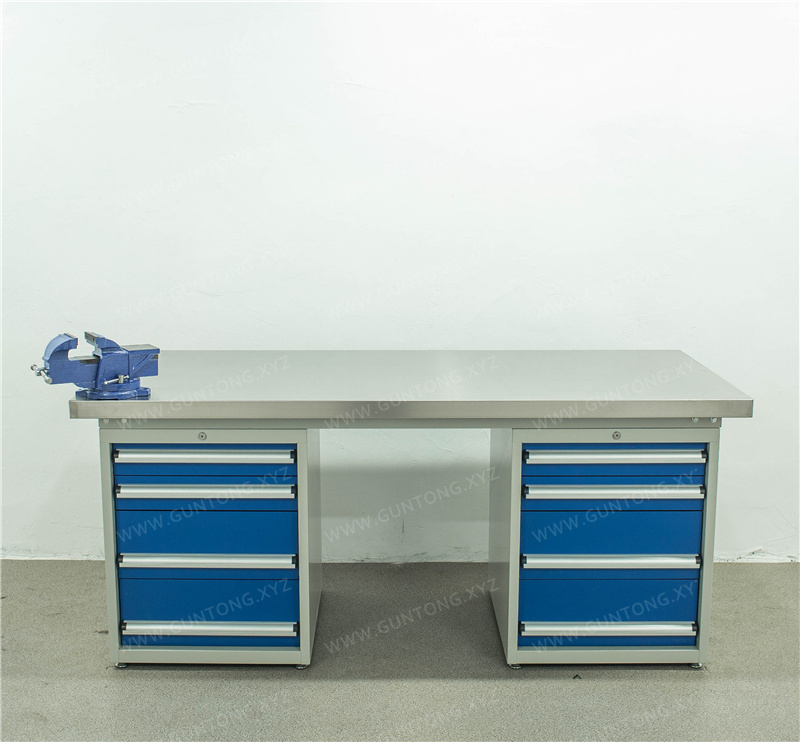
Step-by-Step Anti-Tip Implementation Path
Step 1: Specify Anti-Tip Interlocks at the Procurement Stage
When requesting quotations for custom tool cabinets or 4-drawer tool carts with pegboards, include the following requirement in your technical specification:
"Cabinet shall be equipped with a mechanical anti-tip interlock system that prevents more than one drawer from being fully extended at any time."
This interlock typically uses a single-track rail mechanism: a steel bar runs vertically behind all drawer slides, and only one drawer's release catch can engage the bar at a time. This is the most reliable passive safety measure because it does not depend on operator discipline.
Checkpoint: Verify that the interlock mechanism is rated for the full drawer load (e.g., 80 kg) and that the release force does not exceed 15 N for ergonomic operation.
Step 2: Anchor Floor-Standing Cabinets to the Building Structure
For stationary storage cabinets—such as pegboard storage cabinets with inner half-pegboard configurations used in 6S-managed workshops—floor anchoring provides the highest level of tipping protection.
Implementation procedure:
- Identify the cabinet's pre-drilled anchor holes at the rear base flange (typically two M10 or M12 holes).
- Mark the corresponding floor positions and verify that no under-floor utilities (electrical conduits, drainage pipes) are present.
- Drill into the concrete substrate to the specified depth (minimum 80 mm for M10 wedge anchors in C25 concrete).
- Install wedge anchors and torque to the manufacturer's specification (typically 40–50 N·m for M10).
- Attach the cabinet base flange using washers and nuts; verify that the cabinet is plumb within 2 mm over its full height.
Exception: If the workshop floor is a raised access floor or thin screed over a void, standard wedge anchors are not suitable. In this case, specify through-bolting to the structural slab or use a counterweight base plate designed by the cabinet manufacturer.
Step 3: Apply Load Distribution Rules During Commissioning
Even with interlocks and anchoring, improper loading can compromise safety. Establish the following loading protocol during workshop setup:
- Heaviest tools go in the lowest drawers. This keeps the cabinet's center of gravity as low as possible.
- Do not exceed 80% of rated drawer load for drawers positioned above the cabinet's mid-height.
- Distribute weight laterally within each drawer; avoid concentrating all mass on one side.
- Label each drawer with its maximum load rating using durable industrial labels.
Checkpoint: During the first month of operation, conduct a visual inspection of drawer slides and interlock mechanisms for signs of deformation or binding.
Step 4: Address Mobile Cabinet Risks Separately
Tool carts on casters—such as the 4-drawer 1-door tool cart with pegboard (overall dimensions 1000 × 500 × 850 mm)—cannot be floor-anchored during normal use. For these units, apply the following additional measures:
- Specify locking casters on at least two wheels (diagonal configuration) to prevent unintended rolling during drawer operation.
- Add a rear stabilizer foot that contacts the floor when the cart is stationary, effectively extending the tipping axis backward.
- Limit the top drawer load to 50% of its rated capacity when the cart is used in a free-standing position.
- Train operators to lock casters before opening any drawer and to open only one drawer at a time.
Applicable Boundaries and Limitations
Anti-tip measures described above are effective for cabinets operating within their rated load specifications and on level floors (slope ≤ 1%). They do not address the following scenarios, which require separate engineering review:
- Seismic zones: Facilities in regions with seismic design requirements (e.g., peak ground acceleration ≥ 0.1g) need cabinet restraints designed to lateral force standards, not just anti-tip interlocks.
- Overloaded drawers: If actual tool weight exceeds the rated drawer capacity, the interlock and anchoring system may still fail. Load audits should be conducted annually.
- Modified cabinets: Field modifications such as adding extra shelves, welding hooks to the cabinet exterior, or replacing drawer slides with non-OEM parts void the original stability calculations.
Next Actions for Workshop Buyers
If your facility is procuring new tool cabinets or upgrading existing workshop storage, take these steps:
- Audit your current cabinet inventory: Identify any high-drawer cabinets (4 or more drawers) that lack anti-tip interlocks or floor anchoring.
- Include anti-tip specifications in your next RFQ: Require mechanical interlocks, anchor hole provisions, and load rating labels as standard deliverables.
- Request on-site workstation planning: Guang'ErMei Precision Components provides on-site assessment services covering load-bearing design, 6S adaptation, and safety compliance for workshop workstation equipment across Huizhou, Guangdong Province, and nationwide delivery zones.
For technical consultation on drawer load configurations, anti-tip interlock options, or custom cabinet dimensions, contact the Guang'ErMei engineering team to discuss your specific workshop layout and tool storage requirements.