
Choosing 2-Drawer, 3-Drawer, and 4-Drawer Workbenches: Selection and Configuration Guide
Who This Guide Is For
This comparison is written for procurement managers, workshop supervisors, and facility planners in electronics manufacturing, automotive parts production, hardware mold factories, and maintenance/testing institutions who are evaluating drawer configurations for workbench replacements or upgrades. If you are deciding between a 2-drawer, 3-drawer, or 4-drawer workbench for a specific workstation, this guide provides the decision signals and constraints that matter in real deployment.
The Core Question: What Changes When You Add Drawers?
Drawer count on a workbench is not simply a storage preference. It determines three operational variables simultaneously: tool retrieval speed, floor space efficiency, and load distribution across the workstation frame. Choosing incorrectly leads to either wasted footprint (too many drawers for the task) or chronic disorganization (too few drawers forcing tools onto the desktop surface).
Below is a field-tested framework for matching drawer count to workstation duty.
Signal Checklist: Which Configuration Fits Your Workstation?
Before comparing specifications, identify which signals your workstation currently exhibits.
Signals That Point to a 2-Drawer Workbench
- The workstation handles light assembly or inspection tasks
- with fewer than 15 hand tools in active rotation.
- Desktop surface area is the priority — operators need unobstructed workspace for testing equipment or layout work.
- The workstation is positioned in a tight footprint
- where cabinet depth must remain minimal.
- Load requirements fall within the light-duty range.
A 2-drawer configuration keeps the under-desk profile compact. It is common in electronics assembly stations where the primary storage need is for small hand tools, calibration instruments, and documentation — items that do not require deep tiered organization.
Signals That Point to a 3-Drawer Workbench
- The workstation supports mixed-duty tasks
- such as fitter work, repair, or multi-step assembly where 15–30 tools cycle through daily use.
- Operators currently store tools on the desktop or in open bins, creating 6S compliance issues.
- The workstation needs to accommodate both hand tools and small power tools
- with separation by category.
- Load requirements are in the medium-duty range, and the frame must support moderate static loads without compromising drawer slide longevity.
A 3-drawer workbench introduces a middle tier that typically separates precision instruments from heavier tooling. This is the most common upgrade path for workshops transitioning from basic tables to organized workstations.
Signals That Point to a 4-Drawer Workbench
- The workstation handles heavy-duty fitter work, mold maintenance, or automotive parts inspection
- where 30+ tools are in active rotation.
- Tool retrieval time is a documented bottleneck — operators spend measurable time searching for tooling across shared stations.
- The workstation must support tiered tool organization by size and frequency of use, with dedicated drawers for large, medium, small, and specialty tools.
- Load requirements approach the heavy-duty range, and the drawer system must maintain stability under load.
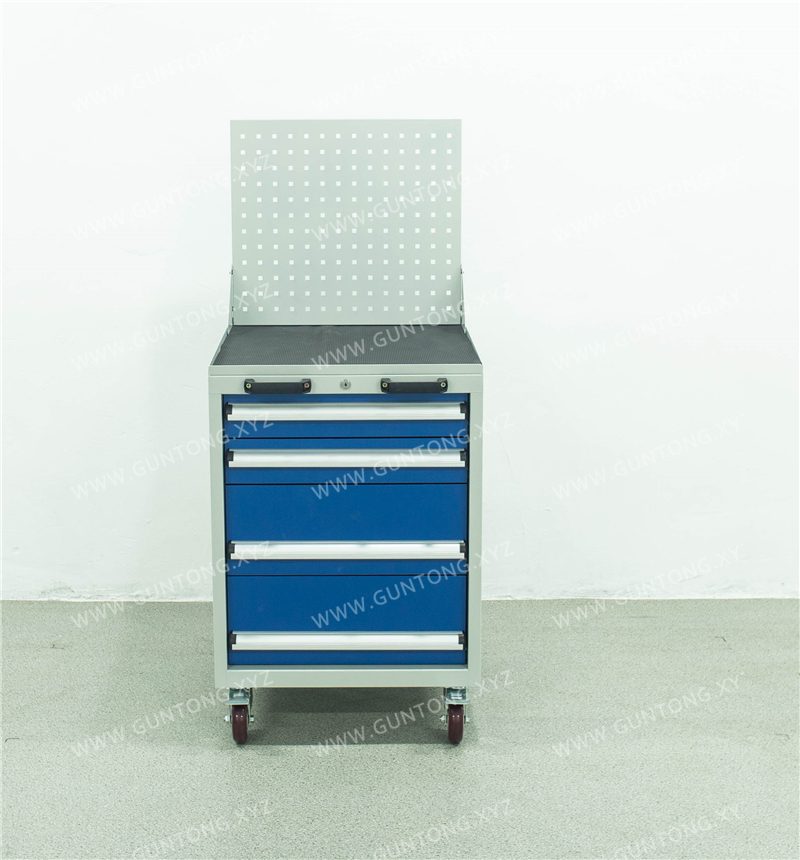
A 4-drawer configuration, such as the Single Back Panel Single Door 4-Drawer Steel Plate Workbench, provides maximum under-desk organization. The tiered drawer heights allow separation of small fasteners and precision tools in shallow drawers from larger wrenches and measuring instruments in deeper drawers.
Evaluation Criteria: Side-by-Side Comparison
| Criterion | 2-Drawer | 3-Drawer | 4-Drawer |
|---|---|---|---|
| Typical Use Case | Light assembly, inspection, testing | Mixed-duty repair, fitter work, multi-step assembly | Heavy-duty maintenance, mold work, automotive parts |
| Tool Capacity (Active Rotation) | Up to 15 tools | 15–30 tools | 30+ tools |
| Desktop Surface Priority | High — maximum clear workspace | Moderate — balanced storage and surface | Lower — storage takes precedence |
| Frame Load Class | Light-duty | Medium-duty | Heavy-duty |
| Footprint Impact | Minimal cabinet depth | Moderate | Full-depth cabinet; requires clearance planning |
| 6S Compliance Support | Basic | Good | Strong — enables visual management by tier |
| Upgrade Complexity | Simple swap | May require frame reinforcement | Requires load-bearing design review |
Practical Configuration Details
Desktop and Frame Compatibility
Drawer count directly influences the frame specification required. A 4-drawer workbench with a composite desktop — such as a raw steel plate over high-density fiberboard — demands a C-type cold-rolled steel frame rated for the combined static load of stored tools plus desktop work pieces. Guang'ErMei's 4-drawer steel plate workbench uses a C-type cold-rolled steel frame designed for heavy-duty total load capacity, which accounts for both drawer contents and surface work.
For 2-drawer and 3-drawer configurations, lighter frame profiles may suffice, but the decision must account for future upgrade paths. If a workstation is likely to accumulate more tooling over time, specifying a heavier frame upfront avoids costly replacement.
Drawer Dimensions and Load Per Tier
Standard drawer configurations in workshop workbenches typically use tiered heights:
- Shallow drawers:*
- Small hand tools, fasteners, calibration gauges.
- Deep drawers:*
- Power tools, large wrenches, measuring instruments, mold components.
Each drawer in a properly specified workstation should support substantial weight on full-extension slides. This is a critical boundary: exceeding per-drawer load ratings accelerates slide wear and compromises smooth operation, particularly in 4-drawer configurations where the cumulative drawer load is significant.
Pegboard and Back Panel Integration
Drawer count also interacts with back panel configuration. A 4-drawer workbench paired with a single back panel and pegboard provides both enclosed storage (drawers) and visual hanging storage (pegboard), which is the standard layout for fitter and maintenance stations. A 2-drawer workbench may forgo the back panel entirely to maintain an open profile for collaborative or inspection workstations.
Risk Boundaries and Constraints
Constraint 1: Floor Space and Aisle Clearance
A 4-drawer workbench has a deeper cabinet profile than a 2-drawer unit. In workshops with narrow aisles or dense workstation layouts, the additional depth can impede operator movement and material cart passage. Always verify aisle clearance against your workshop's lean layout plan before committing to 4-drawer configurations across all stations.
Constraint 2: Load-Bearing Floor Requirements
Heavy-duty 4-drawer workbenches loaded to capacity concentrate significant weight on a small footprint. Facilities with raised floors, mezzanine levels, or non-reinforced concrete should verify floor load ratings. This is particularly relevant for mold maintenance areas where individual mold components stored in drawers can add substantial point loads.
Constraint 3: Anti-Static Requirements in Electronics Environments
For electronics manufacturing workstations, drawer count must be evaluated alongside ESD (electrostatic discharge) protection requirements. Anti-static workbenches require conductive paths from the desktop surface through the frame to ground. Adding more drawers increases the number of metal-to-metal contact points that must maintain conductivity. When specifying 3-drawer or 4-drawer anti-static workbenches, confirm that drawer slides and cabinet joints are included in the ESD grounding path design.
Constraint 4: Non-Standard Customization Lead Time
Standard 2-drawer and 4-drawer configurations are typically available in common dimensions. However, 3-drawer configurations or non-standard drawer height combinations often require custom fabrication. Plan for extended lead times and confirm dimensional drawings before placing orders for non-standard layouts.
Upgrade Path: When to Move from 2 to 4 Drawers
Many workshops begin with 2-drawer workbenches and discover, after 6S audits or productivity reviews, that tool organization is insufficient. The upgrade path typically follows this sequence:
- Audit current tool inventory at the workstation. Count tools in active daily rotation.
- Map tool categories by size and frequency of use. Identify whether 2 tiers or 4 tiers of separation are needed.
- Evaluate frame capacity. If the existing frame is light-duty, upgrading to a 4-drawer configuration will likely require a full workbench replacement rather than a drawer module add-on.
- Confirm desktop compatibility. If the current desktop is a standard laminate or thin steel plate, upgrading to a composite desktop (steel plate + high-density fiberboard) alongside the drawer upgrade ensures the entire workstation matches the new duty class.
For workshops considering a double four-drawer floor cabinet composite workbench or a single-door four-drawer floor cabinet composite workbench, the transition involves both drawer configuration and cabinet structure changes that should be planned as a single workstation upgrade project.
Next Steps
If you are evaluating drawer configurations for a workstation upgrade or new workshop layout:
- Document your current tool inventory and retrieval pain points
- at each workstation before requesting quotes.
- Specify your load requirements
- (both per-drawer and total frame) based on actual tooling weight, not estimated values.
- Request dimensional drawings
- for non-standard configurations to verify fit within your existing layout.
Guang'ErMei Precision Components provides workstation planning, load-bearing design, and full-process delivery for workbench configurations across 2-drawer, 3-drawer, and 4-drawer layouts. Contact the team with your workstation dimensions, tool inventory, and load requirements to receive a configuration recommendation tailored to your workshop scenario.