
Workstation Selection for Vocational Training: Safety, Load Capacity, and 6S Alignment
Workstation Selection for Vocational Training: Safety, Load Capacity, and 6S Alignment
Implementing workstation equipment in a vocational college training center presents unique challenges compared to standard manufacturing floors. The primary goal is not just production efficiency, but durability under variable usage, student safety, and visual management (6S) to foster professional habits.
As an implementation or maintenance manager, your selection process should move beyond basic specifications to evaluate how the equipment supports pedagogical goals and long-term operational costs. This checklist helps you align equipment choices with these critical needs.
1. Structural Integrity and Load-Bearing Verification
In training environments, students may apply uneven loads or handle tools less carefully than experienced operators. Therefore, the structural foundation of the workstation is the first decision point.
- Frame Stability: Prioritize workbenches with C-type cold-rolled steel frames or reinforced square-tube legs. These structures offer superior stability against lateral forces during assembly tasks.
- Load Capacity Standards: Verify the total load capacity claims. For general assembly training, a standard capacity of 1000kg
- is often sufficient, but for heavy machinery simulation, higher ratings are necessary.
- Fact Check: Guang'ErMei’s Single Back Panel Single Door 4-Drawer Steel Plate Workbench
- features a C-type frame designed for a 1000kg total load capacity, providing a reliable baseline for most training scenarios.
- Desktop Composition: The desktop must resist impact and wear. A composite structure combining a raw steel plate base with a high-density fiberboard (HDF) top offers a balance of strength and surface protection.
2. Material Safety and Environmental Suitability
Safety is non-negotiable in educational settings. Materials must be non-toxic, fire-resistant, and easy to clean.
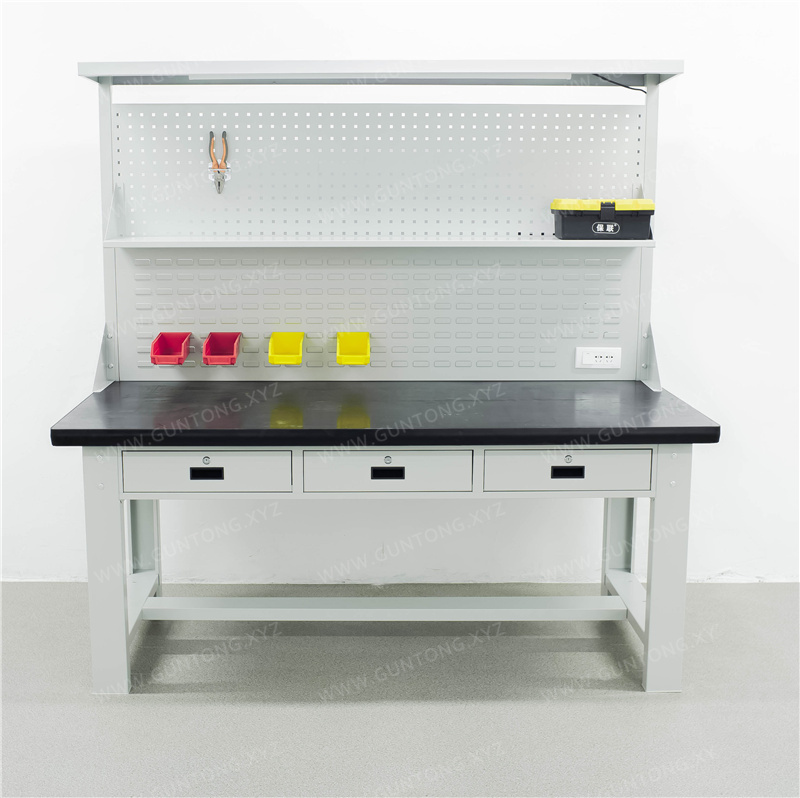
- Surface Finish: Ensure all metal surfaces undergo proper anti-corrosion treatment, such as acid pickling, phosphating, and electrostatic powder coating. This prevents rust and reduces the risk of sharp edges from peeling paint.
- Desktop Edge Protection: Look for desks with black PVC edge banding to prevent chipping and protect student hands from sharp metal corners.
- Anti-Static Requirements: For electronics training modules, specify anti-static workbenches
- with grounded conductive strips to protect sensitive components and teach proper ESD (Electro-Static Discharge) handling protocols.
3. Integrated Storage for 6S Management
Effective 6S (Sort, Set in order, Shine, Standardize, Sustain, Safety) implementation relies on equipment that facilitates visual management and organized storage.
- Modular Drawer Systems: Tiered drawer designs allow for categorized tool storage. For example, a 4-drawer configuration
- can separate small fasteners, hand tools, measuring instruments, and consumables, reducing search time and clutter.
- Pegboard Integration: Pegboards are essential for visual inventory. An **inner half-pegboard storage cabinet*
- or a workbench with integrated pegboard sections allows instructors to display frequently used tools, making it easy to verify if items are returned to their designated spots.
- Application Note: The Pegboard Storage Cabinet (Inner Half-Pegboard Type)
- features dual pegboard layouts on cabinet doors and an interior section, significantly improving retrieval efficiency and visual control.
- Mobility vs. Fixed: Consider tool carts
- with pegboards for mobile training stations. These allow groups to share resources while keeping tools secure and visible.
4. Customization and Spatial Flexibility
Training centers often have irregular floor plans or specific curriculum requirements. Off-the-shelf solutions may not fit perfectly.
- Non-Standard Dimensions: Guang'ErMei supports non-standard customization for length, width, and height. Common dimensions like 1500×750×800mm
- or 1800×750×800mm can be adjusted to fit specific classroom layouts.
- Scenario-Specific Configurations: You can request specialized accessories such as bench vises, power outlets, lighting, or component bins tailored to specific trade programs (e.g., automotive repair vs. electronics assembly).
Implementation Checklist for Managers
| Decision Point | Key Question | Recommended Feature |
|---|---|---|
| Durability | Can it withstand daily student use? | C-type steel frame, 1000kg load capacity |
| Safety | Are edges and surfaces safe? | Powder-coated finish, PVC edge banding |
| Organization | Does it support 6S visual management? | Pegboard integration, tiered drawers |
| Flexibility | Does it fit the classroom layout? | Customizable dimensions, modular accessories |
| Maintenance | Is it easy to clean and repair? | Smooth surfaces, replaceable components |
Next Steps
Selecting the right workstation equipment is a strategic investment in your training infrastructure. By focusing on structural robustness, safety compliance, and 6S-ready design, you create an environment that enhances learning outcomes and reduces long-term maintenance costs.
If you are planning a new training facility or upgrading existing workshops, consider starting with a detailed site survey to determine precise spatial and functional requirements. Guang'ErMei offers full-chain services from design and manufacturing to on-site installation, ensuring that every workstation meets your specific pedagogical and operational standards.
Contact our team today to discuss your vocational training center’s unique requirements and receive a customized workstation solution.