
Workshop Upgrade Scenario: Evaluating a Beech Top Workbench with Single Pegboard and Dual Drawers
The Real-World Upgrade Challenge
In electronics assembly lines, automotive parts maintenance zones, or hardware mold repair bays, the decision to replace a workstation is rarely about aesthetics. It is driven by operational friction: tools getting lost, surfaces warping under heavy loads, or the inability to enforce 6S standards on outdated furniture. When a facility manager or production lead evaluates a beech top workbench configured with a single pegboard, dual drawers, and a bottom rail, the goal is to solve specific workflow bottlenecks.
This scenario focuses on the transition from generic tables to engineered composite desktop workbenches that support high-frequency tool retrieval and heavy component handling. The evaluation must move beyond simple dimensions to verify structural integrity, storage capacity, and adaptability to site-specific constraints.
Defining Goals and Physical Constraints
Before selecting a custom workbench, the evaluation team must define three critical parameters based on the actual customer scenario:
- Load Profile: Will the station support static assembly of heavy sub-assemblies, or dynamic testing with vibrating equipment?
- Storage Density: Does the operator need immediate access to hand tools (pegboard) and secure storage for calibration instruments (drawers)?
- Footprint & Utilities: Are there fixed power drops, air lines, or aisle width restrictions that dictate the bench's length and depth?
A well-configured workshop workbench reduces motion waste by integrating these elements into a single, rigid unit, supporting consistent 6S workbench protocols.
Evaluation Checklist: Desktop, Storage, and Frame
1. Composite Desktop Structure and Durability
The core of any heavy-duty station is the desktop. In a customer scenario involving metal fabrication or electronics repair, a solid wood surface alone may dent or stain, while pure steel can be too hard for precision assembly. A composite desktop workbench offers a balanced solution.
Based on verified manufacturing specifications for heavy-duty stations, a robust composite structure often utilizes a layered approach. For instance, proven designs incorporate a 49mm composite board beneath a durable surface layer (such as steel or hard wood) to distribute point loads evenly. This construction prevents warping under repeated thermal cycles or heavy impact. When evaluating a beech-top option, confirm that the underlying core provides sufficient thickness to resist deflection when clamping large fixtures. Exact material specifications and layer thicknesses vary by model and should be confirmed against technical sheets.
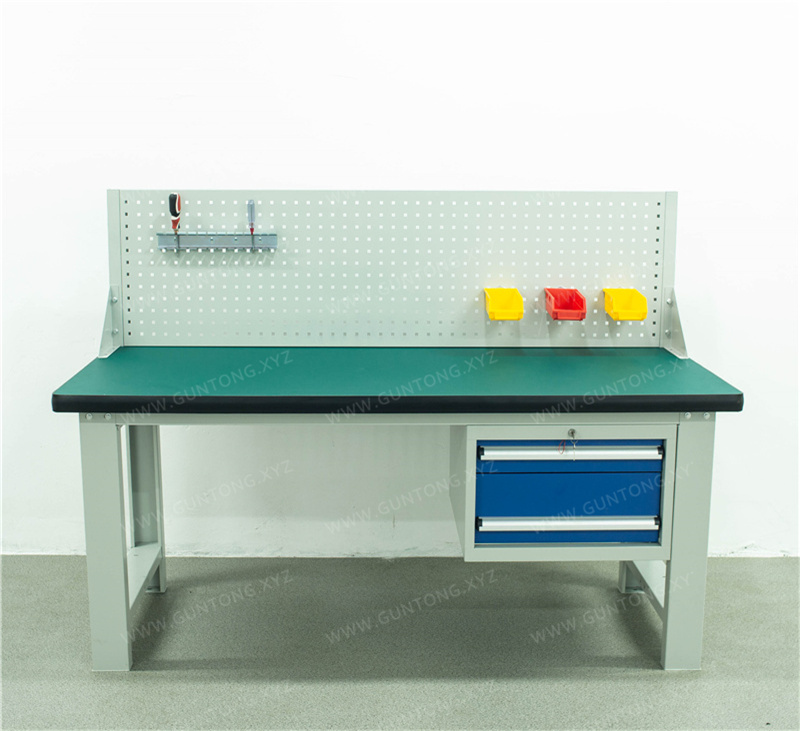
2. Single Pegboard and Drawer Configuration
The single pegboard workbench design prioritizes streamlined visual management. A standard square-hole pegboard allows operators to mount hooks, bins, or torque wrench holders at precise heights, reducing search time.
Paired with this, the drawer configuration is critical for security and organization. While some scenarios require a three-drawer composite workbench for fine categorization, a dual-drawer setup with a bottom cabinet is often optimal for mixed storage. When evaluating storage tiers, verify the load ratings. Industry benchmarks for heavy-duty steel units indicate that stamped steel drawers commonly support around 80 kg per compartment, while adjacent adjustable shelves in associated cabinets can handle up to 100 kg per level. This rating ensures stability when storing bulk components, heavy power tools, or testing fixtures without rail failure.
3. Frame Geometry and Bottom Rail Integration
Stability during heavy assembly depends on frame engineering. A C-type cold-rolled steel frame provides wide leg clearance for chair mobility and cable routing. The bottom rail is not just a footrest; it is a structural tie-beam that anchors the legs against lateral flex.
When positioning heavy sub-assemblies near the edge of the bench, the bottom rail transfers stress away from the desktop joints, preserving surface flatness over years of use. Teams should confirm that rail thickness, weld points, and surface treatments (such as pickling, phosphating, or powder coating) match the intended duty cycle. Typical structural configurations are engineered to support substantial static loads (often up to 1000 kg for the total frame), but exact ratings depend on the selected frame profile and reinforcement layout.
Acceptance Criteria Before Deployment
To validate a selection before full rollout, apply these checkpoints:
- Load Verification: Place rated weights at center and quarter points; check for excessive deflection, audible frame stress, or uneven surface contact.
- Pegboard Alignment: Verify hole spacing matches existing accessories and that mounting hardware does not compromise drawer slide clearance.
- Surface Compatibility: Confirm the beech or composite finish resists oils, solvents, or static discharge relevant to your line.
- 6S Zoning: Map shadow boards, label strips, and waste/recycling bins to the new layout; ensure walkway clearance remains adequate.
Implementation Boundaries and Next Steps
Standardized frames accelerate delivery, but site-specific utilities, anti-static requirements, or non-standard footprints often trigger custom engineering. Full-chain service typically covers initial layout mapping, structural validation, on-site assembly, and post-installation adjustment.
Because exact dimensions, powder-coat specifications, and accessory compatibility vary by model, final configurations should always reference approved drawings or technical sheets before procurement. If your team is transitioning from legacy stations to a structured environment, start by documenting peak load points, tool retrieval patterns, and utility drop locations. These inputs allow a Huizhou workbench manufacturer to configure a custom workbench that matches actual floor conditions rather than theoretical averages.
Conclusion
Evaluating a beech top workstation through a real customer scenario shifts the focus from cosmetic upgrades to operational reliability. By verifying composite desktop integrity (e.g., 49mm core layers), pegboard accessibility, drawer load ratings (e.g., 80kg capacity), and bottom rail stability, maintenance and assembly leaders can select a workshop workbench that reduces motion waste, supports consistent 6S practices, and scales with production changes.