
Workbench Delivery Inspection Checklist: How to Verify Dimensions, Structure, and Accessories on Arrival
Why a Delivery Inspection Matters for Workshop Equipment
When a new workbench, tool cart, or storage cabinet arrives at your facility, the first 30 minutes determine whether the equipment integrates smoothly into your production line or becomes a source of delays. Manufacturing enterprises, automotive parts plants, and maintenance workshops often discover dimension mismatches, missing drawers, or surface defects only after installation begins—leading to downtime and return logistics.
This guide provides a step-by-step workbench delivery inspection checklist based on real product configurations from Guang'ErMei Precision Components, covering steel plate workbenches, pegboard tool carts, and storage cabinets. Use it as a standard operating procedure for your receiving team.
Step 1: Verify External Dimensions Against Your Order
Before unpacking fully, measure the overall footprint and compare it with the purchase order or product specification sheet.
What to check:
- Length × Width × Height: For a standard steel plate workbench, common dimensions are 1500 × 750 × 800 mm (with an additional 500 mm back panel height). Confirm that the delivered unit matches the ordered size—1500, 1800, or 2100 mm in length.
- Pegboard height: If your order includes a tool cart with a pegboard, such as the 4-Drawer 1-Door Tool Cart, the total height should include the 500 mm pegboard section above the 850 mm cabinet body.
- Clearance for aisles and adjacent equipment: Measure the actual space in your workshop to confirm the delivered unit fits the planned workstation layout.
Boundary note: Dimensional tolerances of ±2 mm are typical for cold-rolled steel fabrication. Deviations beyond this should be flagged immediately.
Step 2: Inspect the Desktop or Shelf Structure
The work surface bears the operational load. Any defect here compromises safety and longevity.
For steel plate workbenches:
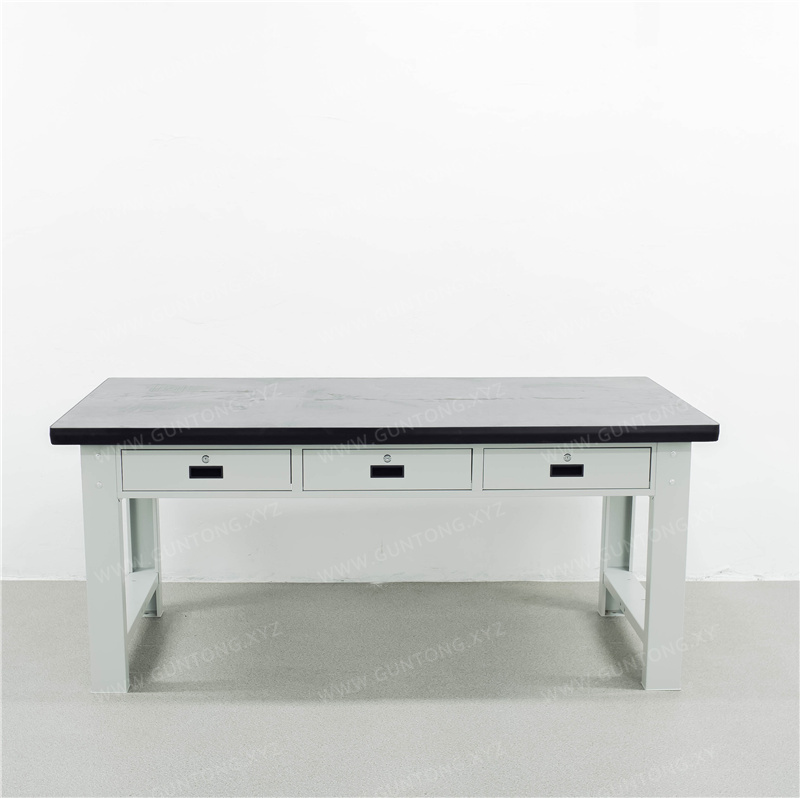
- Confirm the composite desktop structure: a 5 mm raw steel plate bonded over a 45 mm high-density fiberboard core, with black PVC edge banding. Tap the surface to check for hollow spots that indicate delamination.
- Check the total load rating. A C-type cold-rolled steel frame should support up to 1000 kg. Verify that the frame gauge and welding match the specification.
For beech wood workbenches (if applicable):
- The standard beech finger-joint board is 50 mm thick. Inspect for cracks, warping, or uneven joints along the surface.
- Verify the frame material—typically 1.5 mm cold-rolled steel with acid-wash, phosphating, and powder-coated finish baked at 250 °C.
For storage cabinet shelves:
- Each adjustable shelf in a pegboard storage cabinet should carry up to 100 kg. Test the shelf brackets and confirm that three adjustable positions are present and functional.
Step 3: Check Drawers, Doors, and Moving Parts
Drawer and door functionality directly affects daily tool retrieval efficiency.
Drawer inspection:
- Open and close each drawer fully. A standard tool cart drawer with a single-track rail should support 80 kg per drawer. Load a test weight if possible.
- Verify drawer heights match the order—common configurations include 100 mm, 150 mm, and 200 mm heights. For example, a 4-drawer tool cart may have two 100 mm and two 200 mm drawers.
- Confirm that drawer panels are 1.0 mm or thicker cold-rolled steel and that handles are securely fastened.
Door and lock inspection:
- If the unit includes a cabinet door (such as the single-door section on a combination tool cart), check hinge alignment, latch engagement, and lock operation.
- For pegboard storage cabinets with an inner half-pegboard design, verify that the dual pegboard panels on the cabinet door are flat and that square holes are cleanly punched without burrs.
Step 4: Verify Accessories and Hardware Completeness
Missing accessories are the most common delivery complaint. Cross-check against the packing list.
Standard accessories to confirm:
| Accessory | Typical Quantity | Notes |
|---|---|---|
| Caster wheels | 4 per cart | 2 fixed + 2 swivel with brake; default 4-inch |
| Drawer dividers or separators | As ordered | Confirm slot count and material |
| Pegboard hooks or tool holders | As ordered | Square-hole pattern compatibility |
| Leveling feet (for stationary workbenches) | 4 per unit | Adjustable thread length |
| Fastener kit (bolts, nuts, Allen keys) | 1 set per unit | Required for on-site assembly |
For tool carts specifically:
- Confirm the wheel configuration: two directional wheels at the front and two swivel wheels with brakes at the rear. Engage the brakes and push the cart to verify it does not slide.
- If the cart includes a configurable shelf panel for additional storage, ensure it is included and undamaged.
Step 5: Inspect Surface Finish and Appearance
Surface quality reflects manufacturing discipline and affects corrosion resistance in your workshop environment.
What to look for:
- Powder coating: The standard finish is electrostatic powder coating, typically in gray-white or blue. Check for even coverage, no drips, no bare spots, and consistent color across all panels.
- Stainless steel surfaces: If you ordered stainless steel workbenches or cabinets, verify the material grade. Stainless steel should resist weak corrosive media such as moisture, steam, and mild acids. Inspect for scratches, dents, or weld discoloration.
- Edge banding on composite desktops: PVC edge banding should be flush, without gaps or peeling at the corners.
Color customization note: Non-standard colors (red, green, yellow, black) are available for batch orders. If your order specifies a custom color, compare the delivered shade against the approved sample before signing the delivery receipt.
Step 6: Document and Report Issues Immediately
If any discrepancy is found during the inspection:
- Photograph the defect or mismatch with a measuring tape or reference object in frame.
- Note the item on the delivery receipt with a clear description—do not sign as "received in good condition" if issues exist.
- Contact the supplier within 24 hours with photos and your purchase order number to initiate a resolution.
Guang'ErMei provides full-process after-sales service, including on-site workstation planning and replacement support. Standard products typically ship within 2–3 working days, while non-standard custom orders require 7–10 working days—factor this into your project timeline when requesting replacements.
Quick Reference: Workbench Delivery Inspection Checklist
| Inspection Area | Key Checks | Pass Criteria |
|---|---|---|
| Dimensions | L × W × H vs. order | Within ±2 mm tolerance |
| Desktop / Shelves | Material, thickness, load rating | Matches spec; no delamination or warping |
| Drawers & Doors | Rail operation, load, lock function | Smooth operation at rated load |
| Accessories | Casters, hooks, fasteners, dividers | Complete per packing list |
| Surface Finish | Coating evenness, edge banding, color | No bare spots, drips, or peeling |
| Documentation | Packing list, warranty card, assembly guide | All documents present |
Next Steps After a Successful Inspection
Once the workbench or tool cart passes all checks:
- Position and level the unit using adjustable feet or caster brakes.
- Anchor stationary workbenches to the floor if your workshop safety protocol requires it.
- Configure pegboard hooks and drawer dividers according to your 6S tool management plan.
- Schedule a follow-up with your supplier if you need additional units or workstation layout adjustments for adjacent bays.
For manufacturing teams in Huizhou, Guangdong, and nationwide, Guang'ErMei Precision Components supports on-site workstation planning, load-bearing design, and full-process after-sales service. If you are planning a new workshop setup or expanding an existing production line, request a workstation consultation to align your equipment specifications with your operational requirements.