
What Determines the Price of Heavy-Duty Steel Workbenches? A Configuration and Budget Guide
Imagine a facility planner sourcing workbenches for an automotive parts maintenance workshop. They request quotes for "heavy-duty steel workbenches" from three suppliers and receive numbers that vary significantly. This discrepancy rarely comes from arbitrary markups; instead, it reflects fundamentally different interpretations of "heavy-duty." In industrial environments, the price of a steel workbench is strictly determined by its load-bearing architecture, material composition, and modular configurations.
The 4 Core Factors Driving Workbench Pricing
1. Desktop Composition and Thickness
The work surface is the most critical cost driver. A true heavy-duty setup, such as those used in hardware mold factories, requires a robust composite structure to withstand severe impacts. For instance, a 50mm thick desktop combining a 5mm raw steel plate with a 45mm high-density fiberboard core and PVC edge banding costs more to produce than a simple thin steel top. However, this specific composite structure reliably supports up to 1000kg while resisting high temperatures and heavy mechanical shocks.
2. Frame Architecture and Steel Gauge
The legs and support beams dictate the overall stability and longevity of the workstation. Pricing shifts based on the steel profile and gauge used. A heavy-duty C-type cold-rolled steel frame (e.g., with a 100x50mm cross-section) requires more raw material and advanced bending processes than standard lightweight square tube frames. This structural upgrade directly impacts the final price but is necessary to ensure a safe 1000kg total load capacity without frame deflection.
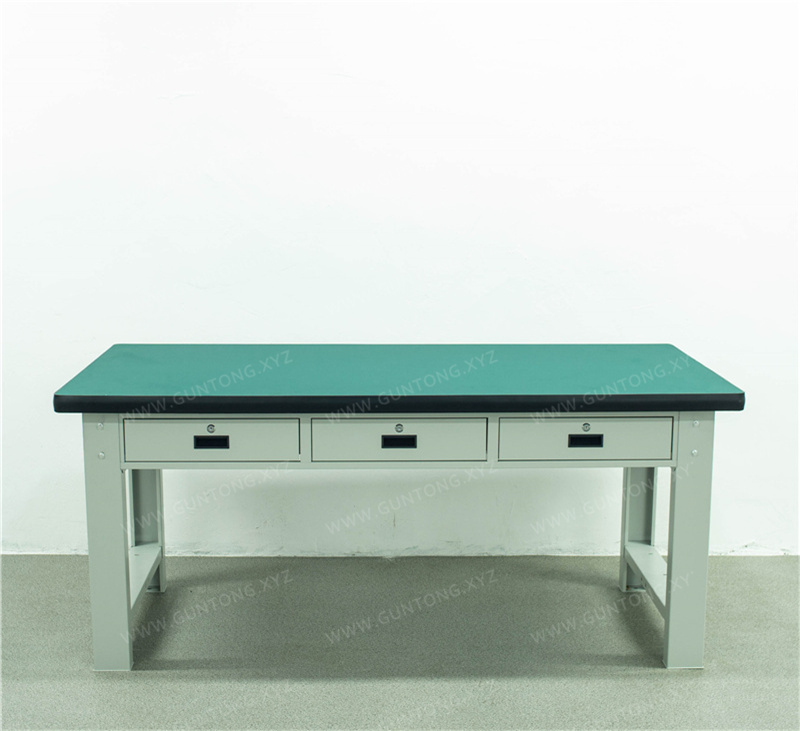
3. Modular Accessories and Storage Integration
A bare workbench is only the baseline. Adding functional modules transforms it into a complete workstation but adds to the material and manufacturing costs. Configurations such as square-hole or louver pegboards for tool hanging, multi-drawer cabinets, floor-standing storage, adjustable shelves, tie rods, or double-layer structures require additional steel, precision hardware, and assembly time. The more integrated the storage, the higher the unit price.
4. Dimensions and Customization Level
Standardized lengths (such as 1500mm, 1800mm, or 2100mm with a standard 750mm depth and 800mm height) benefit from economies of scale in batch production. Non-standard dimensions, specialized cutouts for specific machinery integration, or unique height requirements require custom engineering and disrupt standard manufacturing flows, increasing the unit price.
Decision Checklist: Balancing Budget and Performance
To avoid over-specifying or under-specifying your workstation equipment, use this checklist during the procurement phase:
- Define Exact Load Requirements:*
- Calculate the maximum point load and distributed load. Do not pay for a 1000kg capacity frame if your heaviest assembly is only 200kg.
- Match Desktop Material to the Task:*
- Raw steel plates are ideal for heavy impacts, welding, and mold repair. If your application is electronics assembly, an anti-static or polymer top is more appropriate and cost-effective.
- Phase Accessory Investments:*
- Start with the core frame and desktop. Ensure the design allows for future additions like pegboards or drawer cabinets as your 6S management requirements evolve, rather than buying everything upfront.
- Optimize Footprints:*
- Stick to standard 1500x750x800mm, 1800x750x800mm, or 2100x750x800mm dimensions where facility layout permits to keep costs predictable and lead times short.
Conclusion
The price of a heavy-duty steel workbench is a direct reflection of its engineering, material thickness, and configuration complexity. By understanding these structural variables, procurement teams and facility planners can make transparent, value-driven decisions that align with actual workshop demands.