
Welded vs. Knock-Down Stainless Steel Workbenches: A Buyer's Comparison Guide
Welded vs. Knock-Down Stainless Steel Workbenches: A Buyer's Comparison Guide
The Core Buyer Question
When outfitting a manufacturing floor, electronics assembly line, or testing laboratory, procurement teams frequently face a specific structural decision: Should we specify fully welded or knock-down (bolt-together) stainless steel workbenches?
While both configurations serve the fundamental purpose of providing a durable, corrosion-resistant work surface, their underlying engineering dictates vastly different performance boundaries. Selecting the wrong type can lead to structural wobbling under heavy loads, hygiene compliance failures in cleanrooms, or unnecessary logistical bottlenecks during installation. This guide compares both options across critical operational constraints to help manufacturing enterprises, testing institutions, and warehousing facilities make an informed procurement decision.
Comparing Options by Operational Constraints
1. Structural Integrity and Load Capacity
The most significant differentiator between the two designs is load-bearing performance under dynamic conditions.
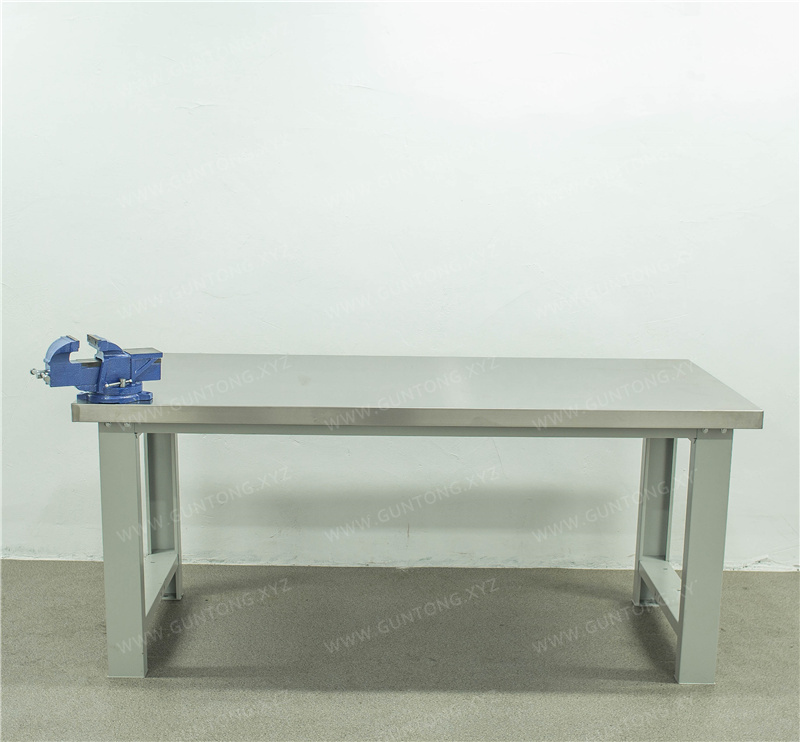
- Welded Workbenches: By fusing the frame joints, welded workbenches eliminate mechanical play. Heavy-duty welded frames typically utilize 1.5mm high-quality cold-rolled steel, achieving a total load capacity of up to 1000kg. This makes them mandatory for hardware mold factories, automotive parts maintenance, and heavy testing institutions where impact, vibration, and heavy tooling are constant.
- Knock-Down Workbenches: These rely on mechanical fasteners (bolts and brackets). While adequate for light to medium-duty electronics assembly or packaging, the joints can loosen over time under dynamic loads, requiring periodic maintenance and retightening to prevent frame racking.
2. Hygiene, Cleanability, and Corrosion Resistance
In food processing, pharmaceutical, and precision electronics environments, the physical geometry of the workbench matters as much as the material itself.
- Welded Workbenches: Continuous welds create seamless joints that prevent the accumulation of dust, moisture, and bacteria. When paired with specialized surfaces—such as a 50mm total thickness desktop consisting of 1mm 201 stainless steel wrapping a 49mm high-density board on all five sides—the entire unit delivers high strength and acid/alkali resistance. This configuration is explicitly suited for environments with strict dust-proof and anti-corrosion requirements.
- Knock-Down Workbenches: The overlapping brackets and bolt heads inherent in knock-down designs create microscopic crevices. In highly regulated cleanrooms or wash-down environments, these crevices become liability points for contamination and localized corrosion, requiring more rigorous cleaning protocols.
3. Logistics, Installation, and Facility Access
- Knock-Down Workbenches: The primary advantage of bolt-together designs is logistical flexibility. They ship flat, significantly reducing freight costs, and can be easily maneuvered through narrow corridors, standard elevators, or restricted cleanroom airlocks before final assembly on-site.
- Welded Workbenches: Fully assembled units require significant transport volume and clear pathways for installation. However, they offer immediate operational readiness upon delivery, eliminating on-site assembly labor and the risk of improper torque application by installation crews.
4. Dimensional Standardization vs. Customization
Both configurations support standard footprints, commonly including 1500×750×800mm, 1800×750×800mm, and 2100×750×800mm. However, when facilities require non-standard customization—such as integrating heavy-duty drawer cabinets, specific pegboard back panels, or automated storage and retrieval system (Miniload) interfaces—welded construction provides the necessary torsional rigidity to support asymmetric loads and complex add-ons without frame distortion.
Summary of Trade-Offs
| Constraint | Welded Stainless Steel Workbench | Knock-Down Stainless Steel Workbench |
|---|---|---|
| Load Capacity | High (Up to 1000kg); zero mechanical play | Light to Medium; requires periodic retightening |
| Hygiene Compliance | Excellent; seamless joints prevent contamination | Moderate; fastener crevices can trap particulates |
| Logistics & Access | Requires clear transport pathways; ships assembled | Ships flat; ideal for restricted access or multi-story facilities |
| Customization | Highly adaptable for heavy, non-standard integrations | Best suited for standard, modular configurations |
| Installation | Zero on-site assembly; ready for immediate use | Requires on-site labor and torque verification |
Next Steps for Procurement
Before finalizing your specification, audit your facility's physical access routes, calculate the maximum dynamic load per workstation, and confirm your industry's specific hygiene or ESD (Electrostatic Discharge) compliance standards. If your application involves heavy tooling, corrosive chemicals, or strict cleanroom protocols, prioritize fully welded structures. If your layout changes frequently or access is severely restricted, evaluate heavy-duty knock-down alternatives. Engage with a manufacturer capable of both standardized production and non-standard customization to ensure the structural design aligns perfectly with your operational reality.