
Verifying 1000kg Load Claims: Structural Checkpoints for Composite Workbenches in Heavy Assembly
Verifying 1000kg Load Claims: Structural Checkpoints for Composite Workbenches
For technical evaluators and manufacturing engineers, the specification "1000kg total load capacity" on a workstation datasheet is often a source of risk rather than a guarantee of safety. When selecting equipment for heavy assembly, automotive parts handling, or hardware mold maintenance, relying solely on aggregate numbers can lead to structural failure at critical stress points.
This article provides a diagnostic framework for verifying the structural integrity of composite workbenches, focusing on the interplay between frame geometry, desktop composition, and component-specific load limits based on Guang'ErMei Precision Components' product specifications.
The Physics of the "1000kg" Claim
In industrial workstation design, particularly within the context of manufacturers like Guang'ErMei Precision Components, the "1000kg" figure typically refers to the total static load capacity of the entire unit under ideal conditions. It does not imply that any single point on the surface can support 1000kg, nor does it account for dynamic forces such as dropping tools or uneven weight distribution.
To verify if a workbench meets your specific heavy-duty requirements, you must dissect this claim into three verifiable structural components:
1. Frame Geometry: The Role of C-Channel Steel
The foundation of load-bearing capability lies in the leg structure. Standard lightweight benches often use square tubing, which lacks the moment of inertia required for heavy loads.
High-capacity composite workbenches utilize C-channel cold-rolled steel legs with dimensions of 100×50×1.5mm.
- Why this matters: The 100mm height provides significant vertical rigidity, preventing sway during torque-intensive tasks (e.g., tightening large bolts). The 1.5mm wall thickness ensures the column does not buckle under compressive loads.
- Verification Step: Request cross-sectional drawings or physical samples. If the legs are thinner than 1.2mm or narrower than 80mm in height, the 1000kg claim is likely theoretical and unsafe for practical heavy assembly.
2. Desktop Composition: Thickness and Material Layering
A "composite desktop" is not a single material but a layered system designed to balance durability, shock absorption, and weight distribution.
Standard specifications for heavy-duty units include a 50mm thick composite desktop. This thickness is critical because it acts as a beam itself, distributing point loads across the frame legs rather than concentrating stress in the center.
Typical layering includes:
- Surface: 2mm imported polymer composite (for chemical/oil resistance).
- Core: Medium-density fiberboard (MDF) layers (1-3 blocks depending on total thickness) for structural bulk.
- Base: Black adhesive backing for stability.
- Edges: Black plastic edge banding to prevent moisture ingress and delamination.
Risk Indicator: If a supplier offers a "heavy-duty" bench with a desktop thinner than 40mm, the risk of sagging or cracking under concentrated loads (like engine blocks or heavy molds) increases significantly.
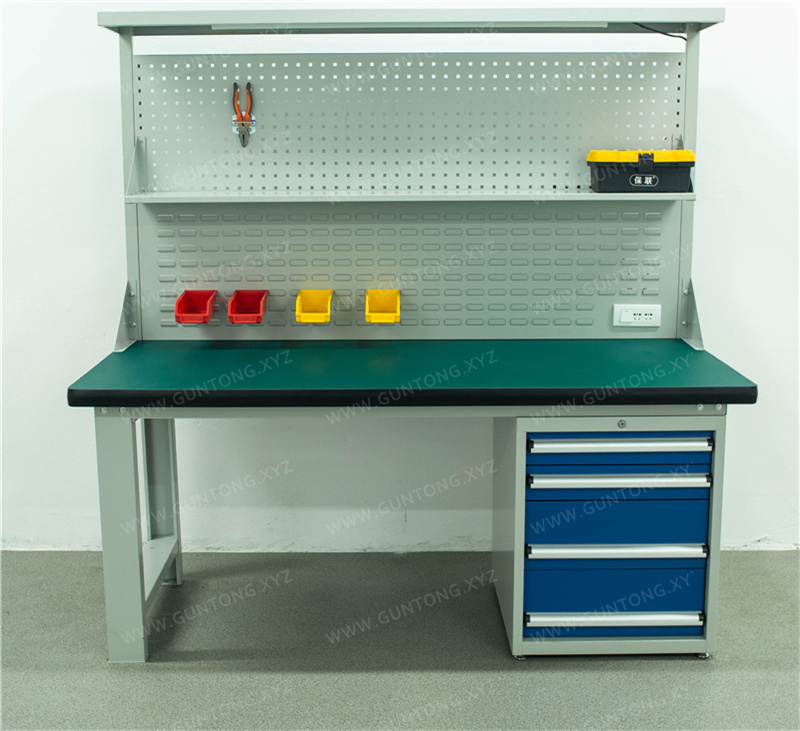
3. Component-Specific Limits: Drawers and Pegboards
The most common point of failure is not the main table, but its accessories. A workbench may have a 1000kg top load, but its drawers often have much lower limits.
- Drawer Load: In verified high-spec models, individual drawers are rated for 80kg per drawer.
- Mechanism: They typically use single-rail slides that allow 85% opening.
- Panel Thickness: Drawer panels are usually 1.5mm thick to prevent bowing when fully loaded.
Critical Check: Never stack heavy items exclusively in one drawer. If you need to store 200kg of tools, you must distribute them across at least three separate drawers. Overloading a single drawer beyond 80kg will cause slide failure, regardless of the main frame's strength.
Selection Criteria for First-Time Adopters
When transitioning from standard office-style benches to industrial-grade composite workbenches, evaluate suppliers based on these technical boundaries:
| Parameter | Minimum Acceptable Spec | Risk of Non-Compliance |
|---|---|---|
| Leg Material | 100×50×1.5mm C-Channel Steel | Frame buckling, lateral instability |
| Desktop Thickness | ≥50mm Composite | Sagging, surface cracking under point loads |
| Drawer Capacity | 80kg/drawer (Single Rail) | Slide deformation, drawer collapse |
| Surface Treatment | Pickling, Phosphatization, Anti-static Spray | Rust, electrical damage to sensitive components |
Implementation and Delivery Boundaries
It is important to distinguish between standardized inventory and non-standard customization:
- Standard Models: Typically available within 2-3 working days. These adhere strictly to the dimensions and load specs described above.
- Custom Solutions: For unique factory layouts or specialized tooling needs, lead times extend to 7-10 working days. Custom designs require detailed engineering validation to ensure the 1000kg rating is maintained across modified geometries.
All units generally come with a 3-year warranty, covering structural defects and material degradation under normal industrial use.
Conclusion
The "1000kg" label is a system-level metric, not a permission to overload individual components. For manufacturing enterprises prioritizing safety and compliance, verification must focus on the 100×50×1.5mm C-channel frame and the 50mm composite desktop as the primary indicators of structural integrity. Always distribute loads evenly across drawers and avoid exceeding the 80kg per-drawer limit.
By adhering to these technical checkpoints, procurement teams can mitigate the risk of workplace accidents and ensure long-term operational reliability.
Next Steps
If you are evaluating workstations for a new assembly line or upgrading existing facilities, request detailed structural drawings and load test reports from your supplier. For custom configurations that exceed standard parameters, engage directly with engineering teams to validate specific use-case requirements.
Contact our technical team for a consultation on heavy-duty workstation specifications.