
Why Tool Carts Fail Under Load: Configuration Mistakes That Drive Up Real Costs
The Hidden Cost of a Wrong Tool Cart Configuration
A manufacturing plant in Guangdong recently replaced an entire fleet of tool carts after only 14 months in service. The carts hadn't collapsed — they had simply become unusable. Drawers sagged under the weight of heavy dies. Casters cracked on epoxy-coated floors. Pegboard hooks pulled out of thin-gauge steel panels during routine movement across the shop floor.
The replacement cost was nearly three times the original purchase price when factoring in downtime, re-procurement labor, and scrapped accessories. This is the real pricing problem with tool carts: the factors that drive long-term cost are rarely visible on a quotation sheet.
For procurement managers and workshop planners evaluating factors affecting tool cart prices, the decision is never just about comparing line-item costs. It is about understanding how configuration choices — drawers, casters, pegboards, and load capacity — interact under real working conditions.
Factor 1: Drawer Configuration and Load Distribution
Drawer design is the single largest variable in tool cart pricing, and it is also the most common source of field failure.
What Buyers Often Get Wrong
Many buyers specify drawer count based on tool variety without calculating per-drawer load. A cart with four drawers rated at 80 kg each sounds adequate — until a single drawer is loaded with 60 kg of hardened steel inserts and the remaining capacity is consumed by the drawer's own slide mechanism and divider hardware.
How It Affects Price
- Drawer height tiers: A configuration mixing 100 mm and 200 mm drawer heights (as seen in Guang'ErMei's 4-Drawer 1-Door Tool Cart) requires different slide gauges and reinforcement brackets. Uniform-height drawers are cheaper to produce but waste vertical space.
- Slide mechanism grade: Heavy-duty ball-bearing slides with full extension cost significantly more than partial-extension friction slides. The price gap widens at higher load ratings.
- Divider systems: Adjustable internal dividers add material and assembly cost but prevent tool-on-tool damage that leads to premature replacement.
Corrective Action
Before specifying drawers, audit the heaviest single-drawer load in your workflow. Request the manufacturer's per-drawer dynamic load rating — not just the static rating — and confirm that slide mechanisms are rated for repeated extension under that load.
Factor 2: Caster Selection and Floor Interaction
Casters are the most underestimated pricing factor in tool cart procurement. They are also the component most likely to cause a cart to be pulled from service.
What Buyers Often Get Wrong
Standard quotations frequently list casters by diameter alone — 100 mm or 125 mm — without specifying wheel material, bearing type, or braking mechanism. A polyurethane wheel and a nylon wheel of the same diameter perform completely differently on concrete versus epoxy floors.
How It Affects Price
- Wheel material: Polyurethane wheels resist chemical exposure and floor marking but cost more than nylon or rubber alternatives.
- Bearing type: Precision roller bearings support higher dynamic loads and smoother rolling than plain bushings, but add to unit cost.
- Brake configuration: A standard configuration uses two fixed directional wheels at the front and two swivel wheels with brakes at the rear. This arrangement — documented in Guang'ErMei's tool cart product lines — provides directional stability and secure parking. Upgrading to four-wheel braking or adding total-lock mechanisms increases hardware cost and assembly time.
Corrective Action
Map your shop floor surface type and the cart's typical travel distance. Specify caster material and brake type explicitly in your RFQ. If carts will carry loads above 300 kg total, require the manufacturer to provide a dynamic load test report for the caster assembly.
Factor 3: Pegboard Integration and Panel Gauge
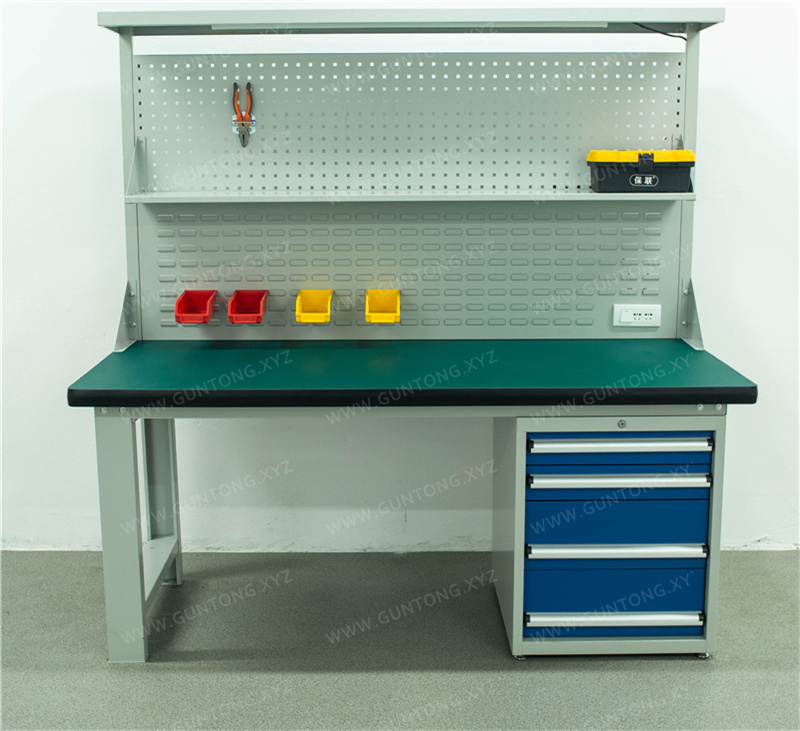
Pegboards transform a basic tool cart into a visual management station. But pegboard integration introduces structural variables that directly affect both pricing and durability.
What Buyers Often Get Wrong
Buyers often treat pegboards as accessories rather than structural components. A 500 mm square-hole pegboard mounted on a cart — as configured in Guang'ErMei's 4-Drawer 1-Door Tool Cart with Pegboard — adds top-heavy weight and lateral stress during movement. If the pegboard panel is fabricated from thin-gauge steel to save cost, hooks will loosen and the panel will warp under repeated loading.
How It Affects Price
- Panel thickness: Cold-rolled steel pegboard panels at 1.0 mm or 1.2 mm gauge provide rigidity for heavy hook loads. Thinner gauges reduce material cost but compromise long-term flatness.
- Mounting method: Welded pegboard frames are more rigid and durable than bolt-on panels but require more fabrication time.
- Hole pattern: Standard square-hole patterns support a wider range of commercial hooks. Custom hole patterns or modular half-pegboard layouts (as used in Guang'ErMei's Inner Half-Pegboard Storage Cabinet) require dedicated tooling and increase per-unit cost for smaller production runs.
Corrective Action
Specify pegboard panel gauge and mounting method in your procurement documents. For carts that will be moved frequently, require a welded frame or reinforced bracket system. Confirm that the hole pattern matches your existing hook inventory to avoid accessory re-procurement.
Factor 4: Load Capacity Rating and Frame Structure
Total load capacity is the most quoted — and most misunderstood — specification in tool cart pricing.
What Buyers Often Get Wrong
A cart rated for 500 kg total load does not mean 500 kg can be placed on any single shelf or drawer. Load capacity is a system rating that depends on frame structure, joint welding quality, caster rating, and load distribution across all tiers.
How It Affects Price
- Frame material: C-type cold-rolled steel frames — used in Guang'ErMei's heavy-duty workbench and cart lines — provide higher load capacity per kilogram of material than angle-iron frames, but require precision forming equipment.
- Joint construction: Fully welded joints outperform bolted assemblies in dynamic load scenarios but add fabrication cost.
- Safety factor: Reputable manufacturers design to a safety factor above the rated load. A cart rated at 500 kg with a 1.5x safety factor is engineered to withstand 750 kg without structural deformation — a meaningful difference in workshop environments where overload events are common.
Corrective Action
Request the manufacturer's load test methodology. Confirm whether the stated capacity is a static rating (cart stationary) or dynamic rating (cart in motion). For environments with uneven loading — such as automotive parts maintenance or mold repair stations — specify a higher safety margin and verify frame gauge and welding standards.
Decision Trade-Offs: Where to Invest and Where to Save
Not every configuration choice requires the premium option. Here is a practical framework for budget allocation:
| Component | Invest More When... | Save Safely When... |
|---|---|---|
| Drawers | Heavy individual loads (>50 kg per drawer); frequent full-extension use | Light hand tools; infrequent access |
| Casters | Long travel distances; chemically treated floors; high total loads | Stationary or short-distance use; smooth concrete floors |
| Pegboard | Cart is moved daily; heavy hook loads; 6S visual management required | Cart remains in fixed position; light accessory hanging |
| Frame | Dynamic loading; uneven weight distribution; multi-shift operation | Light-duty, single-shift assembly tasks |
Real Configuration Example: Guang'ErMei 4-Drawer 1-Door Tool Cart with Pegboard
To illustrate how these factors combine in a single product, consider the specifications of Guang'ErMei's 4-Drawer 1-Door Tool Cart with Pegboard:
- Overall dimensions: 1000 × 500 × 850 mm (including 500 mm pegboard height)
- Drawer configuration: Two 100 mm drawers and two 200 mm drawers with stamped steel construction
- Drawer load: 80 kg per drawer
- Pegboard: 500 mm standard square-hole panel for flexible hook placement
- Casters: High-strength configuration with two fixed directional wheels at front and two swivel brake wheels at rear
This configuration balances tiered storage for mixed tool sizes with mobile stability — a practical middle ground for electronics assembly lines, automotive parts maintenance bays, and hardware mold workshops.
Next Steps for Workshop Buyers
- Audit your actual loads: Weigh your heaviest drawer load and measure your longest cart travel route before issuing an RFQ.
- Specify by performance, not just dimensions: Include dynamic load ratings, caster material, and pegboard gauge in your procurement requirements.
- Request configuration documentation: Ask manufacturers for load test reports, material certificates, and assembly drawings — not just product photos.
- Plan for 6S integration: If your facility follows 6S management protocols, ensure pegboard layouts and drawer labeling systems are compatible with your visual standards.
Guang'ErMei Precision Components provides tool cart configuration consulting, on-site workstation planning, and full-process after-sales support for manufacturing facilities across Guangdong and nationwide. Contact our engineering team to discuss your specific load requirements, floor conditions, and workflow layout.