
Pre-Dispatch Inspection Protocol for Tool Cart Casters, Brakes, and Drawer Slides
Who This Guide Is For
Manufacturing buyers, maintenance supervisors, and procurement engineers who receive mobile workstation equipment—such as the 4-Drawer 1-Door Tool Cart with Pegboard—need a clear baseline to verify that casters, brakes, and drawer slides perform as specified after transit. This guide documents the inspection logic Guang'ErMei Precision Components applies before dispatch, so receiving teams know which signals matter and where functional boundaries lie.
Why Caster and Drawer Inspection Matters Before Acceptance
Tool carts in automotive parts workshops, hardware mold factories, and electronics assembly lines endure repeated repositioning and heavy cyclic loading. A caster brake that slips on a slight incline or a drawer slide that binds under an 80 kg load creates immediate safety and productivity risks. Pre-dispatch inspection is the last controlled checkpoint to catch assembly variances, fastener torque drift, and surface defects before the equipment enters an uncontrolled site environment.
Inspection Signals: What to Look For
Caster and Brake Assembly
| Signal | Acceptance Criterion | Common Failure Mode |
|---|---|---|
| Swivel rotation | Smooth 360° rotation without grinding or lateral play | Bearing race contamination or overtightened kingpin |
| Brake engagement | Full lock within one pedal stroke; cart remains stationary on a 3° slope | Brake pad misalignment or spring fatigue |
| Wheel tread condition | No flat spots, cracks, or embedded debris | Storage under load causing deformation |
| Mounting plate fasteners | All four bolts torqued; no visible gap between plate and frame | Vibration loosening during transit |
Drawer Slide and Cabinet Body
| Signal | Acceptance Criterion | Common Failure Mode |
|---|---|---|
| Extension smoothness | Full extension with one hand; no lateral wobble | Slide rail misalignment or ball bearing loss |
| Load retention | Drawer remains closed when cart is tilted 5° forward | Latch mechanism under-tensioned |
| Drawer face alignment | Uniform gap (≤2 mm) between adjacent drawer faces | Frame racking during handling |
| Pegboard mounting | Square-hole pegboard firmly seated; no rattle at 500 mm height | Clip or rivet omission |
Operating Logic: How Guang'ErMei Structures the Inspection
Step 1 — Static Dimensional Verification
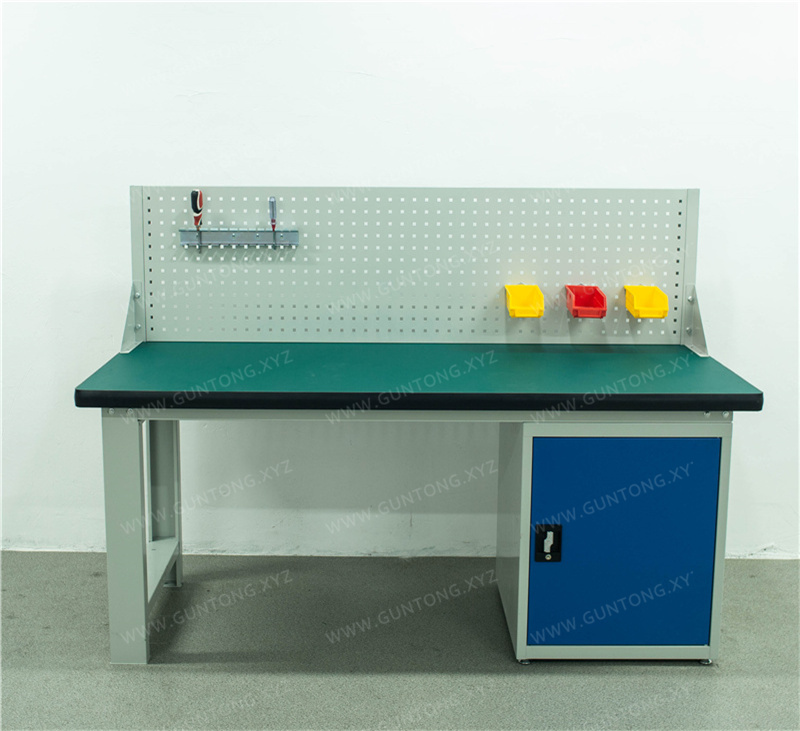
Before dynamic tests, inspectors confirm overall dimensions against the build sheet. For the 4-Drawer 1-Door Tool Cart with Pegboard, the reference envelope is 1000 × 500 × 850 mm (including the 500 mm pegboard height). Any deviation beyond ±2 mm triggers a frame squareness check.
Step 2 — Caster Load and Brake Hold Test
Each caster is rated to support a proportion of the cart's total working load. The brake hold test places the loaded cart on a calibrated 3° ramp. The brake must prevent any drift over a 60-second observation window. Inspectors record the result per wheel position, not just a pass/fail for the whole cart, because uneven floor contact in real workshops often exposes a single weak brake.
Step 3 — Drawer Cycle and Load Test
Drawers configured in the standard 100 mm H × 2 + 200 mm H × 2 layout are cycled 50 times under an 80 kg distributed load—the rated capacity per drawer. Inspectors check for:
- Binding or increased friction after 30 cycles
- Slide rail separation or ball bearing ejection
- Drawer face deformation exceeding 1 mm at the center point
Step 4 — Fastener Re-Torque and Visual Audit
Transit vibration can loosen mounting hardware. A calibrated torque wrench verifies all caster plate bolts, slide rail screws, and pegboard fasteners. Surface finish is inspected under 500 lux lighting for scratches, coating blisters, or weld spatter that could compromise corrosion resistance in humid workshop environments.
Applicable Boundaries and Limitations
- Slope rating: The 3° brake hold test reflects typical workshop floor gradients. Carts deployed on mezzanine ramps exceeding 5° require upgraded brake specifications, which must be confirmed at the order stage.
- Load rating: The 80 kg per drawer rating assumes evenly distributed loads. Concentrated point loads (e.g., a single heavy die block) may exceed slide rail moment capacity and require reinforced slides.
- Environmental limits: Standard powder-coated finishes are rated for indoor use. Carts destined for washdown or outdoor staging areas need stainless steel or galvanized alternatives—something Guang'ErMei addresses through its stainless steel workstation product line.
- Transit damage: Inspection records confirm the cart left the factory within tolerance. Damage from improper forklift handling or unsecured transport is outside the pre-dispatch scope and must be documented on the delivery receipt.
Practical Example: Receiving Inspection Checklist
When a batch of tool carts arrives at an automotive parts plant in Huizhou, the receiving team can replicate key checks in under 15 minutes per unit:
- Roll test: Push the cart 10 meters on a flat surface; note any pulling to one side (indicates caster misalignment).
- Brake test: Engage all brakes, push firmly from the side; cart should not pivot or slide.
- Drawer load test: Place a known weight (e.g., two 25 kg calibration blocks) in each drawer; open and close three times.
- Gap check: Use a feeler gauge to verify drawer face gaps remain ≤2 mm.
- Pegboard pull test: Apply moderate hand pressure to mounted hooks; pegboard should not deflect more than 3 mm.
Any failure at this stage should be logged with photos and reported to the supplier within the contractual inspection window.
Risk Signals That Require Escalation
- Brake pedal travel exceeding 75% of its range before engagement
- Visible cracking at the caster mounting plate weld
- Drawer slide rail separation during the first 10 cycles
- Missing or substituted fasteners (e.g., non-grade bolts)
These signals suggest a systemic assembly issue rather than transit damage and warrant a batch-level review with the manufacturer.
Next Steps for Buyers
If you are specifying tool carts for a new workshop layout or replacing aging mobile storage, request the pre-dispatch inspection record with your shipment. Guang'ErMei provides these records for all standard and custom tool cart orders, including configurations integrated with pegboard storage cabinets and workbench systems.
For site-specific requirements—such as ESD-safe casters for electronics assembly or heavy-duty slides for mold maintenance bays—contact our engineering team to review load calculations and inspection criteria before production begins.