
Tool Cart Caster and Brake Maintenance: A Field Service Log from Guang'ErMei
Tool Cart Caster and Brake Maintenance: A Field Service Log from Guang'ErMei
Workshop tool carts endure constant movement, heavy loads, and frequent braking across uneven floors. Over time, casters and brake assemblies degrade in ways that are easy to miss until a cart drifts on a slope or a wheel seizes mid-aisle. This field guide draws on Guang'ErMei Precision Components' after-sales service experience with products like the 4-Drawer 1-Door Tool Cart with Pegboard to outline the wear signals, inspection routines, and replacement thresholds that maintenance teams in manufacturing environments should follow.
Who This Guide Is For
This log is designed for maintenance supervisors, workshop 6S coordinators, and equipment managers in electronics assembly plants, automotive parts factories, hardware mold workshops, and vocational training centers—any environment where tool carts carry significant daily loads and must remain stationary during precision tasks.
Common Wear Signals in Tool Cart Casters
Caster degradation rarely happens all at once. Based on field service visits, the following signals typically appear in sequence:
Early-Stage Indicators
- Uneven rolling resistance: One wheel requires noticeably more force to push than the others, often caused by debris wrapped around the axle or early bearing wear.
- Slight wobble at low speed: The caster fork shows lateral play when the cart is pushed slowly, indicating loosened swivel bearings or a worn kingpin.
- Floor marking or scuffing: Polyurethane or rubber wheel treads begin to leave marks, signaling surface hardening or flat-spot development from prolonged static loading.
Mid-Stage Indicators
- Audible grinding during swivel: Metal-on-metal noise from the swivel raceway, often accompanied by visible metal dust around the caster stem.
- Brake pedal travel increase: The brake lever or pedal requires deeper engagement before the wheel locks, pointing to pad wear or linkage stretch.
- Visible tread deformation: Flat spots or chunking on the wheel surface, particularly on carts that carry loads near the 80 kg per-drawer capacity and are frequently parked in the same position.
Late-Stage Indicators Requiring Immediate Action
- Caster fork cracking or bending: Structural deformation visible at the weld points or along the fork legs, often caused by impact with dock edges or threshold ramps.
- Complete brake failure: The brake mechanism no longer holds the wheel stationary on a 3-degree incline, creating a safety hazard near machining stations or assembly lines.
- Wheel seizure: The wheel no longer rotates freely, forcing operators to drag the cart and damaging both the floor and the caster mounting plate.
Inspection Checklist: What to Verify and When
Guang'ErMei recommends integrating caster and brake checks into the existing workshop equipment maintenance cycle. The following intervals serve as a baseline for carts used in standard manufacturing shifts:
| Inspection Item | Weekly Check | Monthly Check | Quarterly Check |
|---|---|---|---|
| Wheel rotation freedom | |||
| Swivel play and wobble | |||
| Brake engagement depth | |||
| Brake holding test on incline | |||
| Axle bolt torque verification | |||
| Caster fork visual inspection | |||
| Tread condition and flat spots | |||
| Mounting plate bolt integrity |
How to Perform the Brake Holding Test
- Load the cart to its typical operating weight (for the 4-Drawer 1-Door Tool Cart with Pegboard, this means drawers loaded with standard tool sets).
- Position the cart on the steepest ramp or incline it will encounter in normal use.
- Engage all wheel brakes fully.
- Release the cart and observe for any drift over a 60-second period.
- If drift exceeds 10 mm, the brake pads or linkage require adjustment or replacement.
Load-Related Risks and Boundary Conditions
Caster lifespan is directly tied to how the cart is loaded relative to its rated capacity. Key boundaries to observe:
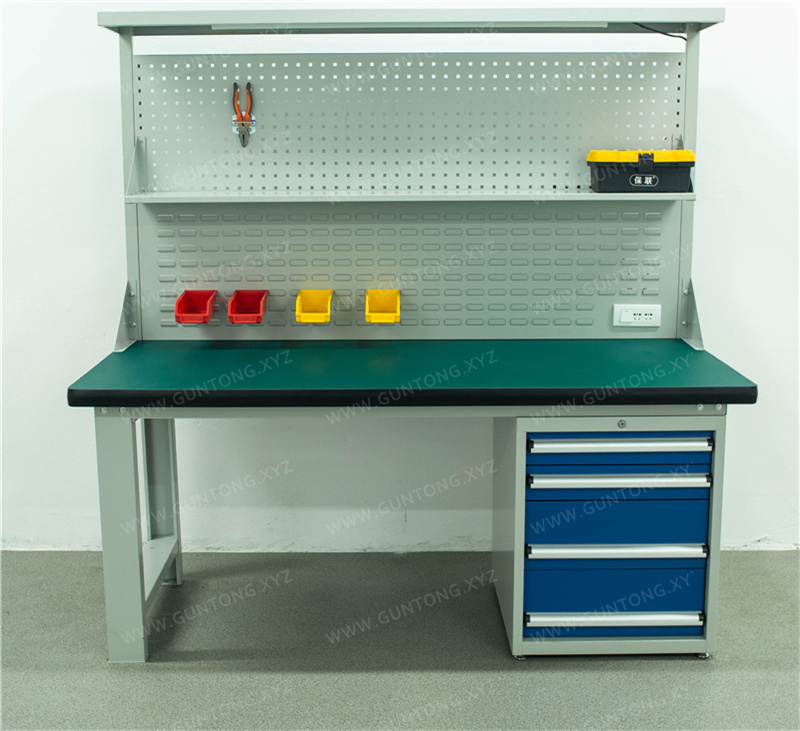
- Per-drawer load limits: The 4-Drawer 1-Door Tool Cart with Pegboard is rated for 80 kg per drawer. Exceeding this concentrates stress on the two rear casters during pushing, accelerating bearing wear.
- Static vs. dynamic loading: Carts parked for extended periods with full loads develop flat spots on wheel treads faster than carts in continuous rotation. If a cart will remain stationary for more than 48 hours under load, consider repositioning it or using jack stands.
- Floor surface compatibility: Hard polyurethane casters perform well on smooth epoxy floors but transmit more shock on concrete with expansion joints, increasing fork fatigue. Softer tread compounds reduce vibration but wear faster on rough surfaces.
Replacement Criteria: When Repair Is Not Enough
Not every caster issue warrants full replacement. The following decision framework helps maintenance teams determine the appropriate action:
Repair or adjust when:
- Debris is wrapped around the axle and can be cleared.
- Brake linkage has stretched and can be re-tensioned.
- Swivel bearings are dry but undamaged and can be re-lubricated.
Replace the caster assembly when:
- The fork shows any visible cracking or permanent bending.
- Wheel tread has lost more than 25% of its original thickness.
- Swivel raceway shows pitting or spalling visible to the naked eye.
- Brake mechanism no longer holds after linkage adjustment.
Service Conditions and After-Sales Support
Guang'ErMei provides after-sales service covering workstation equipment including tool carts, workbenches, and storage cabinets. Service scope includes:
- On-site troubleshooting for caster and brake issues on Guang'ErMei-manufactured tool carts.
- Replacement part supply for caster assemblies, brake mechanisms, and mounting hardware matching original specifications.
- Workstation re-evaluation if recurring caster failures suggest the cart configuration does not match the actual load or floor conditions in the facility.
Service coverage includes manufacturing customers in Huizhou and Guangdong Province, with nationwide project delivery support available for larger workstation equipment installations.
Practical Example: Resolving Recurrent Brake Drift
A recent service call involved a set of tool carts in an automotive parts workshop where operators reported brake drift on a loading ramp. The inspection revealed:
- The carts were consistently loaded to near maximum drawer capacity.
- The ramp gradient exceeded the standard brake holding threshold.
- Brake pad wear was within normal range, but the linkage had stretched from repeated high-force engagement.
The resolution involved re-tensioning the brake linkages, replacing the standard casters with a higher-rated variant for the ramp conditions, and adjusting the workshop's cart parking protocol to avoid loaded carts on inclines. No cart replacement was necessary.
Next Steps for Workshop Maintenance Teams
If your facility operates Guang'ErMei tool carts or is evaluating caster maintenance protocols for existing workshop equipment:
- Download or create a caster inspection log based on the checklist above.
- Assign inspection responsibilities to specific shifts or maintenance personnel.
- Track failure patterns over a 90-day period to identify whether issues are isolated or systemic.
- Contact Guang'ErMei's after-sales team if recurring failures suggest a configuration mismatch between the cart and its operating environment.