Switching from Fixed Tool Cabinets to Mobile Carts: A Step-by-Step Safety and Readiness Guide
When Fixed Storage Becomes a Bottleneck
In electronics assembly, automotive parts machining, and hardware mold workshops, operators often face a recurring friction point: tools and fixtures are stored in fixed cabinets far from the actual workstation, forcing repeated walking, search time, and interruption to flow. The decision to switch from stationary cabinets to mobile tool carts is typically driven by floor supervisors or lean-improvement teams, but the burden of safe implementation falls on the operator who will push, stop, and load the cart every day.
This guide is written for the operator or team lead in the preparation stage. It uses a diagnostic structure—symptom, cause, checks, resolution, and escalation boundary—to help you verify whether your workshop is ready for the switch, and what specific product parameters must match your real load conditions.
Symptom: The Problems Fixed Cabinets Create on the Floor
Operators in high-mix, low-volume environments report three consistent symptoms:
- Motion waste: Walking to a central tool cabinet consumes a measurable portion of cycle time in cells where changeovers are frequent.
- Search and retrieval delay: Without visual management, drawers become disordered, and wrong tools are selected.
- Space rigidity: Fixed cabinets cannot follow workflow rearrangements, especially when production lines are rebalanced for 6S or seasonal demand shifts.
These symptoms are especially acute in maintenance and testing institutions, where technicians must carry diagnostic equipment between machines, and in vocational training centers, where stations are reconfigured frequently.
Cause: Why Mobility Introduces New Risk
Mobile tool carts solve proximity and flexibility problems, but they introduce dynamic load and stability risks that fixed cabinets do not face:
- Load shift during movement: A cart loaded with heavy cutting tools or measurement gauges can tip when rolled over joints or thresholds.
- Brake failure on slopes: Without reliable wheel locking, carts drift on slightly sloped epoxy or concrete floors.
- Drawer ejection: Drawers not rated for dynamic conditions can slide open during transport, creating falling-object hazards.
The root cause is not the cart itself, but a mismatch between the cart's engineered limits and the actual weight distribution, floor condition, and operator behavior in your specific cell.
Checks: What to Verify Before Deployment
1. Caster Configuration and Floor Compatibility
Guang'ErMei's mobile tool cart designs specify a caster arrangement of two fixed wheels and two swivel wheels with brakes. Before deployment, operators should confirm:
- Floor surface is level and joints or cable covers are flush.
- Swivel-with-brake casters are positioned on the operator-push side for intuitive foot braking.
- Wheel material matches floor type—PU casters for epoxy, nylon for rough concrete.
If your floor has frequent coolant or oil exposure, verify with your supplier whether the caster housing and brake mechanism are sealed against contamination.
2. Per-Drawer Load Rating vs. Actual Content
The disclosed load capacity for tool cart drawers in Guang'ErMei's product range is 80 kg per drawer. Operators must:
- Weigh or estimate the total mass of tools intended for each drawer before loading.
- Distribute weight with heavier items in lower drawers to lower the center of gravity.
- Never exceed the per-drawer limit even if the overall cart frame rating is higher.
For reference, the Single Back Panel Single Door 4-Drawer Steel Plate Workbench in the same product family uses a C-type cold-rolled steel frame with a total load capacity of 1000 kg, but that rating applies to static bench conditions, not to dynamic cart operation.
3. Pegboard and Accessory Security
Many operators add square-hole pegboards to cart sides for visual tool access. Before moving the cart:
- Verify that pegboard hooks have retaining clips or locking mechanisms.
- Confirm that top-heavy accessories (power tool holders, large wrenches) are not mounted above shoulder height.
- Check that the pegboard panel itself is bolted, not merely slotted, to resist vibration during rolling.
4. Operator Clearance and Traffic Pattern
Measure the cart's footprint against your aisle width. A typical tool cart requires adequate clear aisle for safe passage. In narrow cells common to electronics manufacturers, consider whether a slimmer cart or a wall-mounted shadow board is the safer alternative.
Resolution: Staged Implementation Steps
| Stage | Action | Responsible | Completion Criteria |
|---|---|---|---|
| 1. Audit | Catalog all tools by weight and frequency of use; identify which must travel with the operator. | Operator / Team Lead | Tool list with mass estimates; red-tag items never used |
| 2. Match | Select cart configuration (drawer count, pegboard height, cabinet door) based on audit results. | Production Engineer | Cart BOM matches tool list within drawer capacity limits |
| 3. Inspect | Receive cart; verify caster type, brake function, drawer slide integrity, and load label accuracy. | Operator | Inspection checklist signed; photos of any shipping damage |
| 4. Load | Load tools per weight-distribution rules; label drawer contents; install pegboard retainers. | Operator | Loaded cart weight within rated capacity |
| 5. Pilot | Operate on one shift for one week; log tipping incidents, brake usage, and retrieval time. | Operator / Supervisor | Pilot log with safety observations; no injuries or near-misses |
| 6. Scale | Roll out to additional cells with lessons learned; schedule 30-day re-inspection. | Plant Manager | Standard operating procedure updated |
Escalation Boundary: When to Stop and Consult
Operators should halt deployment and escalate to engineering or the equipment supplier if any of the following conditions are encountered:
- Actual single-drawer load exceeds 80 kg after audit—this requires a heavier-duty drawer slide or a switch to a stationary cabinet for that tool category.
- Floor slope is significant—standard swivel-brake casters may not hold; ask about wheel chocks or floor-anchored parking brackets.
- Cart must travel between buildings or over outdoor surfaces—this exceeds the design intent of indoor workshop carts and may require a dedicated transport trolley.
- Tool value or precision requires climate control—mobile carts are open systems; sealed cabinets or controlled-environment storage may be non-negotiable.
In these cases, contact Guang'ErMei's project team for a workstation planning review. The company provides on-site load-bearing design and 6S adaptation support as part of its full-chain service scope.
Related Configurations Worth Evaluating
If your audit reveals that some tools must remain centralized but others need mobility, consider a hybrid approach:
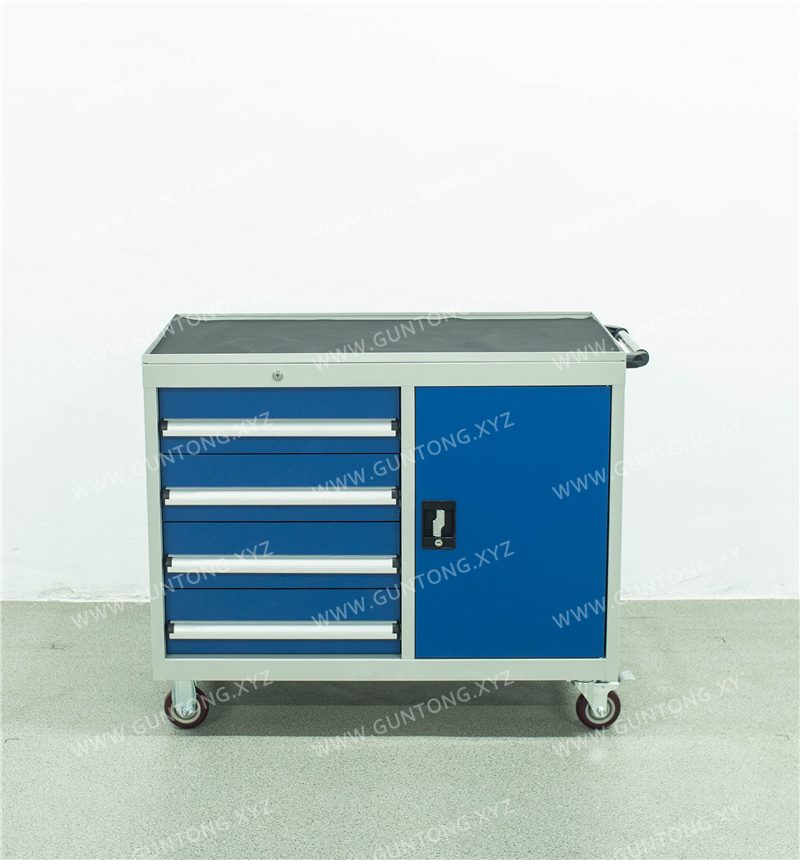
- Stationary base + mobile satellite cart: Heavy reference standards stay in a Pegboard Storage Cabinet (Inner Half-Pegboard Type) with 100 kg per shelf capacity, while daily-use tools move on a 4-Drawer 1-Door Tool Cart with Pegboard.
- Workbench-integrated storage: For cells where the operator works standing in one zone, a Single Back Panel 4-Drawer Steel Plate Workbench with composite desktop provides both work surface and tool access without the tipping risk of a tall cart.
Conclusion
Replacing fixed tool cabinets with mobile carts is a valid lean improvement, but only if the operator-level checks—caster configuration, per-drawer load limits, floor condition, and traffic clearance—are completed before the first shift uses the equipment. The 80 kg per-drawer rating and the two-fixed-plus-two-swivel-brake caster pattern are engineered boundaries, not suggestions. Treat them as hard stops, and escalate when your real conditions exceed them.