
Steel Workbench Configuration Checklist for Machining Workshops: Selection and Configuration Essentials
Why Machining Workshops Need a Structured Workbench Checklist
In machining and hardware mold environments, a workbench is not just a table—it is the primary interface between operators, heavy tooling, and precision tasks. Buyers who select a workbench based only on overall dimensions often discover later that the desktop cannot handle repeated impact from hammers or presses, or that the frame deflects under a 500 kg load. A structured configuration checklist prevents these costly mismatches by aligning the workbench's physical properties with the actual forces, tools, and workflow of the shop floor.
This guide focuses on steel plate workbenches, the most common choice for heavy-duty machining, fitting, and maintenance tasks. It covers the core decision points: desktop composition, frame load capacity, dimensional planning, and accessory integration.
Step 1: Confirm the Desktop Structure and Impact Resistance
The desktop is the first point of failure in a machining workshop. Pure steel plates can dent or transmit excessive vibration, while wood or laminate surfaces degrade quickly under metalworking conditions.
Key configuration fact: Heavy-duty steel plate workbenches typically use a composite desktop structure. A proven configuration combines a 5mm raw steel plate on top with a 45mm high-density fiberboard core, machine-pressed together and finished with black PVC edge banding. This yields a total desktop thickness of approximately 50mm.
Decision checklist for desktops:
- Impact tasks (hammering, press-fitting, mold repair): Prioritize the 5mm steel plate composite top. It offers wear resistance, high-temperature tolerance, and impact absorption that a thin steel sheet alone cannot provide.
- Precision layout or inspection tasks: Verify that the steel plate surface is ground flat. If sub-millimeter flatness is required, discuss surface finishing options with the manufacturer before ordering.
- Anti-static requirements: If the machining workshop also handles electronic components or sensitive instrumentation at the same station, confirm whether an anti-static laminate layer can be integrated into the composite structure.
Step 2: Verify Frame Load Capacity and Structural Design
A 50mm composite desktop is heavy on its own. Add a bench vise, a set of tooling plates, and an operator leaning on the edge, and the total static and dynamic load can approach or exceed 800 kg.
Key configuration fact: Heavy-duty steel workbenches designed for machining applications commonly use a C-type cold-rolled steel frame with a cross-section of approximately 100mm × 50mm. This frame configuration supports a total load capacity of up to 1000 kg for the entire workbench.
Decision checklist for frames:
- Static vs. dynamic load: A 1000 kg rating typically refers to evenly distributed static load. If your application involves concentrated point loads (e.g., a 200 kg vise mounted at one end), ask the manufacturer to confirm the localized load rating and whether additional cross-bracing is needed.
- Frame profile: C-type frames provide good legroom and allow operators to sit or stand. If the workbench will be placed against a wall and accessed from one side only, verify that the rear frame members do not interfere with wall-mounted utilities.
- Leveling and anchoring: Machining workshops often have uneven concrete floors. Confirm whether adjustable leveling feet are included and whether the frame has pre-drilled anchor holes for floor bolting—critical for safety when heavy tooling is in use.
Step 3: Select Dimensions That Match the Workflow
Workbench length directly affects how many operators can work simultaneously and how much tooling can remain on the surface.
Key configuration fact: Standard heavy-duty steel workbench lengths commonly available include 1500mm, 1800mm, and 2100mm, with a standard depth of 750mm and a working height of 800mm (plus optional 500mm for back panel accessories).
Decision checklist for dimensions:
- 1500mm length: Suitable for single-operator fitting, repair, or inspection stations where floor space is constrained.
- 1800mm length: The most versatile option for general machining support, allowing room for a bench vise at one end and layout space at the other.
- 2100mm length: Ideal for two-operator stations or for accommodating large mold components during maintenance.
- Custom dimensions: If your workshop layout requires non-standard lengths or depths (e.g., to fit between CNC machines), most manufacturers with dual capabilities in standardized production and non-standard customization can accommodate this. Provide a floor plan with utility locations to get an accurate quote.
Step 4: Plan Accessory Integration for Tool Management
A bare workbench in a machining workshop quickly becomes cluttered with wrenches, measuring instruments, fasteners, and cutting tools. Integrated accessories improve both efficiency and 6S compliance.
Decision checklist for accessories:
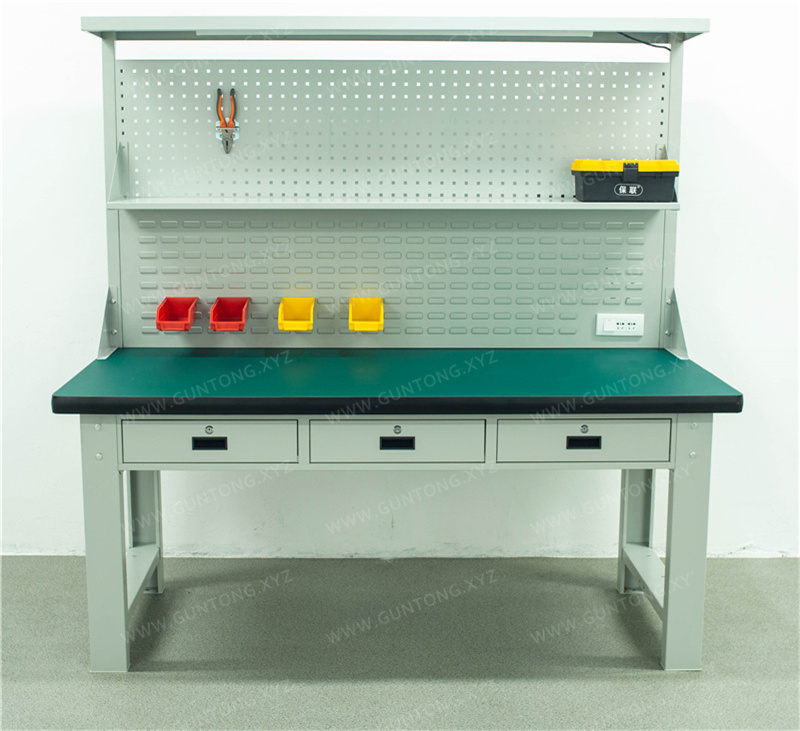
- Back panels and pegboards: A single or dual square-hole pegboard mounted above the workbench keeps frequently used tools visible and within reach. Confirm the pegboard height (commonly 500mm above the desktop) and whether it includes a lighting bracket.
- Drawers and cabinets: A 4-drawer configuration with a single-door lower cabinet allows tiered storage—smaller measuring tools in shallow upper drawers, heavier tooling in deeper lower drawers. Verify individual drawer load ratings (commonly up to 80 kg per drawer in heavy-duty models).
- Bench vise mounting: If a bench vise will be installed, confirm that the desktop's steel plate thickness and the frame's edge structure can handle the clamping force without deformation. Some configurations include a reinforced vise mounting zone.
- Lean pipe and shelving add-ons: For workshops implementing lean manufacturing, lean pipe racks can be attached to the workbench frame to hold bins of fasteners or consumables, reducing operator walk time.
Step 5: Evaluate the Supplier's Service Scope
The configuration of a steel workbench is only as reliable as the supplier's ability to deliver, install, and support it.
Decision checklist for supplier evaluation:
- On-site planning: Does the supplier offer on-site workstation planning, including load-bearing design and 6S adaptation? This is especially valuable for multi-station machining workshops where workflow continuity matters.
- Non-standard customization: If your workshop has unique constraints (low ceilings, overhead cranes, specific utility hookups), confirm that the supplier has proven capability in non-standard customization, not just catalog sales.
- Installation and after-sales: Heavy-duty workbenches with 50mm composite tops and C-type frames are substantial structures. Professional on-site installation ensures proper leveling, anchoring, and accessory alignment. Confirm the scope of after-sales service, including warranty terms and response times for structural issues.
Configuration Trade-Offs: Budget vs. Performance
| Configuration Choice | Lower-Cost Approach | Higher-Performance Approach | Trade-Off Consideration |
|---|---|---|---|
| Desktop | Thin steel sheet (2-3mm) on particleboard | 5mm raw steel plate + 45mm HDF composite (50mm total) | Thin sheets dent under impact; composite lasts significantly longer in machining use |
| Frame | Lighter gauge steel, lower load rating | C-type 100×50mm cold-rolled steel, 1000 kg capacity | Lighter frames may deflect under vise or press loads |
| Accessories | No back panel, open shelving | Integrated pegboard, 4-drawer cabinet, vise mounting zone | Accessories add upfront cost but reduce tool search time and improve 6S scores |
| Dimensions | Standard 1500mm only | Custom lengths to fit specific workshop zones | Custom sizes may have longer lead times but optimize floor space utilization |
Next Steps for Machining Workshop Buyers
- Audit your current workstations: Note the heaviest tools, the most common tasks, and any recurring issues (desktop damage, frame wobble, tool clutter).
- Define load requirements: Estimate the maximum combined weight of tooling, workpieces, and operator force at each station.
- Request a configuration quote: Provide the supplier with your preferred dimensions, load requirements, and accessory needs. For workshops in Huizhou and Guangdong Province, local manufacturers can typically arrange on-site surveys to validate the configuration before production.
- Plan for installation: Ensure floor conditions, utility clearances, and access routes are suitable for delivering and anchoring heavy-duty workbenches.
Guang'ErMei Precision Components provides design, production, and installation services for steel plate workbenches and complete workstation equipment tailored to machining, automotive parts, and hardware mold workshops. Contact our team to discuss your specific configuration requirements and request a detailed proposal.