Stainless Steel Workbench Project Delivery: A Step-by-Step Implementation Log for Manufacturing Workshops
Who Needs a Stainless Steel Workbench Delivery Plan?
Manufacturing enterprises, electronics and electrical appliance producers, automotive parts manufacturers, hardware mold factories, maintenance and testing institutions, and vocational college training centers all share a common requirement: work surfaces that resist corrosion, support heavy loads, and comply with strict hygiene or ESD (electrostatic discharge) standards. When these organizations source stainless steel workbenches, the product itself is only part of the equation. The real value lies in how the project is scoped, fabricated, delivered, and commissioned on-site.
This log documents the typical implementation path Guang'ErMei Precision Components follows when delivering stainless steel workbench projects, drawing on our dual capability in standardized production and non-standard customization. It is intended for procurement managers, workshop planners, and facility engineers who need to understand what a realistic delivery timeline looks like and where common risks emerge.
Step 1: On-Site Workstation Planning and Requirement Lock
Objective: Define the exact workstation configuration before any steel is cut.
Before fabrication begins, the project team conducts an on-site assessment or reviews detailed workshop layout files. Key parameters are locked at this stage:
- Load-bearing requirements: Static and dynamic loads per work surface, typically ranging from light-duty electronics assembly (under 100 kg) to heavy-duty mold inspection (several hundred kilograms).
- Material grade selection: SUS304 for general corrosion resistance in food-grade or humid environments; SUS316 for chemical exposure or coastal facilities.
- Dimensional constraints: Bench length, depth, and height must align with existing production lines, lean pipe frameworks, and automated storage and retrieval system (ASRS) interfaces.
- 6S adaptation: Surface finish, edge treatment, and accessory placement (tool hooks, shelf brackets, grounding points) are specified to support the client's 6S management protocol.
Checkpoint: A signed technical drawing package with material specifications, load calculations, and accessory list. No fabrication proceeds without this sign-off.
Exception Handling: If the client's workshop layout is not yet finalized, Guang'ErMei provides a provisional design based on standard module dimensions (e.g., 1500×750×800 mm or 1800×750×800 mm) that can be adjusted later without scrapping completed work.
Step 2: Design Validation and Non-Standard Customization
Objective: Ensure the workbench design meets both functional and integration requirements.
Guang'ErMei's design team produces 2D fabrication drawings and, where necessary, 3D assembly models. This step is critical for non-standard customization scenarios, such as:
- Integrated ESD grounding: For anti-static workbenches used in electronics assembly, copper grounding strips and wrist-strap connection points are embedded into the stainless steel frame.
- Mold rack or tool cabinet integration: When the workbench must interface with adjacent mold racks, tool cabinets, or automotive parts turnover racks, connection brackets and alignment tolerances are specified.
- Lean pipe compatibility: For workshops using lean pipe (pipe rack) systems, the workbench frame includes pre-drilled mounting points and compatible joint hardware.
Checkpoint: Client engineering team reviews and approves the final drawing set. Any changes after this point may affect lead time and cost.
Risk Boundary: Designs that require third-party certification (e.g., cleanroom validation or food-safety audit) must be flagged at this stage. Guang'ErMei provides fabrication to specification but does not assume responsibility for external certification processes unless explicitly contracted.
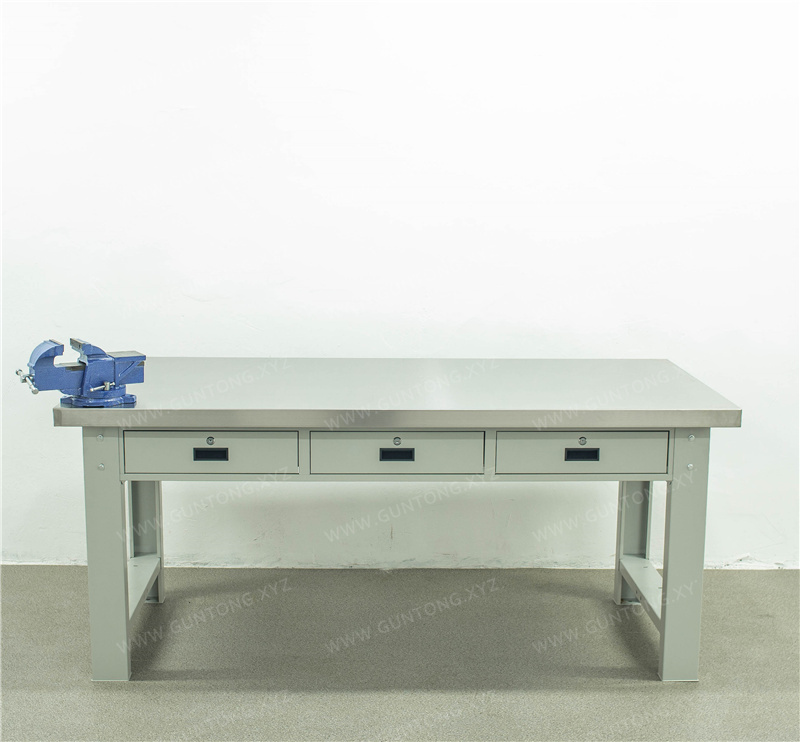
Step 3: Fabrication and Quality Inspection
Objective: Produce workbenches that match approved drawings within stated tolerances.
Fabrication takes place at Guang'ErMei's facility in Huizhou, Guangdong Province. The production process includes:
- Laser cutting and CNC bending of stainless steel sheets and profiles.
- TIG welding for structural joints, with weld seams ground smooth to prevent debris accumulation.
- Surface treatment: Brushed or mirror-polished finishes depending on the application environment.
- Assembly of accessories: Shelves, drawers, tool hooks, and grounding components are pre-assembled where possible to reduce on-site installation time.
Each unit undergoes a dimensional inspection and load test before packaging. Inspection records are retained and can be shared with the client upon request.
Checkpoint: Pre-shipment inspection report with photographs, dimensional verification, and load-test results.
Exception Handling: If a batch contains units with cosmetic defects (e.g., minor surface scratches that do not affect structural integrity), the client is notified and can choose to accept with a discount or request rework before shipment.
Step 4: Logistics, Delivery, and On-Site Installation
Objective: Deliver and install workbenches with minimal disruption to ongoing production.
Guang'ErMei provides full-chain service from product design and manufacturing to on-site installation and after-sales support. Delivery logistics are coordinated based on the client's location:
- Huizhou and Guangdong Province: Direct delivery via company vehicles, typically within a few days of fabrication completion.
- Nationwide projects: Freight forwarding with protective crating; installation teams are dispatched to the site.
On-site installation includes positioning, leveling, anchoring (where required), accessory mounting, and a final walkthrough with the client's facility team.
Checkpoint: Installation acceptance certificate signed by both parties, confirming that all units match the approved drawings and function as specified.
Risk Boundary: Installation timelines assume the client's workshop floor is ready (level, clean, and accessible). Delays caused by unfinished site preparation are not included in the original delivery schedule.
Step 5: After-Sales Service and Continuous Support
Objective: Ensure long-term performance and address any post-installation issues.
Guang'ErMei's full-process after-sales service covers:
- Warranty claims: Structural defects in materials or welding are addressed per the agreed warranty terms.
- Accessory replacement: Worn or damaged components (e.g., shelf brackets, grounding strips) can be reordered using the original part numbers.
- Workstation reconfiguration: If the client's production line changes, existing workbenches can be modified or relocated. The original design files are retained to facilitate this.
Checkpoint: Post-installation follow-up within the first month to identify any adjustment needs.
Next Action: Clients are encouraged to maintain a record of their workbench configuration (drawing number, material grade, load rating) to streamline future service requests.
Common Risks and How to Mitigate Them
| Risk | Mitigation |
|---|---|
| Incomplete requirement definition leading to redesign | Lock all parameters in Step 1; use provisional designs if layout is pending |
| Lead time overruns due to late design changes | Freeze design after Step 2 checkpoint; manage changes through formal revision process |
| On-site installation delays | Confirm site readiness before scheduling installation team |
| Material grade mismatch for corrosive environments | Specify SUS316 for chemical exposure; document environment conditions in Step 1 |
Summary and Next Steps
A stainless steel workbench project is not simply a product purchase—it is a workstation implementation that requires careful planning, precise fabrication, and coordinated installation. Guang'ErMei's delivery log demonstrates a structured approach that reduces risk and ensures the final installation meets the client's operational requirements.
If your organization is planning a workstation upgrade or new production line setup, the most effective next step is to share your workshop layout and load requirements with our engineering team. We can provide a preliminary design and delivery timeline based on your specific scenario, whether it involves standardized stainless steel workbenches or fully customized configurations integrated with tool cabinets, mold racks, or lean pipe systems.
Contact Guang'ErMei Precision Components to discuss your stainless steel workbench project requirements and request a site assessment or technical consultation.