
Single Pegboard 3-Drawer Composite Workbench: Cross-Site Deployment Checklist for Operations Managers
Who This Guide Is For
This article targets operations managers, maintenance supervisors, and facility coordinators responsible for deploying standardized workstation equipment across multiple production lines, regional workshops, or vocational training centers. If your organization is evaluating single pegboard 3-drawer composite workbenches for electronics assembly, automotive parts inspection, hardware mold repair, or testing laboratories, this guide clarifies what to verify before issuing purchase orders and what to inspect during site acceptance.
Cross-team or cross-region deployments introduce coordination risks: inconsistent tool storage layouts, mismatched load capacities, and unclear acceptance criteria. Addressing these during the preparation phase prevents costly rework and warranty disputes after installation.
Preparation Phase: Specification Alignment Before Procurement
Checkpoint 1: Confirm Load-Bearing Requirements by Application
Composite desktop workbenches combine a steel plate or high-density fiberboard surface with a cold-rolled steel frame. For heavy-duty scenarios like mold repair or automotive component testing, confirm that the total load capacity meets your peak operational load. For lighter electronics assembly or testing stations, composite desktops with PVC edge banding may suffice.
Action: Document the maximum static load per workstation and the dynamic load during tool retrieval. Cross-reference with the manufacturer's load rating for the specific frame and desktop combination. Request written confirmation of load test methodology if your application involves impact loading or vibration.
Checkpoint 2: Standardize Drawer Configurations Across Sites
When deploying across multiple facilities, inconsistent drawer heights and rail types create confusion during cross-site audits or operator transfers. Define a standard configuration early:
- Drawer heights:*
- Common options include 100mm, 150mm, and 200mm tiers. A 3-drawer setup might use 100mm + 150mm + 200mm for small hand tools, medium power tools, and bulky fixtures.
- Rail type:*
- Heavy-duty stamped rails support up to 80kg per drawer with approximately 85% extension. Confirm whether your tools exceed this limit.
- Drawer load per tier:*
- Verify that the combined weight of tools in each drawer stays within the rated capacity. Overloading a single drawer can cause rail deformation or frame instability.
Action: Create a configuration matrix listing drawer count, height per tier, rail type, and maximum load per drawer. Share this with all site managers before finalizing orders.
Checkpoint 3: Align on Pegboard Layout and 6S Visual Management Standards
Single pegboard workbenches support 6S methodology by enabling shadow boards, color-coded hooks, and labeled drawer dividers. Before procurement, agree on:
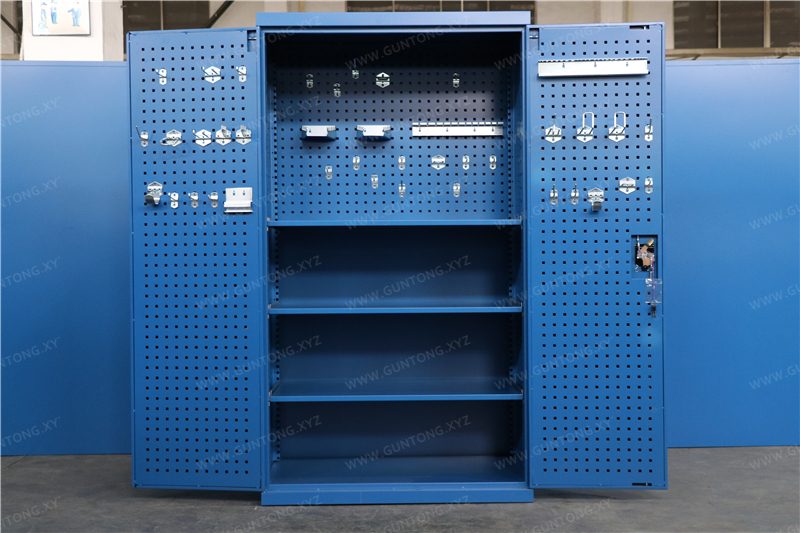
- Hook spacing and labeling conventions
- Drawer divider layouts for tool categorization
- Color coding for safety-critical vs. general-purpose tools
Action: Include a 6S layout diagram in your procurement specification. Request that the manufacturer pre-drill pegboard holes or provide modular hook kits matching your standard.
Implementation Phase: Delivery, Installation, and Site Acceptance
Boundary 1: Lead Time and Customization Constraints
Standard configurations may ship within 2–3 working days if stock is available. Non-standard customizations—such as altered dimensions, special drawer rail types, or branded color schemes—typically require 7–10 working days. For multi-site rollouts, stagger delivery schedules to avoid warehouse congestion and allow phased installation.
Risk: Assuming all sites can receive identical lead times. Remote facilities or regions with limited logistics access may experience delays. Confirm delivery windows per site before committing to a unified go-live date.
Boundary 2: On-Site Assembly and Floor Conditions
Composite workbenches with cold-rolled steel frames require level flooring and, in some cases, floor anchoring for stability under heavy loads. Before installation:
- Verify floor flatness tolerances.
- Confirm whether anchor bolts are included or must be sourced locally.
- Assign a site contact to supervise assembly and sign off on stability tests.
Action: Conduct a load test after assembly—place the maximum rated load on the desktop and open all drawers simultaneously to check for frame deflection or tipping risk.
Boundary 3: Electrical and Pneumatic Integration
Some workstations require integrated power strips, pneumatic hose reels, or grounding points for ESD-sensitive electronics assembly. These accessories are often non-standard and must be specified during the design phase. If your rollout spans sites with different voltage standards or air supply pressures, document these requirements per location.
Risk: Ordering workbenches without confirming utility integration needs, leading to post-installation modifications that void warranties or compromise structural integrity.
Acceptance and Handover: Inspection Criteria Before Sign-Off
Inspection Checklist
| Item | Acceptance Criteria |
|---|---|
| Desktop surface | No visible warping, scratches, or edge banding delamination |
| Drawer operation | Smooth extension to 85% travel; no binding or misalignment |
| Drawer load test | 80kg per drawer (for heavy-duty rails) with no frame deformation |
| Pegboard mounting | Secure attachment; hooks hold specified tools without sagging |
| Frame stability | No rocking on level floor; anchor points engaged if specified |
| Finish quality | Uniform paint or powder coating; no rust spots or bare metal |
Documentation Handover
Ensure each site receives:
- Assembly drawings and parts list
- Load rating certificates or manufacturer specifications
- Warranty terms (e.g., 3-year coverage on structural components)
- Maintenance schedule for drawer rail lubrication and caster inspection (if mobile)
Action: Schedule a 30-day post-installation review to address any alignment issues, drawer sticking, or pegboard hook failures before the warranty claim window narrows.
Maintenance and Operational Boundaries
Routine Maintenance
- Drawer rails:*
- Lubricate stamped rails every 6 months or after 10,000 open/close cycles.
- Casters (if equipped):*
- Inspect 4-inch casters for debris and brake function quarterly. Standard configurations include 2 fixed and 2 swivel casters with brakes.
- Pegboard hooks:*
- Replace bent or deformed hooks immediately to maintain 6S visual standards.
Operational Boundaries
- Do not exceed the rated drawer load (80kg per drawer for heavy-duty stamped rails).
- Avoid using the pegboard as a leverage point for prying or clamping operations.
- For environments with corrosive chemicals or high humidity, verify whether the cold-rolled steel finish is suitable or if stainless steel alternatives are required.
---
Next Steps
If you are preparing a multi-site workstation rollout, start by documenting your load requirements, drawer configurations, and 6S standards. Share these specifications with Guang'ErMei's engineering team to receive 3D layout drawings and a site-specific configuration list. For questions about lead times, customization options, or regional delivery logistics, contact the sales team directly.