
Selecting Workshop Storage Cabinets Based on Inventory Lists: Configuration Trade-offs and Decision Guide
Who Needs an Inventory-Driven Cabinet Selection Approach
Manufacturing workshops, maintenance bays, and vocational training centers often buy storage cabinets based on catalog dimensions alone. The result is predictable: drawers that cannot hold heavy dies, shelves wasted on small fasteners, or pegboards installed where enclosed storage is needed for calibration tools.
If your facility manages hundreds of SKUs—ranging from hand tools and measuring instruments to automotive parts and mold components—starting from an actual inventory list is the most reliable way to avoid configuration mismatches. This guide walks through how to convert that list into a cabinet specification, using real product parameters from Guang'ErMei's storage cabinet lineup as reference points.
Step 1: Categorize Your Inventory by Storage Behavior
Before looking at cabinet models, sort your inventory list into three groups based on how items are retrieved and stored:
Group A – High-frequency hand tools and small parts. These are retrieved dozens of times per shift. Examples include wrenches, screwdrivers, calipers, and drill bits. They benefit from drawer storage with dividers or pegboard hanging.
Group B – Medium-frequency components and kits. Items like automotive sub-assemblies, electronic modules, or packaged consumables. These are typically stored on adjustable shelves where visibility and load capacity matter more than individual tool organization.
Group C – Low-frequency or bulky items. Large fixtures, spare mold components, or infrequently used calibration equipment. These need enclosed shelf space with higher per-shelf load ratings and wider door openings.
This categorization directly maps to the three interior layout options available in standard workshop cabinets: drawers, adjustable shelves, and pegboard panels.
Step 2: Match Inventory Groups to Cabinet Interior Configurations
Drawer-Dominant Layouts
If Group A dominates your inventory, prioritize cabinets with multiple drawer tiers. For example, Guang'ErMei's drawer-type storage cabinets offer configurations with two 100 mm-high drawers using stamped single-rail slides, each rated for approximately 80 kg per drawer. This is suitable for dense hand tool sets but not for heavy die components.
Trade-off: Drawers provide the best tool-by-tool organization and fastest retrieval, but they consume more vertical space per stored item and add cost through slide hardware. If your inventory list shows mostly small items under 2 kg each, a 4-drawer configuration is usually sufficient. If heavier items appear frequently, verify the slide rating before committing.
Shelf-Dominant Layouts
For Group B and C items, adjustable shelf cabinets are more space-efficient. Standard shelf-type cabinets in the 1000 × 500 × 1800 mm or 1000 × 600 × 1800 mm range typically provide 3 to 4 adjustable shelves, each rated for approximately 100 kg. This accommodates boxed parts, component kits, and medium-weight assemblies.
Trade-off: Shelves offer higher volumetric storage density and simpler construction (lower cost), but retrieval is slower because items behind others are not immediately visible. If your inventory list includes many similar-looking parts, consider adding label systems or bin dividers on each shelf.
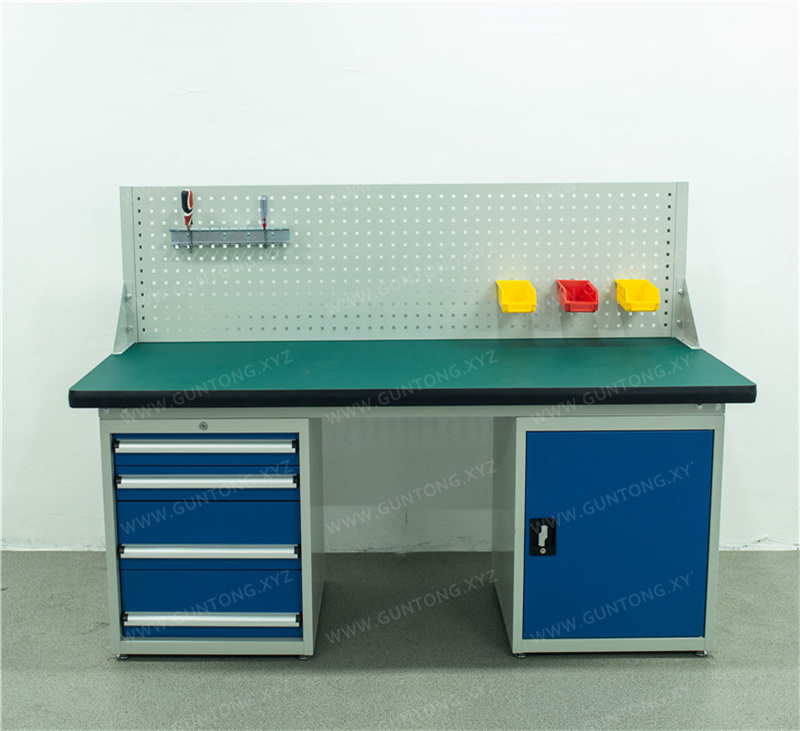
Pegboard-Integrated Layouts
When your inventory list includes a mix of hanging tools and shelved items, a hybrid cabinet with inner half-pegboard configuration can serve both needs. In this layout, the upper interior section and the inner door panels feature square-hole pegboard, while the lower section retains adjustable shelves or drawers.
Trade-off: Pegboard panels maximize vertical hanging space and support visual 6S management, but they require compatible hooks and holders. If your inventory list includes mostly non-hangable items (boxes, bottles, irregular shapes), pegboard area is wasted space.
Step 3: Verify Load Capacity Against Your Heaviest Items
A common procurement mistake is specifying cabinet dimensions correctly but overlooking load ratings. Cross-reference your inventory list's heaviest items against these checkpoints:
- Per-drawer load: Confirm whether the drawer slide system supports the total weight of tools assigned to that drawer. Single-rail stamped slides typically handle up to 80 kg; heavier loads may require double-rail or heavy-duty slide options.
- Per-shelf load: Standard adjustable shelves in cold-rolled steel cabinets are commonly rated at 100 kg per shelf. If your inventory includes items exceeding this (e.g., large mold bases), request reinforced shelf options or reduced shelf span.
- Overall cabinet load: The cumulative weight of all stored items should not exceed the cabinet frame's structural rating. Cabinet bodies constructed from 1.0 mm or 1.2 mm cold-rolled steel with 1.5 mm drawer panels represent a common mid-to-heavy-duty specification.
Always confirm exact load ratings for the specific model you are quoting, as these vary by configuration and are not universal across all cabinet sizes.
Step 4: Size the Cabinet to Your Floor Space and Workflow
Standard workshop storage cabinets are commonly available in widths of 1000 mm, depths of 500 mm or 600 mm, and heights of 1800 mm. Before finalizing your order:
- Measure the allocated floor footprint and confirm door swing clearance. A 1000 mm-wide double-door cabinet needs at least 500 mm of clear space in front for full door opening.
- Check ceiling height and overhead obstructions. A 1800 mm cabinet requires at least 1900 mm of clear vertical space for safe installation and top-shelf access.
- Plan for adjacent equipment. If the cabinet will sit next to a workbench (common lengths: 1500 mm, 1800 mm, or 2100 mm), ensure the combined layout does not block aisle traffic or crane paths.
Decision Trade-offs Summary
| Factor | Drawer-Heavy Config | Shelf-Heavy Config | Pegboard Hybrid |
|---|---|---|---|
| Best for inventory type | Small, high-frequency tools | Boxed parts, medium-weight kits | Mixed hanging tools + shelved items |
| Retrieval speed | Fastest | Moderate | Fast for hanging items |
| Space efficiency | Lower (more hardware per item) | Highest | Moderate |
| Cost tendency | Higher (slides, dividers) | Lower | Moderate |
| 6S visual management | Good with labeling | Requires bin systems | Excellent with shadow boards |
Boundaries and What to Confirm Before Ordering
- Exact drawer slide type and per-drawer load rating for your chosen model.
- Number and adjustability of shelves, and whether shelf brackets match your load requirements.
- Pegboard hole pattern (square hole is standard) and compatible hook availability.
- Whether the cabinet body thickness (1.0 mm vs. 1.2 mm cold-rolled steel) matches your environment's durability demands.
- Delivery condition: flat-pack or pre-assembled, and whether on-site installation support is included.
Next Steps
If you have a current inventory list and need help translating it into a cabinet configuration, prepare the following before requesting a quote:
- A categorized inventory list (Group A / B / C as described above).
- The heaviest single item weight and the total estimated load per cabinet.
- Available floor space dimensions and any adjacent equipment layout.
- Your preferred interior layout priority (drawers, shelves, or pegboard-dominant).
Guang'ErMei Precision Components supports configuration consultation and non-standard customization for workshop storage cabinets, covering cold-rolled steel cabinets, pegboard storage cabinets, and drawer-type units. Contact the team with your inventory list and floor plan to receive a matched specification and quotation.