
Manufacturing Log: Inspecting Structural Integrity and Desktop Lamination in Steel Top Workbenches
In demanding manufacturing environments, a workbench is not just a table; it is a critical piece of workstation equipment. However, facility managers in hardware mold factories and maintenance testing institutions frequently encounter a common failure with standard steel top workbenches after months of heavy use: the steel surface begins to separate from the underlying board (delamination), or the frame exhibits slight deflection under concentrated loads. These issues disrupt 6S management, compromise operational safety, and significantly reduce the lifespan of the equipment.
Root Cause Analysis: Why Desktops Delaminate and Frames Deflect
Why do these structural failures occur in workshop environments? Desktop delamination is typically the result of inadequate lamination processes, where thin steel sheets are poorly bonded to low-density substrates using substandard adhesives. When subjected to the repeated impact of heavy tools, automotive parts, or mold components, the weak bond inevitably fails.
Frame deflection, on the other hand, stems from insufficient material thickness or improper welding sequences that fail to distribute stress evenly across the support structure. When a workbench is loaded unevenly, a weak frame will twist, causing the drawers to jam and the desktop to lose its level alignment.
Guang'ErMei Manufacturing Log: Corrective Actions and Process Upgrades
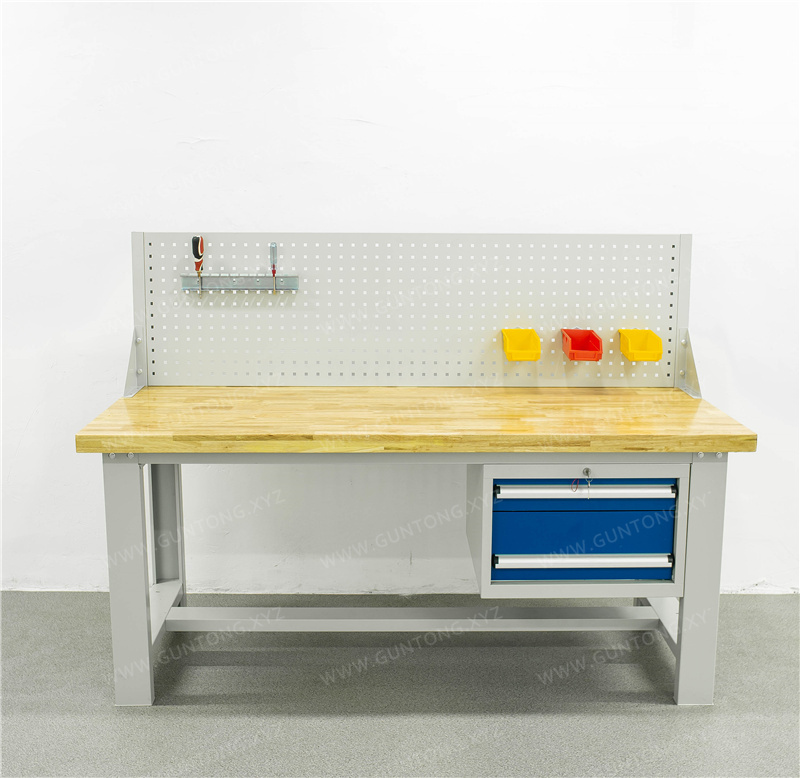
To address these industry-wide pain points, Guang'ErMei Precision Components recently conducted a comprehensive structural inspection and process upgrade for our heavy-duty workbench production line. This manufacturing log documents a recent internal quality improvement and process upgrade initiative at our production facility, focusing specifically on the structural integrity of our Single Back Panel Single Door 4-Drawer Steel Plate Workbench.
1. Upgrading the Composite Desktop Lamination
To eliminate the risk of delamination, we standardized the desktop structure across our heavy-duty series. The upgraded process strictly utilizes a 5mm raw steel plate bonded to a 45mm high-density fiberboard. During the lamination phase, our quality control team inspects the adhesive distribution and pressing pressure to ensure a permanent, void-free bond. This composite structure not only prevents surface separation but also provides the necessary rigidity and impact absorption for rigorous fitter and maintenance tasks.
2. Frame Welding and Load-Bearing Verification
A robust desktop requires an equally robust foundation. Our production log highlights the rigorous inspection of the C-type cold-rolled steel frame. To guarantee a 1000kg total load capacity, we optimized the welding sequence to minimize thermal deformation and residual stress. Post-welding, each frame undergoes a structural inspection to verify dimensional accuracy and joint integrity before proceeding to the surface treatment phase. This ensures the frame remains stable even when the 4-drawer tiered system is fully loaded with heavy tools.
3. Edge Banding and Surface Finishing
Safety and durability extend to the perimeter of the workstation. The manufacturing process now includes a strict inspection of the black PVC edge banding applied to the desktop. This step ensures that the edges are tightly sealed against moisture ingress and remain smooth, preventing operator injuries and protecting the high-density fiberboard core from environmental degradation.
How Facility Planners Can Verify Workbench Quality
When procuring workshop workbenches, buyers should look beyond the surface finish. We recommend the following verification steps to ensure long-term reliability:
- Check the Steel Thickness:*
- Ensure the top steel plate is at least 3mm to 5mm thick for genuine heavy-duty applications. Thinner plates will dent under impact.
- Inspect the Substrate:*
- High-density fiberboard or multi-layer plywood is essential for impact absorption and preventing acoustic resonance during metalworking.
- Review the Frame Profile:*
- C-type or reinforced square tube cold-rolled steel provides superior load distribution compared to standard angle iron.
- Evaluate the Drawer Configuration:*
- Ensure the drawer slides and internal dividers are rated for the specific weight of your tools, maintaining stability even when fully extended.
Conclusion
A reliable steel top workbench is the result of rigorous material selection and disciplined manufacturing processes. By documenting our structural inspections and lamination upgrades in this manufacturing log, Guang'ErMei reaffirms its commitment to delivering durable, high-capacity workstation equipment tailored for electronics, automotive, and hardware mold manufacturing scenarios.