How to choose maintenance and support, double : selection, rollout and support checklist
Maintenance and Support for Double Pegboard Stainless Steel Workbenches: A Diagnostic Workflow for Workshop Operators
Symptom: What Operators Notice First
Workshop teams typically report the following early signs during daily operations:
- Drawers that stick, sag, or fail to close smoothly after repeated loading
- Pegboard hooks that loosen or shift under frequent tool retrieval
- Surface scratches, edge wear, or localized corrosion on stainless or composite tops
- Uneven rolling or brake slippage on mobile tool carts
These symptoms rarely indicate sudden failure. They usually point to load distribution, environmental exposure, or configuration mismatches that can be corrected with structured checks.
Cause: Where the Issue Originates
Load and Structure Mismatch
Heavy-duty workbenches and tool carts are engineered for specific load envelopes. For example, Guang'ErMei's heavy-duty tool cabinets and mobile carts use stamped heavy-duty rails that allow approximately 85% drawer opening, with each drawer rated for up to 80 kg. When operators exceed per-drawer limits or place concentrated weight near the front edge, rail deformation and alignment drift occur over time.
Environmental and Material Exposure
Stainless steel workbenches and composite desktop models behave differently under moisture, coolant, or chemical exposure. Composite desktops are typically optimized for dry assembly and electronics environments, while stainless steel surfaces are selected for corrosion resistance in maintenance, testing, or food-adjacent workshops. Using a composite top in high-moisture zones accelerates edge swelling and fastener loosening.
Mobile vs. Fixed Storage Boundary
Tool carts with 4-inch casters (two fixed, two swivel with brakes) are designed for repositioning within a workstation zone, not for permanent heavy storage. When a cart is used as a fixed cabinet, brake wear and frame fatigue increase. Conversely, placing a fixed tool cabinet in a high-mobility lane creates retrieval inefficiency and safety risks.
Checks: What to Verify Before Escalation
- Load Verification
- Confirm per-drawer and total load ratings against actual tool weight.
- For stamped-rail drawer systems, verify that heavy items are stored in lower drawers and that drawer opening does not exceed the designed 85% travel.
- Pegboard and Hook Integrity
- Inspect square-hole pegboard alignment and hook seating. Standard pegboard panels require periodic tightening if tools are frequently swapped.
- Ensure visual management layouts match 6S standards without overloading single hook points.
- Caster and Brake Function
- Test brake engagement on level and slightly inclined surfaces.
- Check for caster wobble, debris buildup, or uneven floor contact that accelerates wheel wear.
- Surface and Edge Condition
- For composite tops, inspect edge banding for lifting or moisture ingress.
- For stainless tops, verify that cleaning agents are compatible with the surface grade and that abrasive pads are not used.
Resolution: Corrective Actions and Configuration Adjustments
Immediate Fixes
- Redistribute tools to match drawer load ratings; move heavy items to lower compartments.
- Replace worn pegboard hooks with rated alternatives and re-secure mounting points.
- Clean caster tracks, apply manufacturer-approved lubricant, and verify brake pad contact.
Configuration Optimization
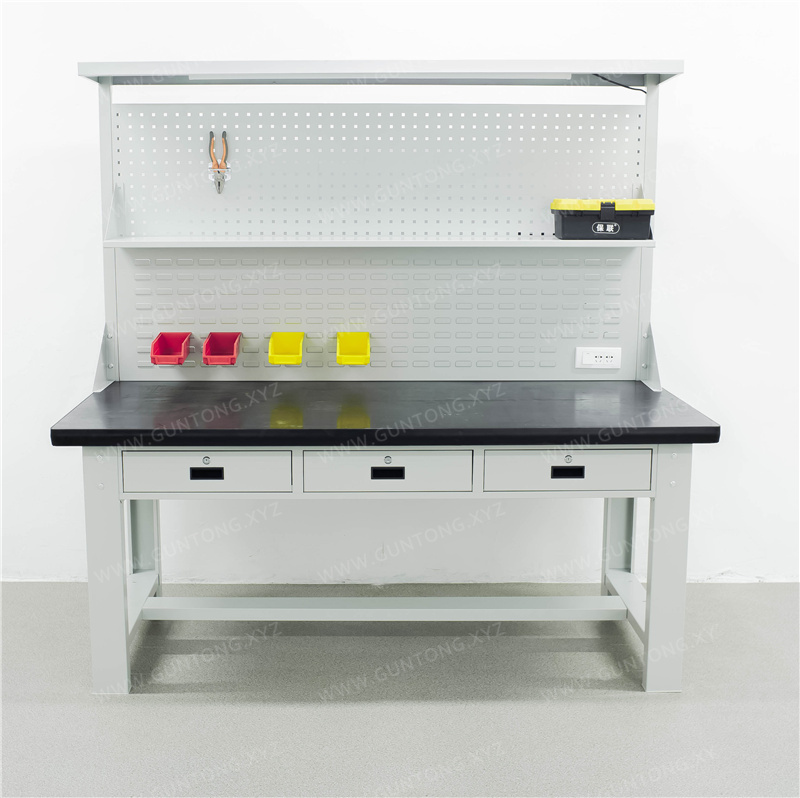
- If a mobile cart is consistently overloaded, transition to a fixed storage solution such as a pegboard storage cabinet
- with adjustable shelves rated at 100 kg per shelf.
- For high-frequency retrieval in electronics or automotive testing, pair a single pegboard workbench with tiered drawer modules and anti-slip pull stops to maintain 6S compliance without overloading the desktop.
When to Escalate
Escalate to Guang'ErMei's engineering team when:
- Load requirements exceed standard catalog ratings.
- Workshop layout changes require integrated workstation planning, load-bearing redesign, or 6S adaptation.
- Non-standard dimensions, material substitutions, or automated storage integration are needed.
Escalation Boundary: What Requires Custom Engineering
Standard workbenches and tool carts cover most routine maintenance scenarios. However, the following conditions require non-standard customization and formal design review:
- Multi-industry layouts combining electronics assembly, hardware mold repair, and warehousing logistics in a single zone.
- Specialized load paths, such as heavy mold racks or automotive parts turnover racks integrated with workstation lines.
- Stainless steel or lean pipe configurations that must meet specific corrosion, cleanroom, or training-center durability standards.
Guang'ErMei's customization process begins with workshop layout drawings, load requirements, and usage scenarios. The engineering team outputs 3D configuration drawings and a detailed bill of materials before production. This ensures that maintenance and support align with the original design intent, rather than relying on field modifications.
Next Steps for Workshop Teams
- Document current load patterns, retrieval frequency, and environmental exposure for each workstation.
- Match equipment type to usage boundary: mobile carts for dynamic tool access, fixed cabinets for heavy or infrequently moved items.
- Submit layout and load data to Guang'ErMei for a configuration review if standard models do not cover your operational envelope.
- Schedule on-site planning or after-sales support for installations requiring 6S adaptation, load verification, or integrated storage systems.
For detailed configuration guidance, load verification, or non-standard workstation planning, contact Guang'ErMei Precision Components with your workshop layout and usage requirements. Our team will provide a structured assessment and configuration options aligned with your operational boundaries.