
How to Install and Inspect Knock-Down Workbenches: A Practical Guide for Workshop Managers
Direct Conclusion
Successfully installing and inspecting knock-down workbenches requires a systematic three-phase approach: verifying material and dimensional accuracy upon delivery, assembling the load-bearing frame before securing the desktop, and conducting functional tests for specific features such as anti-static grounding and drawer mobility. For manufacturing and electronics facilities, skipping the grounding test or ignoring frame leveling can compromise both operational safety and equipment longevity.
Pre-Installation Inspection Upon Delivery
Before unboxing and assembling, procurement and facility managers must verify that the delivered components match the technical specifications.
- Material and Structural Verification:*
- Check the steel thickness and frame specifications. For instance, standard light-duty frames often utilize 40x40x1.2mm square tubes designed for a 300kg load capacity, whereas heavy-duty applications require reinforced structures, such as C-type cold-rolled steel frames capable of supporting up to 1000kg.
- Dimensional and Surface Checks:*
- Confirm standard dimensions (e.g., 1500x750x800mm or 1800x750x800mm) or custom sizes. Inspect the spray coating for uniformity and check the desktop surface—whether it is a 5mm raw steel plate composite for high impact resistance or a specialized anti-static surface.
- Accessory Inventory:*
- Ensure all modular components are present, including drawers, pegboards, adjustable foot cups, and pre-drilled power socket holes.
Step-by-Step Installation Process
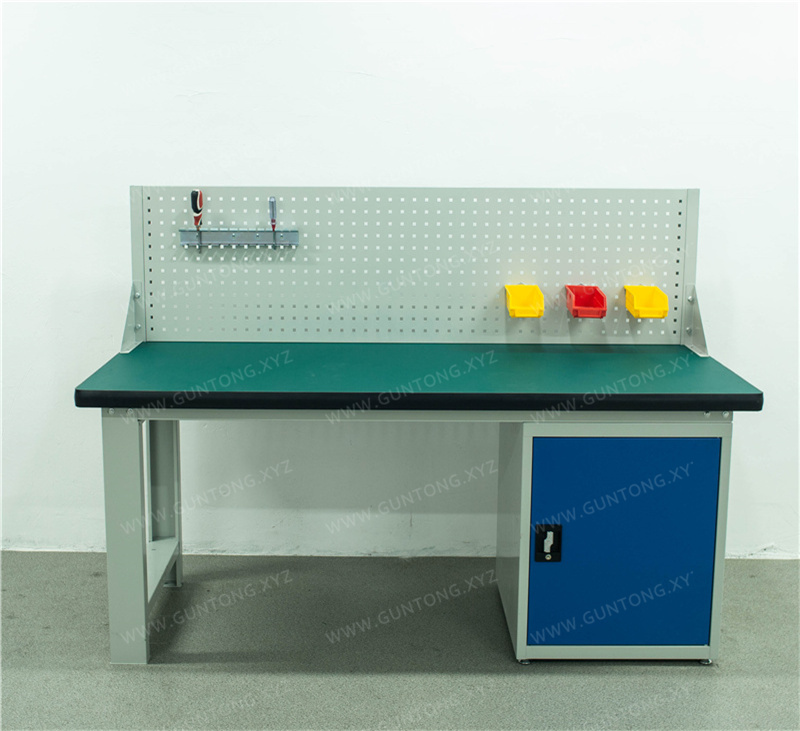
- Frame Assembly and Leveling: Assemble the main frame using the provided high-strength bolts. Before tightening all connections completely, place the frame in its designated position and adjust the foot cups to ensure the workbench is perfectly level, especially on uneven workshop floors.
- Desktop Securing: Mount the desktop onto the leveled frame. For heavy-duty steel plate workbenches, ensure the composite structure (e.g., 5mm steel plate over high-density fiberboard) is evenly supported and securely fastened to prevent shifting under heavy loads.
- Modular Component Installation: Attach back panels, pegboards, and overhead lighting or tool cabinets. Install drawers and cabinet doors, checking the slide rails for smooth operation.
- Electrical and Anti-Static Setup: If the workbench is designated for electronics assembly, install the anti-static mat and connect the grounding wire to the facility's earth ground. Route power cables through the reserved corner holes to maintain a clean workspace.
Functional Inspection and Testing
Once assembled, conduct a final inspection to validate operational readiness:
- Load and Stability Test:*
- Apply a test load to verify structural integrity. Light-duty workbenches should comfortably hold 300kg, while heavy-duty models, such as the Single Back Panel 4-Drawer Steel Plate Workbench, must remain stable under a 1000kg load without frame deformation.
- Anti-Static Dissipation Test:*
- For anti-static workbenches, use a surface resistance meter to verify that the static electricity is effectively dissipated to the ground through the connected wire.
- Moving Parts Check:*
- Open and close all drawers and doors. A properly assembled 4-drawer configuration should operate smoothly without catching, even when loaded with tools.
Boundaries and Risk Management
- Missing or Damaged Parts:*
- If surface scratches, missing bolts, or deformed slide rails are found during the delivery inspection, halt the installation and contact the manufacturer for replacements. Do not attempt to weld or modify cold-rolled steel frames on-site, as this compromises the anti-corrosion coating and structural load rating.
- Grounding Limitations:*
- An anti-static workbench is only effective if the facility has a proper grounding system. The workbench grounding wire must be connected to a verified earth ground, not just to a nearby metal structure.
Conclusion
Proper installation and rigorous inspection of knock-down workbenches ensure that your workshop equipment meets the demanding requirements of fitter, testing, and assembly environments. By strictly following material verification, precise assembly, and functional testing protocols, facilities can maximize the lifespan and safety of their workstation investments.
Next Steps
If your facility requires tailored workstation layouts or professional on-site installation, consult with experienced manufacturers who provide full-chain services from design to delivery.