
Incoming Inspection Protocols for Tool Cabinet Drawer Slide Rails: A Technical Field Guide
The operational reliability of a heavy-duty tool cabinet or workbench is fundamentally limited by its most stressed mechanical component: the drawer slide rail. In demanding manufacturing environments—such as automotive parts repair, hardware mold maintenance, and electronics assembly—drawer failure is not merely an inconvenience; it is a direct safety and productivity hazard.
To guarantee that our workshop storage equipment meets rigorous load-bearing requirements, Guang'ErMei Precision Components enforces strict incoming inspection protocols for all drawer slide rails. This field guide outlines the technical principles, evaluation criteria, and operational boundaries of this quality control process.
Signals: When Strict Incoming Inspection is Critical
Not all storage environments demand the same level of component scrutiny. Rigorous incoming inspection for slide rails is triggered by the following operational signals:
- High Static and Dynamic Loads:*
- Drawers designed to hold dense metal parts, heavy tooling, or molds (e.g., ratings of 80 kg to 100 kg per drawer).
- High-Frequency Retrieval:*
- Environments utilizing strict 6S management where drawers are opened and closed dozens of times per shift.
- Harsh Workshop Conditions:*
- Exposure to metal dust, machining oils, or temperature fluctuations that can degrade inferior lubricants and bearing mechanisms.
Evaluation Criteria: The Inspection Process
The Guang'ErMei incoming inspection for drawer slide rails focuses on verifying mechanical integrity and material compliance before the components enter the assembly line. The core evaluation criteria include:
1. Dimensional and Material Verification
Inspectors measure the thickness of the cold-rolled steel used in the rail profiles. Undersized materials compromise the structural rigidity of the rail, leading to deformation under heavy loads.
2. Smoothness and Clearance Testing
Using standardized testing jigs, quality control personnel evaluate the ball-bearing or roller mechanisms. The focus is on identifying friction anomalies, lateral play, and alignment issues that indicate poor machining tolerances or inadequate lubrication.
3. Load Capacity Validation (Sampling)
A statistical sample from each batch undergoes static and dynamic load testing. For instance, rails destined for our 4-Drawer 1-Door Tool Cart with Pegboard must reliably support the specified 80 kg load capacity per drawer without sagging or binding during extension and retraction cycles.
4. Surface Treatment and Corrosion Resistance
Visual and instrumental checks verify the uniformity of anti-corrosion coatings (such as zinc plating or powder coating). This ensures the rails can withstand typical workshop environments without premature rusting, which would eventually seize the bearing mechanism.
Risks and Applicable Boundaries
Understanding the boundaries of incoming inspection is crucial for facility planners and procurement teams.
Risks of Inadequate Inspection
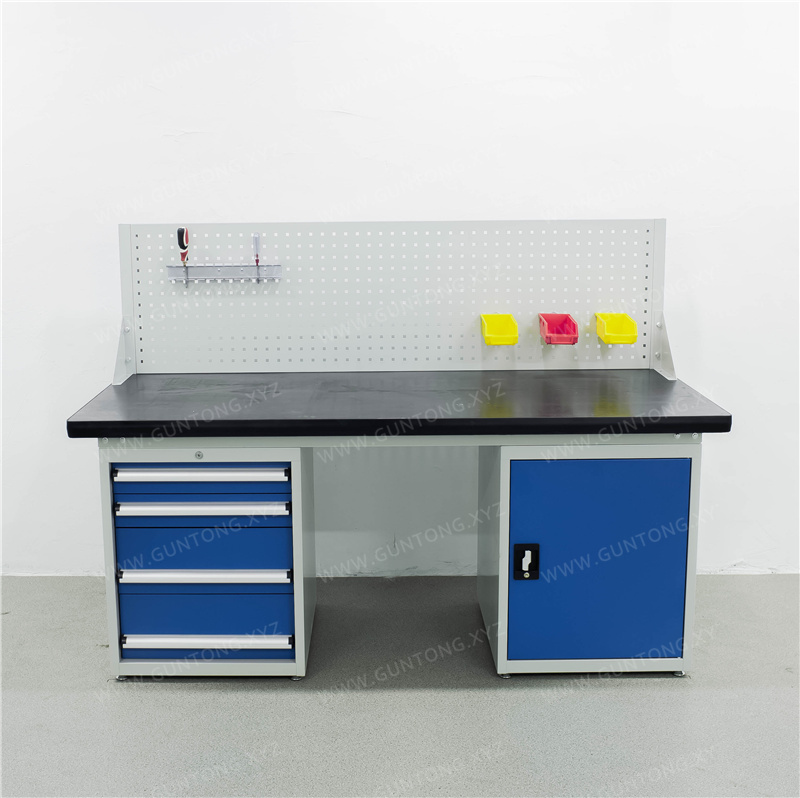
Bypassing or rushing the incoming inspection of slide rails introduces severe risks. In a heavy-duty setup like the Single Back Panel Single Door 4-Drawer Steel Plate Workbench—which features a 5mm raw steel plate composite desktop and a C-type cold-rolled steel frame with a 1000kg total load capacity—substandard rails can lead to drawer detachment, frame distortion, or catastrophic failure when fully extended under load.
Process Boundaries
It is important to note that incoming inspection verifies component quality, but it does not replace system-level validation. The performance of a slide rail is heavily dependent on the structural rigidity of the cabinet body it is mounted to. For example, a high-capacity rail will still fail if mounted to a cabinet body made of insufficiently thick steel. Therefore, component inspection must be paired with the verification of the main body material (such as the 1.0 mm or 1.2 mm cold-rolled steel used in our Pegboard Storage Cabinets) and final assembled product load testing.
Practical Examples in Application
The principles of this inspection process directly translate to the performance of our standardized and customized products:
- 4-Drawer 1-Door Tool Cart with Pegboard:*
- The 4-drawer tiered design requires slide rails that maintain absolute stability even when the 80 kg per drawer limit is reached. The incoming inspection ensures the rails prevent tipping or binding, allowing for safe, one-handed operation on the shop floor.
- Single Back Panel 4-Drawer Steel Plate Workbench:*
- The heavy-duty nature of this workbench means the drawers often store dense calibration tools or metal fixtures. The inspected slide rails ensure that the 4-drawer tiered design operates smoothly, complementing the heavy-duty 1000kg load capacity of the overall workbench frame.
By treating the incoming inspection of drawer slide rails as a critical quality gate, we ensure that our workstation equipment delivers consistent, safe, and long-lasting performance in demanding industrial scenarios.