
How to Clean and Maintain Composite Workbench Tops: A Practical Guide for Workshop Managers
Why Composite Workbench Tops Fail Prematurely in Workshops
Manufacturing managers often notice composite workbench tops degrading within months of deployment: edge banding peels away, the steel surface develops localized rust spots, or the desktop warps under repeated fluid exposure. These failures rarely stem from load capacity issues—a properly engineered composite top with a 5mm raw steel plate over 45mm high-density fiberboard can support up to 1000 kg. Instead, they result from incorrect cleaning agents, neglected edge seals, and unaddressed micro-damage.
For electronics assembly, automotive parts finishing, and hardware mold workshops, where workbenches face daily contact with cutting fluids, solvents, and metal particulates, understanding composite top maintenance is essential to protect both the workstation investment and product quality.
Understanding the Composite Desktop Structure
Before selecting a cleaning protocol, it is important to understand what you are maintaining. Guang'ErMei's steel plate composite workbenches use a three-layer construction:
- Top layer: 5mm raw steel plate, providing impact resistance and heavy-duty load support.
- Core layer: 45mm high-density fiberboard, delivering structural rigidity and vibration dampening.
- Edge protection: Black PVC edge banding, sealing the fiberboard core from moisture ingress.
This structure is designed for heavy-duty applications—fitter workbenches, mold repair stations, and automotive parts assembly—where load capacity reaches 1000 kg. However, the fiberboard core remains vulnerable if moisture penetrates the edge banding or if the steel plate surface is exposed to prolonged chemical contact without proper cleaning.
Common Failure Modes and Their Root Causes
1. Edge Banding Delamination
What happens: The black PVC edge banding lifts or separates from the desktop perimeter, exposing the fiberboard core.
Why it happens: Aggressive solvent-based cleaners (acetone, thinners, undiluted degreasers) degrade the PVC adhesive. High-pressure water spray during workshop washdowns forces moisture behind the seal.
Corrective action: Switch to pH-neutral industrial cleaners diluted per manufacturer instructions. Use damp microfiber cloths rather than spray-and-rinse methods. Inspect edge banding weekly; re-adhere early-stage lifting with industrial PVC contact adhesive before moisture reaches the core.
2. Localized Surface Corrosion
What happens: Small rust spots appear on the steel plate, particularly near edges or where cutting fluid pools.
Why it happens: Raw steel plate, while highly durable, is not stainless. When metalworking fluids, saline residues, or acidic cleaning agents remain on the surface for extended periods, oxidation begins at micro-scratches.
Corrective action: Wipe the steel surface dry after any fluid contact. For existing rust spots, use a fine-grade steel wool pad with light machine oil, then apply a thin protective oil film. Do not use wire wheels or abrasive discs, which create deeper scratches that accelerate future corrosion.
3. Fiberboard Core Swelling
What happens: The desktop surface develops a visible bulge or soft spot, typically near the edges or around drilled holes for power outlets.
Why it happens: Moisture has penetrated through damaged edge banding or unsealed cutouts, causing the high-density fiberboard to absorb water and expand.
Corrective action: Once core swelling occurs, the affected section cannot be fully restored. Prevention is the only reliable strategy: ensure all drilled holes (for power sockets, cable grommets, or grounding points on anti-static workbenches) are sealed with silicone or rubber gaskets. Replace severely swollen tops to maintain a level working surface and prevent workpiece damage.
Daily and Weekly Maintenance Protocol
Daily Cleaning (End of Shift)
- Remove all tools, workpieces, and debris from the desktop.
- Wipe the steel plate surface with a dry or slightly damp lint-free cloth to remove metal dust and particulates.
- If cutting fluid or oil is present, use a cloth dampened with diluted pH-neutral degreaser, then wipe dry immediately.
- Check the PVC edge banding for any signs of lifting or damage.
Weekly Inspection
- Inspect the full perimeter of edge banding; press firmly along the seal to detect early adhesion loss.
- Examine the steel surface for rust spots, particularly in corners and near fluid drainage paths.
- Verify that all drilled cutouts (power holes, grounding points) remain properly sealed.
- For anti-static workstation configurations, test the grounding connection point to ensure the static-dissipative mat or surface remains properly bonded to earth.
Monthly Deep Clean
- Clear the workbench completely, including drawers and under-shelf areas.
- Clean the steel surface with a mild industrial detergent solution, applied with a soft cloth—not sprayed directly.
- Dry thoroughly and apply a light coat of protective machine oil to the steel plate if the workstation is in a high-humidity environment.
- Tighten all frame bolts and check the C-type cold-rolled steel frame connections to ensure the 1000 kg load capacity rating is maintained structurally.
Chemical Exposure Boundaries: What to Avoid
| Cleaning Agent | Effect on Composite Top | Recommendation |
|---|---|---|
| pH-neutral industrial degreaser | Safe for steel plate and PVC edge | Use diluted, wipe dry |
| Acetone / paint thinner | Dissolves PVC edge banding adhesive | Avoid completely |
| Hydrochloric acid / muriatic acid | Corrodes steel plate rapidly | Never use |
| Isopropyl alcohol (70%+) | Safe for occasional spot cleaning | Use sparingly, wipe dry |
| High-pressure water spray | Forces moisture past edge seals | Avoid; use damp cloth only |
| Abrasive scouring pads | Scratches steel surface, traps moisture | Use fine steel wool only for rust removal |
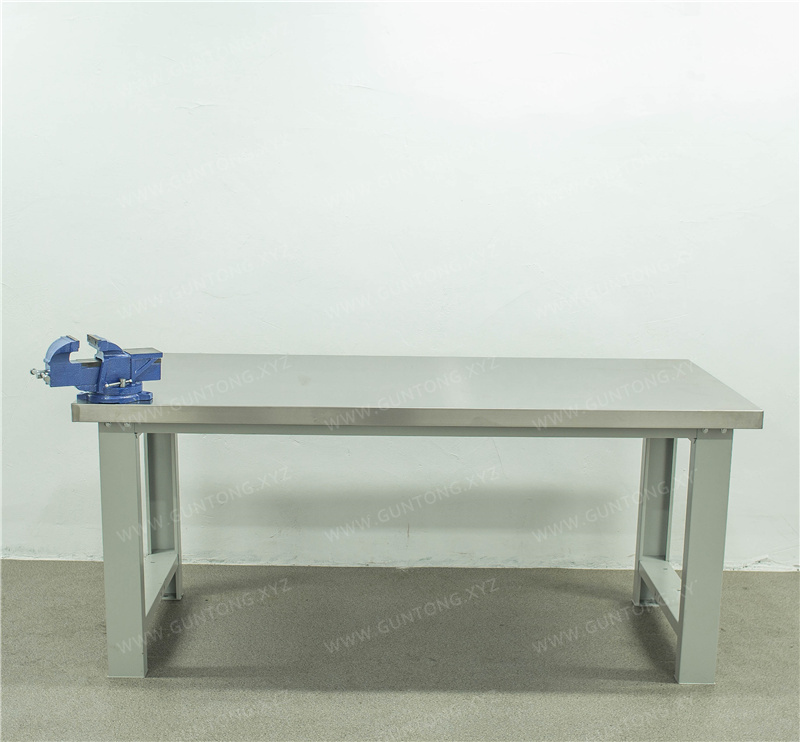
For workshops handling aggressive chemicals—such as automotive parts cleaning stations or hardware mold maintenance areas—consider specifying a stainless steel workbench top instead of composite. Stainless steel surfaces offer superior corrosion resistance where chemical exposure is continuous rather than incidental.
When to Repair vs. Replace the Composite Top
Repair is viable when:
- Edge banding lifting is localized (under 10% of perimeter) and the fiberboard core remains dry.
- Surface rust is superficial and limited to small areas.
- The desktop remains structurally flat with no visible warping.
Replacement is necessary when:
- Fiberboard core swelling has created surface irregularities exceeding 2mm.
- Edge banding failure exceeds 25% of the perimeter, indicating systemic adhesive degradation.
- The steel plate has developed through-corrosion (perforation), compromising load-bearing integrity.
Guang'ErMei supports both replacement top supply and full workbench reconfiguration. For workshops running standardized workstation layouts, replacement tops can be ordered in common dimensions (1500×750mm, 1800×750mm, 2100×750mm) to minimize downtime.
Selection Consideration: Matching Desktop Material to Your Workshop Environment
Composite steel-plate tops deliver excellent load capacity and impact resistance for heavy-duty mechanical work—fitter benches, mold assembly, and automotive component handling. However, if your workshop involves:
- Continuous chemical or solvent exposure: Specify stainless steel workbench tops for corrosion resistance.
- Electrostatic-sensitive assembly (electronics manufacturing): Configure anti-static workbench tops with grounded static-dissipative surfaces and proper earth connections.
- Food-grade or cleanroom environments: Stainless steel with sealed joints is the appropriate choice.
The workbench frame—typically C-type cold-rolled steel rated for 300 kg (light-duty) to 1000 kg (heavy-duty)—remains compatible across all desktop material options, allowing you to upgrade the top surface without replacing the entire workstation.
Next Steps
If your workshop workbenches are showing edge banding failure, surface corrosion, or core swelling, the issue is likely correctable through adjusted maintenance protocols or targeted component replacement. For a workstation assessment or to discuss composite top replacement options for your specific manufacturing environment, contact Guang'ErMei's technical team with your current workbench dimensions and application details.