
Guang'ErMei Workbench New Configuration Release: Upgraded Steel Plate Desktops and Drawer Layouts for Heavy-Duty Worksho
Manufacturing enterprises, hardware mold factories, and automotive parts producers require workbenches that withstand continuous heavy loads while keeping tools organized and accessible. The latest configuration release from Guang'ErMei Precision Components addresses these demands through specific structural and functional upgrades to the Single Back Panel 4-Drawer Steel Plate Workbench.
This field guide outlines the signals that indicate a need for this configuration, the evaluation criteria for workshop planners, practical application examples, and the boundaries of this setup.
Signals That Your Workshop Needs a Configuration Upgrade
Before specifying a new workbench, facility managers and procurement teams should identify operational signals that current stations are underperforming:
- Desktop deformation or surface wear: Standard wooden or thin-laminate tops degrade under heavy vise clamping, impact from metal parts, or constant abrasion from hardware components.
- Insufficient tool organization: Operators spending excessive time searching for tools across open shelves or cluttered surfaces indicate a need for tiered, categorized drawer storage.
- Frame instability under load: Wobbling or deflection when placing heavy molds, automotive assemblies, or testing equipment on the bench signals that the load-bearing frame is inadequate.
- 6S management non-compliance: Disorganized workstations that fail visual management audits require integrated storage solutions that keep tools behind closed panels or within labeled drawers.
Evaluation Criteria for the New Configuration
When assessing the upgraded Single Back Panel 4-Drawer Steel Plate Workbench, decision-makers should verify the following technical and functional parameters:
Desktop Structure and Load Capacity
The new configuration features a composite desktop structure combining a 5mm raw steel plate with 45mm high-density fiberboard, finished with black PVC edge banding. This dual-layer approach provides:
- High impact resistance for metalworking and assembly tasks
- A flat, stable surface that resists warping under sustained loads
- Edge protection that prevents chipping and extends service life
The total load capacity reaches 1000kg, supported by a C-type cold-rolled steel frame. This specification suits scenarios involving heavy vise operations, mold inspection, and automotive component assembly.
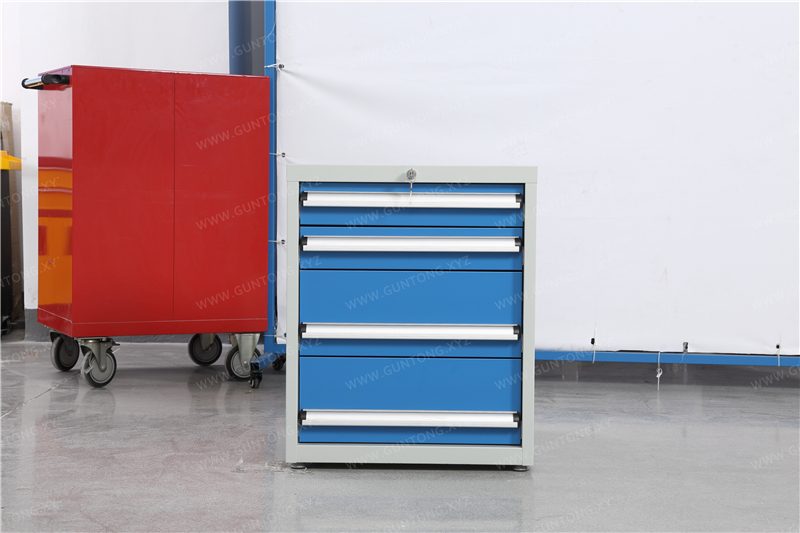
Drawer Configuration and Tool Management
The 4-drawer tiered design allows workshop planners to organize tools by category, frequency of use, or operator assignment. Key considerations include:
- Drawer height variation: Different drawer heights accommodate hand tools, measuring instruments, and small parts bins
- Load per drawer: Verify that each drawer supports the weight of your heaviest tool sets without slide rail deflection
- Single back panel with single door: This configuration provides enclosed storage for sensitive instruments or consumables that require dust protection
Dimensional Options and Workshop Layout
The upgraded workbench is available in three standard lengths:
| Dimension (L×W×H mm) | Suitable Scenario |
|---|---|
| 1500×750×800+500 | Compact assembly cells, electronics testing stations |
| 1800×750×800+500 | Standard machining and fitting operations |
| 2100×750×800+500 | Multi-operator stations, large component inspection |
The 800mm working height plus 500mm back panel height provides ergonomic reach while supporting overhead tool boards or lighting fixtures.
Practical Application Examples
Automotive Parts Manufacturing
In automotive component workshops, operators handle heavy brake calipers, suspension parts, and transmission assemblies. The 5mm steel plate desktop resists impact from dropped components, while the 1000kg frame capacity supports multiple parts staged for batch assembly. The 4-drawer layout separates torque wrenches, gauges, and fasteners by operation step.
Hardware Mold Factories
Mold maintenance technicians require stable surfaces for disassembly, cleaning, and reassembly. The composite desktop provides the rigidity needed for pressing operations, while enclosed storage behind the single door protects precision measuring tools from shop-floor dust and coolant mist.
Maintenance and Testing Institutions
Testing labs and maintenance facilities benefit from the back panel configuration, which supports pegboard-mounted instrument holders and cable management. The drawer system keeps calibration tools separated from general maintenance equipment, supporting traceability and 6S compliance.
Boundaries and Risk Considerations
While this configuration addresses heavy-duty requirements, planners should recognize its boundaries:
- Not suitable for ESD-sensitive environments: The raw steel plate desktop is conductive. Electronics manufacturers requiring electrostatic discharge protection should specify anti-static workbench configurations with grounded surfaces and wrist-strap connection points.
- Stainless steel alternative for corrosive environments: Food processing, chemical handling, or cleanroom applications require stainless steel workbenches rather than carbon steel with PVC edge banding.
- Non-standard customization may be required: If your workshop layout demands unusual dimensions, integrated power rails, or specialized drawer dividers, Guang'ErMei supports non-standard customization beyond these standard configurations.
Next Steps for Workshop Planners
- Audit current workstation pain points: Document desktop wear, tool search time, and load-related frame issues across your existing benches.
- Match configuration to scenario: Use the dimensional guide above to select the appropriate length for your primary operations.
- Verify load requirements: Confirm that 1000kg total capacity and the specified drawer loads meet your heaviest anticipated use case.
- Request site planning support: Guang'ErMei provides on-site workstation planning, load-bearing design validation, and 6S adaptation consulting for manufacturing customers in Huizhou, Guangdong Province, and nationwide.
For detailed specifications or to discuss non-standard customization requirements, contact Guang'ErMei Precision Components to schedule a workstation assessment.