Guang'ErMei Workbench Manufacturing Process Improvement Log: Correcting Desktop Delamination and Frame Deflection
Guang'ErMei Workbench Manufacturing Process Improvement Log: Correcting Desktop Delamination and Frame Deflection
The Common Failure: Desktop Delamination and Frame Deflection
In demanding manufacturing environments—such as hardware mold factories, automotive parts maintenance, and heavy equipment assembly—workstation equipment faces extreme physical stress. A frequent failure observed in standard workshop workbenches is desktop delamination, where the top steel layer separates from the core board under repetitive impact. Additionally, long-term heavy loading can cause slight frame deflection, compromising the precision required for fitter workbenches and leading to drawer jamming in integrated tool cabinets.
Why These Failures Happen
These issues typically stem from two manufacturing bottlenecks:
- Inadequate Composite Bonding: Traditional adhesive-only bonding for composite desktops fails to withstand the shear forces generated by heavy mold repairs or hammering.
- Residual Welding Stress: When C-type cold-rolled steel frames are welded without proper stress relief, the residual stress gradually releases under heavy loads, causing micro-deformations that misalign drawers and pegboards.
Corrective Actions: Guang'ErMei Process Upgrades
To address these operational boundaries, Guang'ErMei Precision Components has implemented targeted process improvements and quality upgrades in our manufacturing lines for heavy-duty workbenches and storage cabinets. This improvement log details the technical adjustments and validation processes now applied to our standardized and non-standard customized equipment.
1. Upgraded Desktop Composite Pressing Process
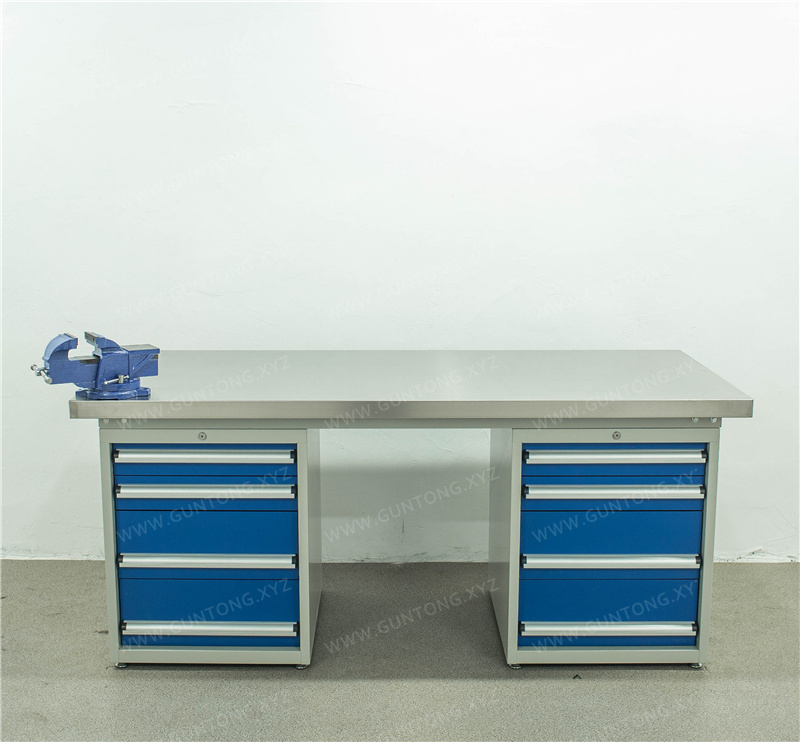
For our Single Back Panel Single Door 4-Drawer Steel Plate Workbench, we have upgraded the desktop manufacturing process. The desktop features a composite structure of a 5mm raw steel plate and a 45mm high-density fiberboard.
- Process Adjustment:*
- Instead of relying solely on standard industrial adhesives, we introduced a multi-point mechanical pressing process combined with reinforced edge sealing using black PVC edge banding.
- Validation:*
- This ensures the 5mm steel plate remains permanently bonded to the fiberboard, effectively eliminating delamination risks even under high-impact mold maintenance scenarios.
2. Frame Welding and Stress Relief Optimization
To prevent frame deflection in heavy-duty stations, the welding process for the C-type cold-rolled steel frames has been revised.
- Process Adjustment:*
- We implemented a standardized stress-relief protocol post-welding. This stabilizes the structural integrity of the frame before the final powder-coating stage.
- Validation:*
- The upgraded frame reliably supports a 1000kg total load capacity without micro-deformation, ensuring that integrated components—like the 4-drawer tiered design and square-hole pegboards—remain perfectly aligned during heavy use.
3. Dynamic Load Testing for Moving Components
Workbenches are often paired with mobile or modular storage, such as the 4-Drawer 1-Door Tool Cart with Pegboard and the Inner Half-Pegboard Storage Cabinet.
- Process Adjustment:*
- We upgraded our quality control from static load testing to dynamic load validation. Drawers configured for an 80 kg load capacity and adjustable shelves rated for 100 kg are now tested under simulated full-load movement and vibration.
- Validation:*
- This ensures the stamped drawer slides and shelf brackets maintain structural stability and smooth operation in active warehousing and logistics environments, preventing rail detachment or shelf bowing.
Applicable Boundaries and Implementation Notes
These process improvements specifically target heavy-duty and high-impact scenarios.
- Best Suited For:*
- Hardware mold factories, automotive parts manufacturers, and maintenance or testing institutions requiring high load-bearing capacity and impact resistance.
- Limitations:*
- For specialized environments requiring strict ESD (Electrostatic Discharge) compliance or cleanroom standards, alternative desktop materials should be specified during the non-standard customization phase, as the 5mm raw steel plate is optimized for mechanical durability rather than ESD dissipation.
Next Steps for Facility Planners
When planning a workshop upgrade or implementing 6S management, selecting the right workstation equipment requires matching the physical demands of the task with the manufacturing quality of the furniture.
If your facility experiences frequent desktop wear, frame misalignment, or drawer jamming, it is time to evaluate your current equipment's load-bearing design and composite structure. Contact Guang'ErMei Precision Components to discuss your specific on-site workstation planning needs. Our engineering team can provide customized load-bearing designs and recommend the optimal configuration of workbenches, tool cabinets, and automated storage accessories for your production line.