
Guang'ErMei Workbench After-Sales Follow-Up Log: What We Check After Delivery
Why Post-Delivery Follow-Up Matters for Workshop Workbenches
For manufacturing enterprises, electronics factories, and automotive parts workshops, a workbench is not just furniture—it is a load-bearing production asset. After delivery and installation, real-world usage often reveals issues that factory testing cannot fully simulate: uneven floor contact, drawer alignment shifts under load, or desktop surface wear from specific workpiece types. Guang'ErMei Precision Components maintains a structured after-sales follow-up log to track these conditions and ensure long-term workstation reliability.
This article shares the core inspection items, common field observations, and actionable maintenance guidance drawn from our post-delivery service records for steel plate workbenches, tool cabinets, and tool carts.
Core Inspection Items in the After-Sales Follow-Up Log
1. Frame Stability and Floor Contact
The C-type cold-rolled steel frame used in our heavy-duty workbenches—such as the Single Back Panel 4-Drawer Steel Plate Workbench—is rated for a total load capacity of 1000 kg. During follow-up visits, our service team first checks:
- Leveling foot adjustment: Whether all four feet maintain full contact with the workshop floor, especially on epoxy-coated or slightly uneven concrete surfaces.
- Frame bolt torque: Confirming that connection bolts at the leg-to-beam joints remain tight after the initial 30-day load cycle.
- Lateral stability: Applying moderate side force to verify no frame racking or wobble under operational conditions.
If floor unevenness exceeds 5 mm across the workbench footprint, we recommend shimming or adjustable leveling feet with extended thread range.
2. Desktop Surface Condition
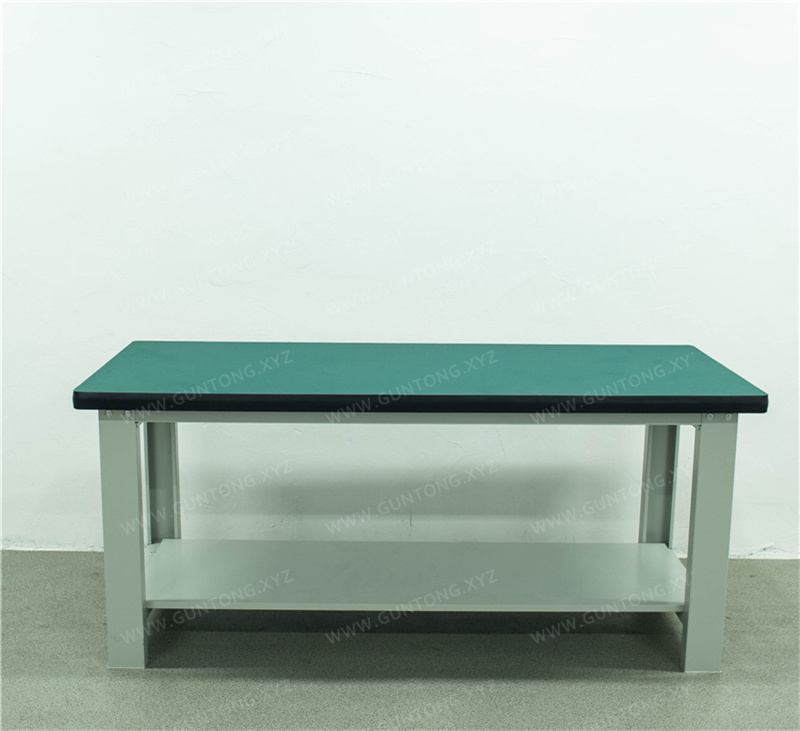
Our composite desktop structure—5 mm raw steel plate bonded to 45 mm high-density fiberboard with black PVC edge banding—is designed for high-load machining and assembly tasks. Post-delivery checks focus on:
- Edge banding adhesion: Ensuring the PVC edge has not lifted due to impact or chemical exposure (e.g., cutting fluids or solvents).
- Surface flatness: Verifying no localized deformation under concentrated loads, such as heavy dies or fixture clamping.
- Wear pattern assessment: Documenting whether surface scratches or dents affect workpiece quality, particularly in electronics assembly or precision fitting scenarios.
3. Drawer and Door Operation
For configurations like the 4-Drawer 1-Door Tool Cart with Pegboard or the Inner Half-Pegboard Storage Cabinet, drawer performance is critical for daily 6S management. Our follow-up log records:
- Drawer slide smoothness: Each drawer (rated at 80 kg load capacity) should extend and retract without binding, even when fully loaded with hand tools or small parts.
- Drawer alignment: Checking that drawer faces remain flush and square to the cabinet body after repeated use.
- Door hinge tension: Confirming that cabinet doors close securely and do not sag, particularly on taller units like the 1800 mm Pegboard Storage Cabinet.
4. Pegboard and Accessory Mounting
The 500 mm standard square-hole pegboard—featured on both our tool carts and storage cabinets—requires periodic verification:
- Hook retention: Ensuring tool hooks remain seated in square holes without loosening from vibration or frequent tool removal.
- Pegboard panel flatness: Confirming the board has not warped due to humidity or uneven loading.
- Expansion accessory compatibility: Verifying that additional shelves, bins, or holders added after initial delivery still align with the hole pattern.
Common Field Observations and Service Conditions
Based on our follow-up records across electronics, automotive, and hardware mold workshops, the following patterns frequently appear:
| Observation | Typical Cause | Recommended Action |
|---|---|---|
| Minor drawer binding after 2–3 months | Uneven tool loading exceeding single-drawer capacity | Redistribute tools; verify load per drawer stays within 80 kg |
| Leveling foot loosening | Workshop floor vibration from nearby stamping presses | Apply thread-locking compound; schedule quarterly re-torque |
| Edge banding lift at desktop corners | Impact from heavy workpiece placement | Replace edge banding section; add corner guards if recurring |
| Pegboard hook slippage | Use of non-standard hooks not matching square-hole pitch | Replace with matched square-hole hooks; avoid round-peg adapters |
These observations are documented in the Guang'ErMei workbench after-sales follow-up log and shared with the customer's facility management team for preventive maintenance planning.
Service Boundaries and Warranty Conditions
Our after-sales support covers structural defects, hardware failures, and installation-related issues under normal industrial use. The following conditions fall outside standard service scope:
- Overload damage: Desktop deformation or frame bending caused by loads exceeding the rated capacity (e.g., placing a 1200 kg die on a 1000 kg-rated bench).
- Chemical corrosion: Surface degradation from unapproved solvents, acids, or prolonged exposure to cutting fluids without protective mats.
- Unauthorized modifications: Welding, drilling, or structural alterations performed without Guang'ErMei engineering approval.
- Environmental factors: Rust or corrosion in high-humidity environments where stainless steel or galvanized options were not specified at the time of order.
For non-standard customization projects—including automotive parts turnover racks and lean pipe workstation configurations—after-sales terms are defined in the project delivery agreement and may include extended on-site inspection schedules.
Actionable Maintenance Checklist for Workshop Teams
To extend workbench service life between scheduled follow-ups, we recommend workshop teams perform these monthly checks:
- Visual inspection: Look for loose bolts, lifted edge banding, or drawer misalignment.
- Load verification: Confirm no single drawer or shelf exceeds its rated capacity.
- Clean sliding rails: Wipe drawer slides with a dry cloth; apply light machine oil if operation feels stiff.
- Pegboard audit: Remove and reseat any loose hooks; replace damaged ones immediately.
- Leveling check: Place a spirit level on the desktop; adjust feet if deviation exceeds 2 mm over 1 meter.
Next Steps: Request a Follow-Up Inspection
If your workshop has Guang'ErMei workbenches, tool cabinets, or tool carts that have not received a post-delivery inspection within the past six months, contact our service team to schedule an on-site follow-up. We will review your current workstation conditions, update the after-sales follow-up log, and provide a written maintenance recommendation report.
For new workstation planning—including on-site layout, load-bearing design, and 6S adaptation—our engineering team supports full-process consultation from initial design through installation and after-sales service.