
Assembly Record on the Guang'ErMei Storage Cabinet Manufacturing Floor: Shelf and Pegboard Integration
Assembly Record on the Guang'ErMei Storage Cabinet Manufacturing Floor: Shelf and Pegboard Integration
When procuring industrial storage equipment, facility planners often ask: How can we ensure that a heavy-duty storage cabinet maintains both high load-bearing capacity and precise visual management alignment after years of use? The answer lies in the assembly protocols executed on the manufacturing floor. This article documents a recent assembly record from the Guang'ErMei storage cabinet manufacturing floor, focusing on the integration of adjustable shelves and inner pegboards, to help buyers understand the structural trade-offs involved.
Comparing Cabinet Assembly Options by Constraints
Designing a tool storage cabinet for a manufacturing environment requires balancing rigidity with operational flexibility. Buyers typically face two primary constraints: load capacity and tool retrieval efficiency.
Frame Construction: Welded vs. Bolted
- Fully Welded Frames:*
- Offer maximum torsional rigidity but limit flat-pack shipping efficiency and make on-site modifications difficult.
- Bolted and Modular Frames:*
- Improve logistics and allow for on-site adjustments but require strict torque control during assembly to prevent wobbling under heavy loads.
On the Guang'ErMei manufacturing floor, the standard approach for heavy-duty units utilizes precision-stamped cold-rolled steel components with reinforced bolted connections at critical stress points, ensuring stability without sacrificing modularity.
Interior Layout: Fixed Shelves vs. Adjustable Pegboard Systems
- Fixed Shelves:*
- Provide superior load distribution for uniformly heavy items but waste vertical space for smaller tools.
- Adjustable Shelves with Pegboards:*
- Maximize space utilization and support 6S visual management. However, integrating a pegboard inside a cabinet introduces constraints regarding door clearance and shelf depth.
Trade-Offs in Shelf and Pegboard Integration
Integrating a pegboard into a storage cabinet involves specific trade-offs. Adding a full-height internal pegboard reduces the usable depth of the shelves. To resolve this, Guang'ErMei engineers utilize an inner half-pegboard structure. This design places the pegboard on the upper interior section and the cabinet doors, preserving the full depth of the lower adjustable shelves for bulkier items while maintaining visual tool management at eye level.
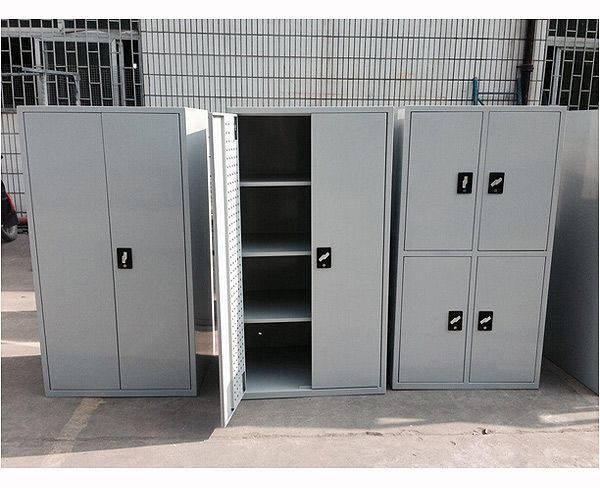
Assembly Record: Inner Half-Pegboard Storage Cabinet
The following record outlines the assembly and quality verification process for the Pegboard Storage Cabinet (Inner Half-Pegboard Type) on the Guang'ErMei storage cabinet manufacturing floor. This documentation aligns with our internal quality improvement and factory activity tracking protocols.
1. Material Verification and Frame Assembly
The assembly begins with verifying the main body material, which utilizes 1.0 mm or 1.2 mm cold-rolled steel. The cabinet dimensions are set to the standard 1000 x 500 x 1800 mm. Floor technicians ensure that the side panels are perfectly square before securing the top and bottom crossbeams. This step is critical; any deviation here will cause the doors to misalign, rendering the door-mounted pegboards unusable.
2. Shelf Installation and Load Testing
The cabinet is configured with 3 adjustable shelves. During assembly, the shelf clips are seated into the standardized column holes. Each shelf is rated for a 100 kg load capacity. On the manufacturing floor, a sample batch undergoes static load testing to verify that the shelf brackets do not deform under the maximum specified weight.
3. Pegboard Alignment and Door Mounting
The final and most meticulous step is mounting the square-hole pegboards. The inner half-pegboard is secured to the upper back panel, while dual pegboards are mounted on the interior of the cabinet doors. Technicians use specialized jigs to ensure the square holes align perfectly across the panels. This guarantees that standard hooks and tool holders can be inserted smoothly without bending, a common issue in poorly assembled cabinets.
Implementation Boundaries and Risks
While the inner half-pegboard design optimizes space, buyers must observe specific operational boundaries:
- Load Distribution:*
- The 100 kg shelf capacity assumes an evenly distributed load. Concentrating heavy mold components on one side of the shelf can compromise the bracket integrity.
- Pegboard Hook Selection:*
- Only hooks designed for the specific square-hole pitch should be used. Forcing mismatched hooks can deform the cold-rolled steel pegboard surface.
- Door Weight Limits:*
- Overloading the door-mounted pegboards with excessively heavy tools can strain the hinges, affecting the cabinet's long-term alignment.
Next Steps for Facility Planners
Understanding how equipment is assembled on the manufacturing floor provides clarity on its long-term performance. If your facility requires standardized 6S management storage or customized workstation solutions, evaluating the structural design and assembly rigor is just as important as reviewing the final specifications.
For detailed dimensional drawings or to discuss non-standard customization for your specific workshop layout, please contact the Guang'ErMei technical team.