
Onboarding New Production Staff: Guang'ErMei's Manufacturing Process Training for Workbench Equipment
Onboarding New Production Staff: Guang'ErMei's Manufacturing Process Training for Workbench Equipment
Effective manufacturing process training for new employees ensures that every workbench and tool cabinet meets strict load-bearing and dimensional tolerances. At Huizhou Guang'ErMei Precision Components Co., Ltd., factory dynamics—including actual training, quality improvement, process upgrades, and safety activities—form the core of the onboarding protocol. This article outlines the standard step-by-step implementation path used to train new production staff in manufacturing workshop workstation equipment.
Step 1: Safety Protocols and Material Identification
Checkpoint: Trainees must correctly identify material grades and thicknesses before operating machinery.
New employees begin with workshop safety and raw material familiarization. For instance, when producing the Single Back Panel 4-Drawer Steel Plate Workbench, trainees learn to distinguish the 5mm raw steel plate used for the composite desktop from the 1.0mm or 1.2mm cold-rolled steel used in storage cabinets. Understanding these material differences is critical for maintaining the structural integrity of heavy-duty equipment.
Exception Handling: If a non-standard customization order requires alternative materials or unique load-bearing designs, trainees are taught to halt the process and consult the engineering team rather than substituting materials independently.
Next Action: Trainees must pass a material identification quiz and a basic safety certification before moving to the fabrication floor.
Step 2: Frame Fabrication and Welding Precision
Checkpoint: Verifying the structural integrity of C-type cold-rolled steel frames.
The core of heavy-duty workstation equipment lies in its frame. Trainees practice welding and assembling C-type cold-rolled steel frames designed to support up to a 1000kg total load capacity. They also learn to fabricate and punch the 500mm standard square-hole pegboards used in tool carts and inner half-pegboard storage cabinets. Precision in this stage prevents structural wobbling and ensures long-term durability in demanding manufacturing environments.
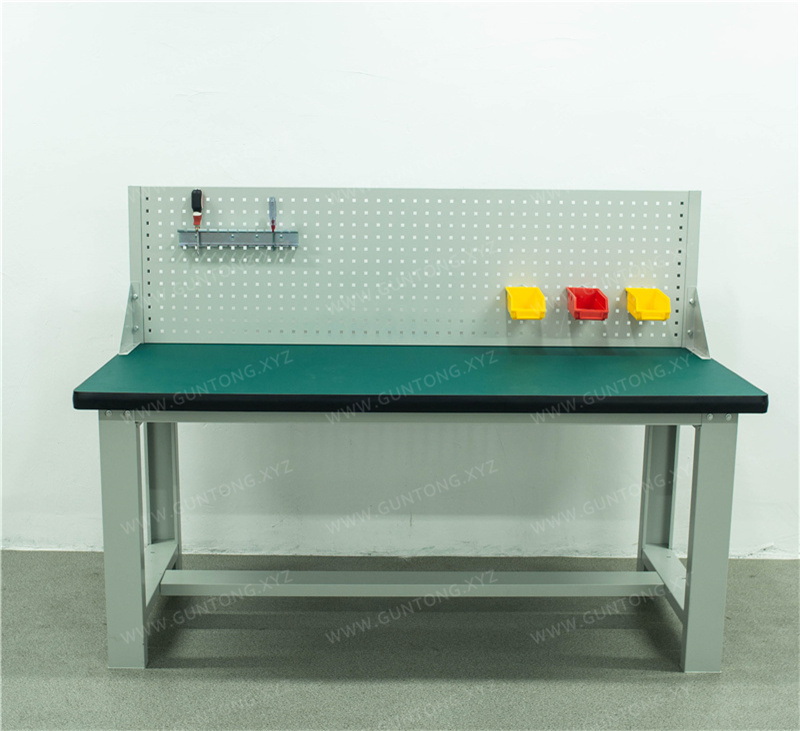
Exception Handling: When dealing with automated storage and retrieval system accessories or non-standard mold racks, trainees follow specialized assembly blueprints provided by the technical department, as standard jig setups may not apply.
Next Action: Trainees must pass a practical welding test on scrap steel, which is then stress-tested, before proceeding to actual product frames.
Step 3: Component Assembly and Drawer Alignment
Checkpoint: Ensuring smooth operation of tiered drawer systems under load.
Assembling multi-drawer configurations, such as the 4-drawer tiered design in tool carts, requires precise alignment. Trainees are instructed on installing stamped drawer slides and verifying that each drawer maintains its 80kg load capacity without jamming. They also learn to integrate dual pegboard layouts on cabinet doors to improve retrieval efficiency for end-users.
Exception Handling: If drawer slides exhibit friction during the initial load test, trainees are required to disassemble and recalibrate the mounting brackets rather than forcing the mechanism.
Next Action: Complete a full assembly of a standard 4-Drawer 1-Door Tool Cart with Pegboard under the supervision of a senior technician.
Step 4: Surface Treatment and Final Quality Inspection
Checkpoint: Checking edge banding and surface coating uniformity.
The final production phase involves surface treatment and desktop finishing. For steel plate workbenches, trainees learn to apply the black PVC edge banding to the 45mm high-density fiberboard base. Quality inspectors then verify the overall dimensions and load-bearing stability. Furthermore, aligning with our documentation standards, any specific production metrics or project delivery details introduced during advanced training modules must be manually verified and confirmed before public release.
Exception Handling: Any surface scratches or uneven coating discovered during the final inspection must be routed back to the polishing and spraying station immediately.
Next Action: Only products that pass the final 6S adaptation and quality checks are cleared for the packaging and delivery stage.
Conclusion and Next Steps
Guang'ErMei's manufacturing process training for new employees provides a rigorous framework that transforms novices into skilled technicians. By enforcing strict checkpoints and clear exception-handling protocols, the company maintains high standards for both standardized products and non-standard customization. Facility planners and procurement managers can trust that the equipment delivered to their manufacturing, automotive, or warehousing sites is built by a thoroughly trained workforce.
Reviewing detailed product specifications or consulting with the engineering team is the recommended next step for buyers evaluating workstation equipment suppliers.