
Floor Cabinet vs. Overhead Cabinet Workbenches: A Practical Selection Guide for Workshop Planners
Who Needs This Comparison
Workshop planners in electronics assembly, automotive parts manufacturing, hardware mold factories, and maintenance testing facilities face a recurring decision: should workstations use floor-mounted cabinets, overhead (suspended) cabinets, or a combination of both? The answer directly impacts operator efficiency, floor space utilization, and long-term 6S management compliance.
This comparison addresses real procurement scenarios where buyers must specify workbench configurations for new production lines or facility upgrades.
Core Differences at a Glance
| Factor | Floor Cabinet Workbench | Overhead Cabinet Workbench |
|---|---|---|
| Typical Load Capacity | 300–1000 kg per cabinet section | Limited by mounting structure; generally lighter storage |
| Best For | Heavy tools, bulk materials, frequent retrieval | Light tools, visual management, space-constrained layouts |
| Floor Space Impact | Occupies under-bench area | Frees under-bench space for legroom or equipment |
| Ergonomic Profile | Requires bending or crouching for access | Keeps tools at eye level or above |
| Configuration Flexibility | Drawers, shelves, doors, pegboard combinations | Typically shelves or pegboard panels |
When Floor Cabinets Make Sense
Floor cabinet workbenches excel in scenarios where operators handle heavy or bulky items. A typical configuration might include a 4-drawer steel plate workbench with a 5mm raw steel plate composite desktop and C-type cold-rolled steel frame supporting up to 1000 kg total load. The drawer-based storage allows tiered organization—small fasteners in shallow drawers, larger tooling in deeper compartments.
Practical applications:
- Fitter and assembly stations requiring frequent access to hand tools, measuring instruments, and hardware kits
- Maintenance bays where technicians need immediate access to replacement parts stored at bench level
- Automotive parts turnover stations where components weigh 20–50 kg each and must be retrieved without overhead lifting
The trade-off is clear: floor cabinets consume the space beneath the work surface. If operators need to sit with leg clearance or position equipment like testing instruments under the bench, floor cabinets create conflicts.
When Overhead Cabinets Are the Better Choice
Overhead cabinets—often configured as pegboard storage cabinets or suspended shelving units—serve different operational needs. They keep lightweight tools, consumables, and visual management aids within sight lines while preserving under-bench flexibility.
Practical applications:
- Electronics assembly lines where operators use small screwdrivers, tweezers, and ESD-safe tools that weigh under 5 kg
- Cleanroom or lab environments where floor-level storage complicates cleaning protocols
- Training centers where instructors need students to see tool layouts from a distance
A common overhead configuration uses inner half-pegboard storage cabinets with 100 kg shelf load capacity and adjustable shelving. The pegboard surface allows hooks, bins, and tool holders to be repositioned as task requirements change.
Critical boundary: Overhead cabinets require structural assessment. Mounting heavy cabinets to walls or ceiling frames demands verification of load-bearing capacity. If the facility uses lightweight partition walls or suspended ceilings, overhead storage may be structurally infeasible or require reinforcement.
Hybrid Configurations: Combining Both Approaches
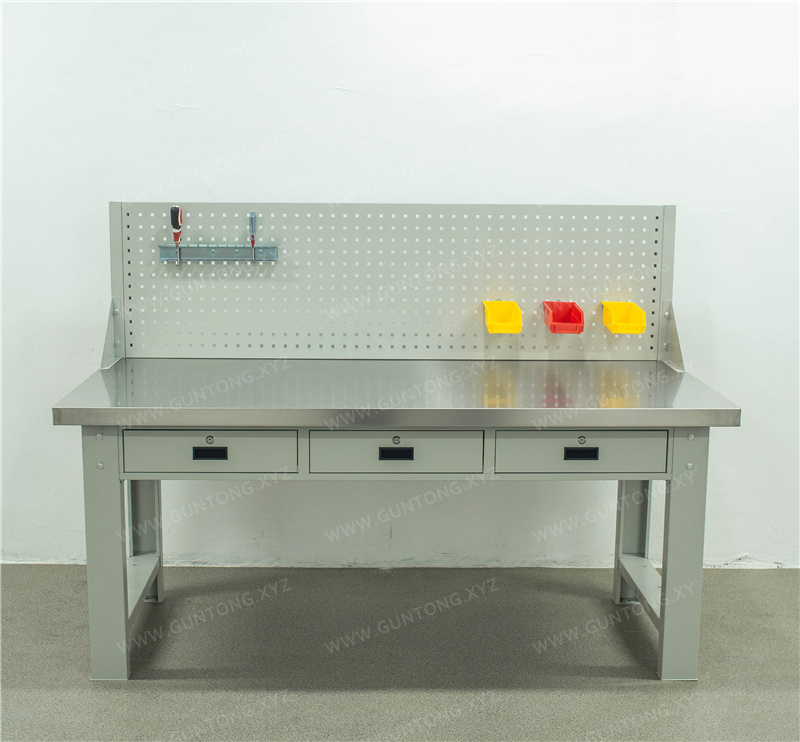
Many workshops benefit from mixed configurations. A single back panel workbench with 4 drawers provides floor-level storage for heavy items, while an overhead pegboard panel holds frequently used hand tools at eye level. This approach supports 6S management principles by assigning each tool category a designated zone.
Configuration example for an automotive parts inspection station:
- Floor cabinet: 4 drawers storing calibration gauges, torque wrenches, and sample parts (total weight ~80 kg)
- Overhead pegboard: Visual display of inspection checklists, lighting fixtures, and lightweight measurement tools
- Desktop: 5mm steel plate composite surface for durability during part handling
Load Capacity and Material Considerations
Workbench load ratings vary significantly by configuration:
- Light-duty workbenches:*
- 300 kg capacity, suitable for electronics assembly and light packaging
- Medium to heavy-duty workbench*es:*
- 1000 kg capacity, designed for hardware mold work, automotive component handling, and metal fabrication support
Material selection affects both load capacity and environmental suitability. Cold-rolled steel frames (40×40×1.2mm square tube) provide structural rigidity for heavy loads. For environments requiring corrosion resistance—such as food processing support areas or chemical testing labs—stainless steel workbenches with anti-static desktop surfaces offer specialized performance.
Anti-static workbenches require proper grounding. The desktop surface connects to earth ground via conductive pathways, dissipating static charge to protect sensitive electronic components. This specification is non-negotiable for electronics manufacturers handling PCBs, semiconductors, or precision sensors.
Ergonomic and Workflow Factors
Operator posture directly impacts productivity and injury risk. Consider these ergonomic guidelines:
- Frequent retrieval (10+ times per hour):*
- Store items between waist and shoulder height to minimize bending or reaching
- Heavy items (>15 kg):*
- Always use floor-level or mid-height storage to avoid overhead lifting hazards
- Visual management priority:*
- Overhead pegboards support at-a-glance tool tracking, reducing search time
For workstations where operators stand for extended periods, anti-fatigue mats and adjustable-height workbenches (750–800mm standard height) reduce lower-body strain. If the task involves seated work, ensure floor cabinets do not block knee clearance—typically requiring 600mm minimum vertical space under the desktop.
Implementation Checklist
Before specifying workbench configurations, verify:
- Task analysis: List all tools, materials, and equipment used at each station. Categorize by weight, retrieval frequency, and size.
- Structural assessment: Confirm wall and ceiling load capacity if overhead cabinets are planned.
- Operator profile: Determine whether work is performed standing, seated, or in mixed postures.
- 6S requirements: Map tool zones to support visual management and standardized workflows.
- Future flexibility: Choose modular configurations (adjustable shelves, repositionable pegboard hooks) to accommodate process changes.
Common Procurement Mistakes
- Over-specifying load capacity:*
- Purchasing 1000 kg workbenches for tasks that never exceed 100 kg wastes budget and adds unnecessary weight to the facility floor.
- Ignoring under-bench needs:*
- Specifying full floor cabinets for seated workstations creates ergonomic conflicts.
- Neglecting grounding requirements:*
- Deploying standard workbenches in ESD-sensitive areas without anti-static upgrades risks component damage.
- Assuming standard dimensions fit all layouts:*
- Common workbench lengths (1500mm, 1800mm, 2100mm) may not align with facility column spacing or aisle widths. Custom dimensions are often necessary.
Next Steps for Buyers
If you are planning a workstation upgrade or new facility layout, start by documenting your task requirements and spatial constraints. Guang'ErMei Precision Components provides on-site workstation planning, load-bearing design consultation, and full-process support from product manufacturing to installation. Our product range covers standardized workbenches, tool cabinets, tool carts, and non-standard custom configurations for electronics, automotive, hardware mold, and warehousing applications.
Contact our engineering team to discuss your specific configuration needs, request dimensional drawings, or schedule a site assessment.