
Evaluating Pegboard Integration Options for Stainless Steel Workbenches in Multi-Tool Environments
Evaluating Pegboard Integration Options for Stainless Steel Workbenches in Multi-Tool Environments
The Challenge: Upgrading Workbenches in High-Frequency Tool Access Scenarios
Manufacturing enterprises—particularly in electronics assembly, automotive parts production, and hardware mold maintenance—face recurring challenges when replacing legacy workbenches. Frequent tool retrieval, mixed tool sizes, and the need for visual management often expose limitations in existing setups. A common upgrade path involves integrating pegboard systems into stainless steel workbenches to improve organization, accessibility, and workflow efficiency.
However, not all pegboard configurations are equally effective. Technical evaluators must validate whether the selected solution aligns with actual load demands, installation constraints, and long-term operational needs.
Key Symptoms Indicating Need for Pegboard Integration
- Tools frequently fall or become disorganized during daily operations
- Operators report time lost searching for specific tools
- Existing cabinets lack expandability for new tool types
- 6S management compliance is inconsistent across workstations
- Manual tool tracking leads to inventory discrepancies
These symptoms suggest that a static, non-modular workstation may no longer support high-throughput or precision tasks.
Root Cause Analysis: Why Standard Configurations Fall Short
Many standard workbenches use fixed panel designs or single-sided pegboards, which limit flexibility and vertical space utilization. In multi-tool environments where tools vary in size (from small screwdrivers to large wrenches), a rigid layout reduces adaptability.
Additionally, without proper structural reinforcement, adding pegboard accessories can compromise the overall stability of the workbench, especially under repeated loading or vibration conditions.
Validation Checks: What to Confirm Before Upgrading
1. Pegboard Configuration Type
Verify if the system supports dual-panel configuration—specifically, an inner half-pegboard structure combined with a full door-mounted pegboard. This design allows:
- Upper interior section for storing smaller tools
- Dual pegboard layout on cabinet doors for quick visual access
- Improved retrieval efficiency in high-turnover settings
Verified fact: The Pegboard Storage Cabinet (Inner Half-Pegboard Type) by Guang'ErMei features this exact configuration, enabling flexible tool placement and enhanced visibility.
2. Load Capacity and Material Integrity
Ensure the pegboard system can handle expected loads. For heavy-duty applications, confirm:
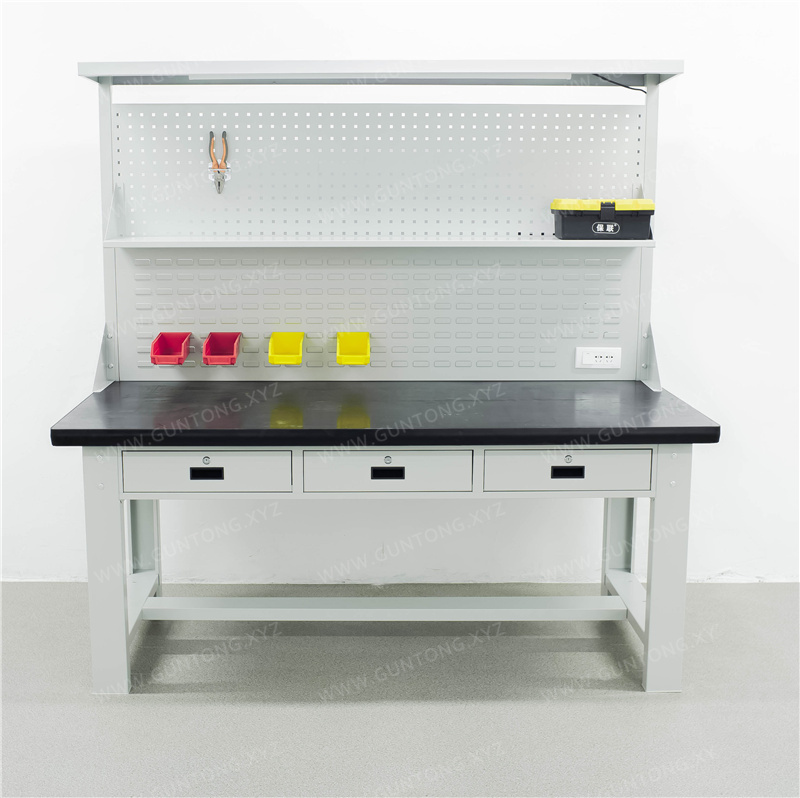
- Shelf load capacity ≥100 kg per shelf
- Use of 1.0 mm or 1.2 mm cold-rolled steel body
- Structural integrity maintained after attachment of pegboard panels
Verified fact: The Inner Half-Pegboard Storage Cabinet has a confirmed 100 kg load capacity per shelf and uses 1.0 mm or 1.2 mm cold-rolled steel construction.
3. Compatibility with Additional Accessories
Check if the workbench frame supports optional upgrades such as:
- LED lighting shelves (for low-light areas)
- Integrated multifunctional power outlets (for electric tools)
- Adjustable mounting brackets for dynamic reconfiguration
These features are critical in environments requiring both illumination and electrical access, such as maintenance testing labs or electronic repair stations.
4. Installation and Space Constraints
Confirm dimensions and clearance requirements:
- Overall dimensions: 1000 × 500 × 1800 mm (standard)
- Pegboard height: 500 mm (included in total height)
- Minimum floor clearance: 100 mm for easy access and cleaning
Ensure the chosen model fits within existing workshop layouts and does not interfere with adjacent equipment or walkways.
Resolution Path: Recommended Upgrade Steps
- Assess current tool inventory: Categorize tools by size, frequency of use, and required storage method.
- Select a dual-pegboard compatible model: Choose a stainless steel workbench with inner half-pegboard and door-mounted pegboard capability.
- Validate structural specs: Confirm material thickness (≥1.0 mm), load capacity (≥100 kg per shelf), and frame stability.
- Plan accessory integration: Request quotes for optional LED lighting and power modules if needed.
- Coordinate on-site installation: Engage Guang'ErMei’s full-service team for site planning, load-bearing assessment, and final setup.
Escalation Boundary: When to Contact the Manufacturer
If your project involves:
- Non-standard dimensions beyond 1000×500×1800 mm
- Specialized environmental conditions (e.g., cleanroom, anti-static zones)
- Integration with automated storage systems (e.g., Miniload AS/RS)
→ Contact Guang'ErMei directly for custom design support. Their service includes on-site workstation planning, load-bearing design, and full-process after-sales service.
Final Recommendation
For technical evaluators overseeing replacement projects in electronics, automotive, or mold manufacturing, upgrading to a stainless steel workbench with dual-pegboard integration offers measurable improvements in tool management, workflow speed, and 6S compliance. Prioritize models with verified load capacities, robust materials, and proven compatibility with lighting and power accessories.
Always verify specifications against the actual product data sheet—exact parameters depend on the final model and confirmation drawings.
Next Step: Request a customized workstation plan with your tool catalog and workspace layout. Guang'ErMei provides one-stop services from design to installation, ensuring seamless integration into your production environment.