
Conditions for Selecting Dual-Pegboard Stainless Steel Configurations in Electronic Assembly Cleanrooms
The Real Decision Behind "Stainless Steel" in Cleanroom Assembly
When an electronics or electrical appliance manufacturer upgrades to a controlled assembly environment, the workbench is rarely just a table. It becomes a compliance surface, a tool organization hub, and a load-bearing station for fixtures, testers, and component trays. Procurement teams often start with "stainless steel workbench cleanroom" as a search intent, but the actual configuration decision hinges on three variables: surface hygiene requirements, vertical tool density, and structural load distribution.
Guang'ErMei Precision Components designs workstation equipment for manufacturing enterprises that need both standardized reliability and non-standard adaptation. This article focuses on one specific configuration path: dual-pegboard stainless steel workbenches built on composite desktop structures, and explains when this setup is justified, when it is over-specified, and how to verify acceptance criteria before purchase.
Start with the Scenario: Electronic Assembly Lines with High Tool Turnover
In electronics assembly, operators frequently switch between torque drivers, calibration gauges, ESD-safe tweezers, and component reels. A flat stainless surface alone does not solve retrieval efficiency or 6S visual management. When tool changeover frequency impacts station throughput, vertical storage becomes a critical factor.
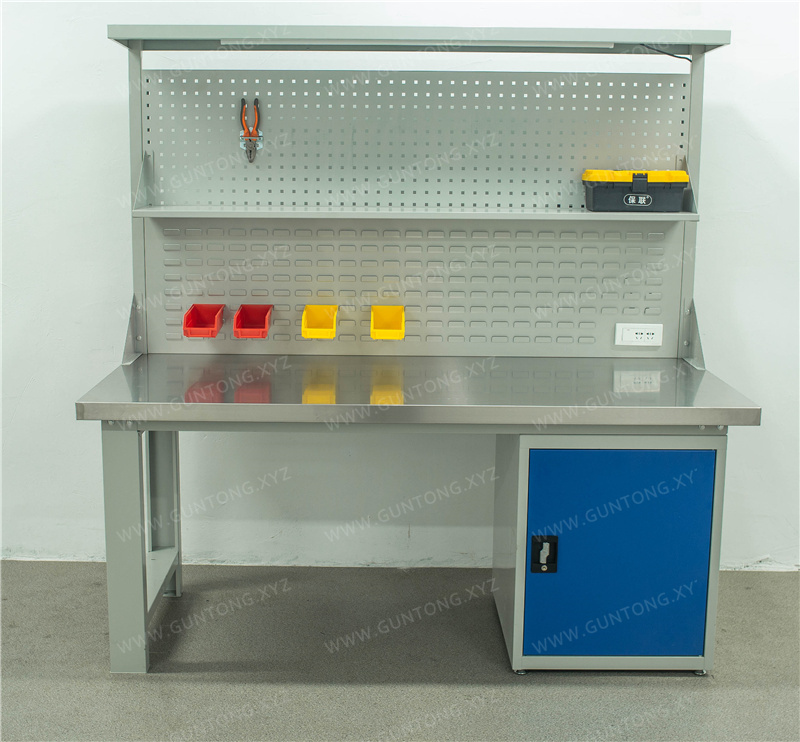
This is where pegboard configuration matters. A single pegboard workbench provides basic hanging capacity for light tools. A dual-pegboard layout (typically square-hole + louver panels, or dual square-hole sections) increases the usable vertical area without expanding the footprint. For first-time adopters, the question is not "which looks better," but "does our tool density and cleaning protocol require dual panels?"
Condition Comparison: When Dual Pegboard + Stainless Steel Wrapping Makes Sense
| Decision Factor | Single Pegboard / Standard Composite | Dual Pegboard + Stainless Steel-Wrapped Desktop |
|---|---|---|
| Tool density per station | Low to moderate | High (mixed sizes, frequent changeover) |
| Cleanroom wiping frequency | Daily or shift-based | Multiple times per shift; requires non-porous, chemical-resistant surface |
| Load requirement | Standard assembly | Heavy fixtures, test equipment, or stacked component totes |
| 6S visual management goal | Basic organization | Full visual control, shadow-board ready, audit-compliant layout |
Key Structural Facts to Verify
- Desktop construction: The stainless steel surface in this configuration is typically a stainless steel wrap over a high-density board core, not a solid metal slab. This maintains flatness, reduces weight, and provides the required wipe-down surface for cleanroom protocols.
- Frame and load capacity: Verified composite workbench designs use C-type cold-rolled steel legs
- with a total load capacity of 1000 kg. This rating covers the desktop, drawers, and pegboard loads combined.
- Pegboard height and type: Standard configurations include square-hole pegboards. Dual layouts may combine square-hole and louver panels to accommodate both hooks and bin rails. Board thickness and hole patterns must be confirmed per model.
- Drawer performance (if integrated): Where horizontal drawers are added beneath the desktop, verified specifications show single-rail drawers that open approximately 85%, with 80 kg load capacity per drawer.
These parameters are model-specific. Procurement teams should request the exact specification sheet for the shortlisted configuration rather than assuming uniform standards across all workbench types.
Implementation Boundaries and Risk Notes
- Stainless steel grade selection: Stainless steel wrapping is suitable for general cleanroom wiping and mild disinfectants. If your process involves strong acids, chlorides, or continuous saline exposure, discuss material upgrades with the manufacturer before finalizing the drawing.
- Pegboard load distribution: The structural load rating applies to the overall frame, not individual pegboard hooks. Heavy testers or power tools should be mounted on reinforced brackets or stored in drawers, not hung on standard pegboard holes.
- Cleanroom compatibility vs. certification: The workbench structure supports cleanroom-style maintenance, but room classification depends on airflow, filtration, and operational protocols. The workbench is a compatible component, not a certified cleanroom system.
- Custom dimensions and lead time: Common composite workbench lengths include standard modular sizes. Non-standard lengths, dual pegboard spacing, or integrated cable management require drawing confirmation and may affect production scheduling.
---
Shortlisting Checklist for Procurement Teams
- [ ] Confirm whether the cleanroom protocol requires full stainless steel wrapping or only edge/corner protection.
- [ ] Map tool inventory per station to decide between single pegboard and dual pegboard layouts.
- [ ] Verify total load requirement (desktop + equipment + drawers) against the structural rating.
- [ ] Request drawer rail type, opening ratio, and per-drawer load data for any integrated storage.
- [ ] Ask for a layout drawing showing pegboard hole pattern, height, and bracket compatibility before order confirmation.
For teams evaluating a three-drawer composite workbench or a composite desktop workbench with partial stainless coverage, the same verification steps apply. The difference lies in storage distribution and surface coverage, not in the underlying frame logic.
Next Steps
If your facility is introducing stainless steel workbenches into electronic assembly or precision maintenance zones for the first time, start with a station-level tool and load audit. Guang'ErMei Precision Components provides custom workbench configurations that combine standardized C-type frames, composite desktops, and flexible pegboard layouts, with full support from design, manufacturing, and on-site installation to after-sales service.
Service coverage includes manufacturing customers in Huizhou and Guangdong Province, supporting nationwide workstation equipment customization and project delivery. To request a configuration drawing, load verification sheet, or site planning consultation, contact our engineering sales team through the official website.
Related workstation configurations
- Double four-drawer floor cabinet composite workbench
- Single-door four-drawer floor cabinet composite workbench