
What to Specify on Custom ESD Workbench Drawings: A Buyer's Configuration Checklist
Who Needs Custom ESD Workbench Drawings?
Electronics manufacturers, testing laboratories, and automotive electronics assembly lines require workstations that actively manage electrostatic discharge. Off-the-shelf benches often fail to match specific floor layouts, grounding infrastructure, or tool storage workflows. When standard dimensions or configurations fall short, buyers must submit detailed drawings or specification sheets to ensure the fabricated workbench meets both ESD safety standards and daily operational demands.
Guang'ErMei Precision Components supports manufacturing enterprises in Huizhou, Guangdong Province, and nationwide with custom ESD workbench design, production, and on-site installation. The following checklist helps procurement teams and workshop planners define exactly what belongs on a custom drawing before engaging a supplier.
Before the Drawing: Define the Operational Scenario
Before specifying dimensions or materials, clarify the primary tasks the workbench will support. ESD workbenches serve distinct roles across assembly, inspection, repair, and packaging stations. Each scenario influences load requirements, surface area, and accessory needs.
- Assembly stations
- typically require moderate load capacity (around 300 kg for light-duty frames) and integrated tool storage via drawers or pegboards.
- Inspection and testing benches
- often need heavier load ratings—up to 1,000 kg for medium and heavy-duty frames—to support oscilloscopes, multimeters, and fixture equipment.
- Repair and rework stations
- benefit from flexible configurations, including adjustable shelves, power outlet cutouts at desk corners, and grounding wrist-strap connection points.
Documenting the specific use case prevents over-engineering or under-specifying the workstation. Suppliers can then recommend appropriate frame profiles and desktop structures rather than defaulting to generic configurations.
Core Specifications to Include on ESD Workbench Drawings
1. Overall Dimensions and Tolerances
Standard ESD workbench lengths commonly include 1,500 mm, 1,800 mm, and 2,100 mm, with a typical depth of 750 mm and working height of 750–800 mm. Custom drawings should state:
- Length × Width × Height
- (e.g., 1800 × 750 × 800 mm)
- Tolerance range
- for critical dimensions, especially when the bench must fit between existing equipment or align with conveyor lines
- Adjustable foot cup range
- if floor leveling is required
2. Desktop Material and ESD Surface Treatment
The desktop is the primary contact surface for sensitive components. Drawings should specify:
- Base material: High-density fiberboard (commonly 45 mm thick) or steel plate composites for higher load demands
- ESD laminate or mat: Anti-static surface layer with a surface resistivity typically in the 10⁶–10⁹ Ω range
- Edge banding: PVC or conductive edge treatment to prevent static buildup at seams
- Grounding point location: A clearly marked grounding terminal or snap connector position, usually at one corner, connected via a grounding wire to the facility's earth ground
For stainless steel ESD workbenches, the drawing should note that a dedicated anti-static mat must be laid on top and connected to ground through a bonding wire, as bare stainless steel alone does not provide controlled static dissipation.
3. Frame Structure and Load Rating
The frame determines long-term stability and load capacity. Specify:
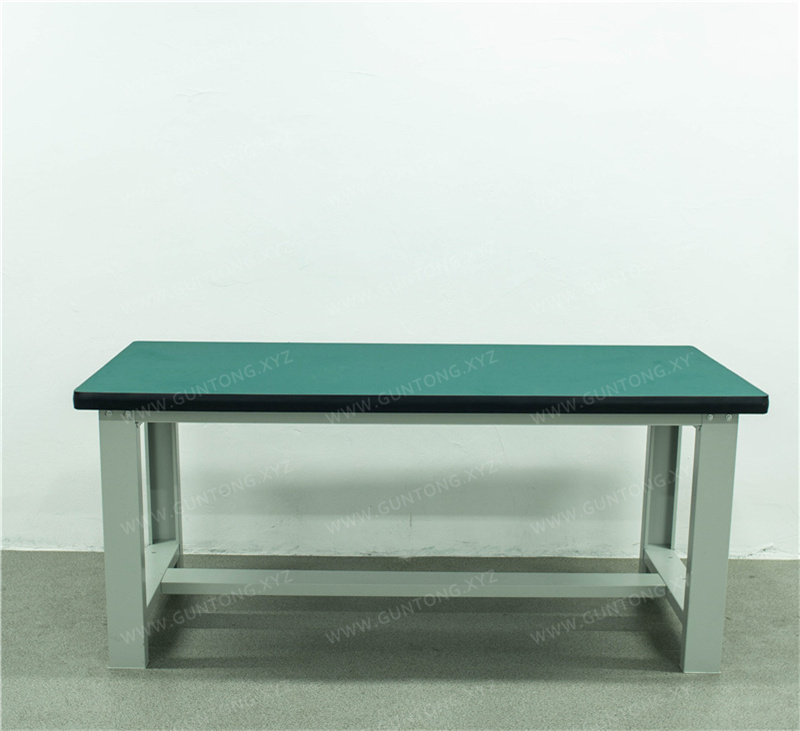
- Frame material: Cold-rolled steel square tubing (e.g., 40 × 40 × 1.2 mm) is standard for frames rated up to 300 kg; heavier sections are required for 1,000 kg ratings
- Joint type: Bolted connections for modular disassembly or welded joints for permanent installations
- Surface treatment: Powder-coated or electrostatically sprayed finish for corrosion resistance in humid workshop environments
Clearly state the total static load the workbench must support, including equipment, tooling, and operator lean force. This prevents suppliers from quoting light-duty frames for heavy inspection tasks.
4. Accessory and Configuration Callouts
ESD workbenches are rarely bare tables. Drawings should annotate:
- Drawer units: Number of drawers, individual drawer height (e.g., 100 mm or 200 mm), and load rating per drawer (commonly 80 kg)
- Pegboards or hanging panels: Single or double panel configuration, square-hole pattern for hook compatibility, and panel height above the desktop
- Overhead components: Light top boards, power rail brackets, or air supply mounts
- Under-desk cabinets: Single-door or double-door configurations, shelf count, and shelf load capacity (e.g., 100 kg per adjustable shelf)
- Power and data cutouts: Pre-drilled holes at desk corners for socket installation, as noted in standard ESD workbench configurations
5. Grounding Path Annotation
A critical but often overlooked drawing element is the complete grounding path. The drawing should show:
- Grounding snap or terminal on the ESD mat surface
- Grounding wire route from the mat to the frame
- Frame-to-earth connection point, typically via a grounding lug bolted to the facility ground bus
This ensures the supplier fabricates the bench with integrated grounding hardware rather than leaving it as a field-installation afterthought.
During Procurement: Evaluating Supplier Capability
Once drawings are prepared, buyers should assess suppliers on several practical dimensions:
Customization depth: Can the supplier modify frame profiles, desktop thickness, and accessory layouts based on your drawing, or do they only offer catalog substitutions? Guang'ErMei supports both standardized production and non-standard customization, covering workbenches, tool cabinets, and integrated workstation systems.
Material traceability: Request documentation for ESD surface resistivity test results and steel grade certifications. Quality ESD workbenches demand verified materials, as equipment integrity during testing and assembly depends on consistent static dissipation.
On-site planning support: For facilities with multiple workstations, suppliers offering on-site workstation planning and 6S adaptation can optimize layout efficiency beyond individual bench specifications.
Lead time and installation: Confirm whether the quote includes delivery, on-site assembly, and grounding verification. Full-chain service from design through installation reduces integration risks.
After Installation: Verification and Maintenance Boundaries
After the custom ESD workbench is installed, buyers should verify:
- Surface resistivity
- of the ESD mat using a calibrated megohmmeter
- Grounding continuity
- from the mat surface through the frame to the earth point
- Load stability
- under actual equipment weight, checking for frame deflection or drawer binding
Ongoing maintenance includes periodic cleaning of the ESD surface with approved solutions (avoiding standard solvents that degrade anti-static properties) and re-testing grounding continuity quarterly.
Risk boundary: Custom drawings that omit grounding path details or load ratings shift verification responsibility to the buyer. Always include these parameters explicitly to avoid receiving a bench that meets dimensional specs but fails ESD compliance.
Next Steps for Buyers
If your facility requires custom ESD workbenches for electronics assembly, testing, or repair applications, prepare a specification sheet covering the five areas above before requesting quotes. Clear drawings reduce revision cycles and ensure the delivered workstation matches your operational requirements.
Contact Guang'ErMei Precision Components to discuss your custom ESD workbench drawings, request a configuration review, or schedule an on-site workstation planning consultation.