
Stainless Steel Square Tube vs Panel Frame Workbenches: A Buyer's Field Guide
Who This Comparison Matters To
Facility planners and procurement teams in electronics assembly, automotive parts manufacturing, hardware mold workshops, and maintenance/testing labs frequently face a structural decision: should the workbench frame use stainless steel square tube construction or cold-rolled steel panel (C-channel) framing? Both approaches appear across standard workshop catalogs, but they serve different operational priorities. Choosing incorrectly leads to premature frame deformation, unnecessary capital spend, or corrosion failures in humid or chemical-exposed environments.
This field guide focuses on practical evaluation signals rather than generic material science. It draws on configuration data from Guang'ErMei's workstation product lines, where both frame types are deployed across standardized and custom workbench builds.
Structural Signals: What Each Frame Type Actually Does
Stainless Steel Square Tube Frames
Square tube frames use hollow rectangular or square stainless steel profiles (commonly 201 or 304 grade) welded into a rigid box structure. In Guang'ErMei's stainless steel workbench configurations, the frame typically uses 30×30 mm or 40×40 mm square tube with wall thicknesses around 1.2–1.5 mm. The desktop is often a composite of 1.0 mm 201 stainless steel sheet bonded over 49 mm high-density fiberboard, wrapped on five sides for sealed-edge protection.
Key structural behavior:
- High torsional rigidity due to closed-section geometry
- Natural corrosion resistance without secondary coating
- Welded joints distribute point loads across the tube network
- Typical rated capacity: up to 500 kg for standard square tube configurations
Cold-Rolled Panel (C-Channel) Frames
Panel frames use stamped or roll-formed C-shaped cold-rolled steel sections, often described as C-type cold-rolled steel frames in workstation specifications. These are assembled with bolted or welded connections and finished with acid pickling, phosphating, and powder electrostatic coating (cured at approximately 250°C).
Key structural behavior:
- Open-section design allows easier accessory mounting (shelf brackets, stretcher bars)
- Higher load ratings in heavy-duty configurations: up to 1,000 kg total capacity on reinforced C-frame builds
- Surface treatment provides corrosion protection but is vulnerable to coating damage at cut edges or impact points
- More modular for field adjustments and reconfiguration
Evaluation Criteria: Five Decision Factors
| Factor | Stainless Steel Square Tube | Cold-Rolled Panel (C-Channel) |
|---|---|---|
| Load capacity (standard config) | ~500 kg | Up to 1,000 kg |
| Corrosion resistance | Inherent (no coating required) | Coating-dependent; vulnerable at damage points |
| Cleanroom / food-grade suitability | High (sealed stainless surfaces) | Low–moderate (coating may chip or outgas) |
| Accessory mounting flexibility | Moderate (requires drilling/welding) | High (pre-punched holes, bolt-on brackets) |
| Cost per unit (standard size) | Higher material cost | Lower material cost; higher finishing cost |
1. Load Environment
If the workstation handles heavy dies, automotive stamping components, or dense tooling sets, the C-channel panel frame's higher rated capacity (1,000 kg on Guang'ErMei's heavy-duty steel plate workbenches with 5 mm raw steel plate composite desktops) provides a meaningful safety margin. Square tube frames at 500 kg are sufficient for electronics assembly, inspection stations, and light packaging lines.
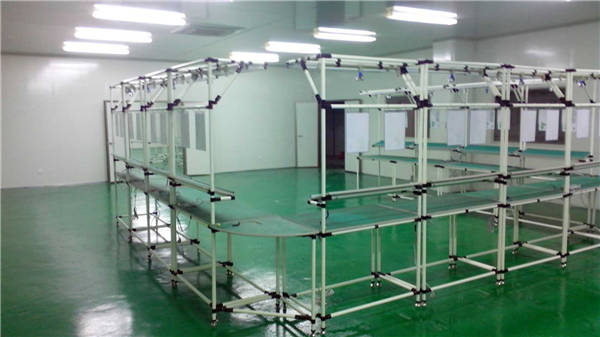
2. Exposure Conditions
Workshops with coolant splash, acid-alkali cleaning processes, or high humidity (common in southern Guangdong manufacturing zones) benefit from stainless steel's inherent resistance. A coated C-frame that suffers a forklift impact or tool drop at a leg joint will expose bare steel, initiating localized rust that spreads under the coating.
3. Cleanliness Standards
Electronics manufacturers requiring ESD-safe or dust-controlled environments, and food/medical device assemblers, typically specify stainless steel surfaces. The 201 stainless steel desktop wrapped on five sides with black PVC edge banding provides a sealed, wipeable surface that meets most cleanroom adjacency requirements.
4. Layout Reconfiguration
Facilities that anticipate frequent workstation repositioning or accessory upgrades (adding pegboards, overhead lighting arms, drawer modules) find C-channel frames more adaptable. The open profile accepts standard bolt-on brackets without field welding.
5. Budget Allocation
For a standard 1500×750×800 mm workbench, the stainless steel square tube version carries a material premium driven by alloy cost. Buyers managing large-scale deployments (50+ stations) often adopt a mixed strategy: stainless frames for wet/clean zones, C-channel frames for dry assembly and heavy-load areas.
Configuration Boundaries and Risks
Do not assume stainless steel always means higher capacity. The square tube's closed section is rigid but the overall load rating depends on tube wall thickness, weld quality, and leg bracing. A 1.0 mm wall tube frame may underperform a well-braced 1.5 mm C-channel frame under dynamic loading.
Do not ignore desktop-frame interaction. A 50 mm composite desktop (stainless sheet over high-density fiberboard) distributes loads differently than a 5 mm raw steel plate over 45 mm fiberboard. The heavier steel plate desktop requires a frame rated for the combined static and dynamic mass.
Standard sizes constrain customization cost. Guang'ErMei's standard workbench lengths—1500 mm, 1800 mm, and 2100 mm at 750 mm depth—keep both frame types in economical production runs. Non-standard dimensions trigger custom jigging for square tube welding and custom die setup for C-channel stamping, increasing lead time and unit cost.
Coating damage is a field reality. Powder-coated C-frames specified for humid environments should include a touch-up protocol in the maintenance plan. Unrepaired coating breaches in phosphated frames corrode faster than uncoated stainless.
Practical Examples by Application
- Electronics SMT assembly line: Stainless steel square tube frame with 201 stainless desktop, ESD grounding provisions, and integrated lighting rail. Load requirement under 200 kg; cleanliness priority is high.
- Automotive parts inspection station: C-channel panel frame with 5 mm steel plate composite desktop, 4-drawer under-bench storage, and pegboard back panel. Load requirement 600–800 kg; reconfiguration expected as part geometries change.
- Hardware mold maintenance bench: Heavy-duty C-channel frame rated at 1,000 kg, reinforced stretcher bars, and anti-vibration foot pads. Square tube frames are generally not specified here due to dynamic impact loads from die handling.
- Warehousing kitting station: Either frame type is viable; selection defaults to C-channel for cost efficiency unless the environment includes washdown protocols.
Next Steps for Buyers
- Audit your workshop zones by exposure condition (dry, humid, chemical, cleanroom-adjacent) and load profile (light, medium, heavy/impact).
- Map frame type to zone using the evaluation table above—avoid specifying one frame type facility-wide unless conditions are uniform.
- Request configuration drawings that specify tube wall thickness or C-channel gauge, weld pattern, and coating system rather than accepting generic "stainless frame" or "steel frame" descriptions.
- Validate standard vs. custom sizing early. If your layout accommodates 1500, 1800, or 2100 mm lengths, standard production pricing applies; deviations require custom quotation.
Guang'ErMei Precision Components supports both frame types across its workbench, tool cabinet, and tool cart product lines, with on-site workstation planning and 6S-adapted layout services for manufacturing facilities in Huizhou, Guangdong Province, and nationwide project delivery.