
Square Hole Pegboard vs Louvered Panel: A Workshop Buyer's Decision Memo
Square Hole Pegboard vs Louvered Panel: A Workshop Buyer's Decision Memo
Manufacturing planners and workshop managers frequently face a specific configuration question when ordering workbenches, tool carts, or storage cabinets: should the vertical organization surface use a square hole pegboard or a louvered panel? Both serve tool storage and visual management, but they solve different operational problems. This memo frames the decision around real workshop conditions, drawing on configuration patterns seen in electronics assembly, automotive parts maintenance, and hardware mold factories.
Objective: What Problem Are You Solving?
Before selecting a panel type, define the primary workstation requirement:
- Frequent tool changeover with varied hand tools
- (wrenches, pliers, screwdrivers, calipers) → visual hanging display is usually the priority.
- Small parts containment and bin-based retrieval
- (fasteners, connectors, electronic components, inserts) → secure bin holding is usually the priority.
- Mixed use
- → a combination or a specific panel layout may be required.
This distinction drives the entire selection. A CNC maintenance bay that cycles through 30+ hand tools per shift has a different need than an SMT assembly station organizing resistor trays and connector bins.
Alternative A: Square Hole Pegboard
How It Works
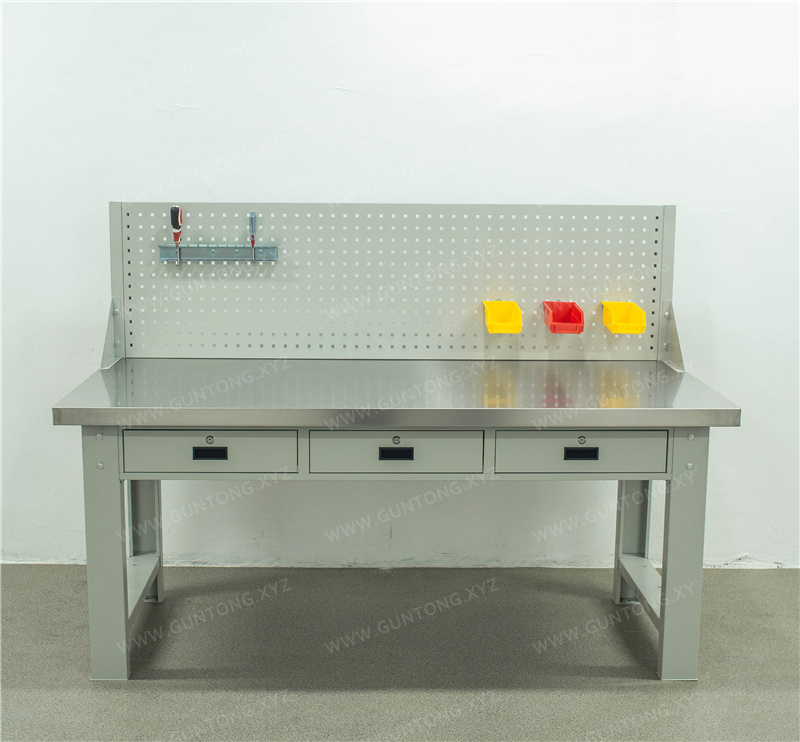
A square hole pegboard is a cold-rolled steel panel with a grid of uniformly spaced square perforations. Hooks, brackets, and specialized holders insert into the holes to suspend tools in a visible, accessible layout. Guang'ErMei's standard configuration uses a 500 mm square-hole pegboard on tool carts and cabinet doors, designed for modular expansion as tool inventories change.
Where It Performs Best
- Tool visibility and 6S compliance.*
- Auditors and supervisors can immediately see if a tool is missing from its assigned position. This supports shadow board practices common in automotive and aerospace maintenance.
- Irregularly shaped tools.*
- Wrenches, hammers, torque tools, and measuring instruments hang naturally on hooks without requiring a dedicated bin.
- Frequent reconfiguration.*
- When a production cell changes over to a new product, hooks can be repositioned in minutes without tools.
- Integration with workbenches.*
- The Single Back Panel 4-Drawer Steel Plate Workbench, for example, supports a square hole pegboard as a back panel accessory, keeping tools within arm's reach of the 1500–2100 mm work surface.
Load and Structural Considerations
Square hole pegboards are typically mounted on 1.0 mm or 1.2 mm cold-rolled steel frames. Individual hook load capacity depends on hook gauge and insertion depth, but the panel itself is designed for distributed light-to-medium tool loads. Heavy power tools or large torque wrenches may require reinforced mounting points or dedicated heavy-duty hooks.
Limitations
- Small loose parts (screws, washers, pins) cannot be stored directly on hooks. They require separate bins or drawers.
- Very dense hook layouts can make tool retrieval slower if operators must reach across multiple hanging items.
Alternative B: Louvered Panel
How It Works
A louvered panel features horizontal slotted rails that accept tilt-front bins or small parts boxes. Bins slide into the louvers and lock in place, creating a grid of contained compartments.
Where It Performs Best
- Small parts organization.*
- Fasteners, electronic components, O-rings, inserts, and consumables stay contained and labeled.
- High-SKU environments.*
- Electronics assembly stations and kitting areas often manage hundreds of small part numbers. Louvered panels with labeled bins support rapid identification.
- Dust and contamination sensitivity.*
- Bins provide partial enclosure, reducing exposure compared to open hooks.
Load and Structural Considerations
Louvered panels carry the weight of bins plus their contents. Load distribution is more predictable than pegboards because each bin has a defined capacity. However, fully loaded bins of metal fasteners can generate significant point loads, requiring robust panel mounting.
Limitations
- Hand tools do not fit in standard bins. A louvered panel alone cannot organize wrenches, pliers, or measuring instruments.
- Bin sizes are fixed by the louver pitch, limiting flexibility for oversized items.
- Reconfiguration requires swapping bins rather than simply moving hooks.
Evidence: Configuration Patterns in Real Workshops
Based on workstation deployments across manufacturing scenarios, the following patterns emerge:
| Scenario | Typical Panel Choice | Reason |
|---|---|---|
| Automotive parts maintenance bay | Square hole pegboard | Large hand tool variety; visual management for 6S audits |
| Electronics assembly workstation | Louvered panel or combination | High small-parts SKU count; kitting efficiency |
| Hardware mold fitting station | Square hole pegboard + drawer storage | Heavy tools on hooks; inserts and consumables in drawers |
| Warehousing pick station | Louvered panel | Bin-based sorting and order fulfillment |
| Vocational training center | Square hole pegboard | Teaching tool identification; standardized shadow boards |
Guang'ErMei's Pegboard Storage Cabinet (Inner Half-Pegboard Type) illustrates a hybrid approach: the upper interior section uses shelving for bulk items, while the cabinet doors feature a dual pegboard layout for frequently accessed tools. This configuration supports 100 kg load capacity per shelf on the interior, with the pegboard doors handling lighter hand tools. The cabinet's overall dimensions of 1000 × 500 × 1800 mm fit standard workshop aisles while maximizing vertical storage.
For mobile applications, the 4-Drawer 1-Door Tool Cart with Pegboard combines a 500 mm standard square-hole pegboard with four drawers (two at 100 mm height, two at 200 mm height). Each drawer supports 80 kg load capacity, allowing the cart to carry both hanging tools on the pegboard and heavier items or small parts in the drawers. This dual approach addresses the limitation of using either panel type alone.
Recommendation: A Decision Framework
Use the following checklist to guide your selection:
Choose square hole pegboard when:
- The workstation primarily uses hand tools of varying shapes and sizes.
- Visual management and 6S compliance are operational priorities.
- Tool inventory changes frequently between production runs.
- The workbench or cart already includes drawers for small parts containment.
Choose louvered panel when:
- The workstation primarily handles small parts, fasteners, or electronic components.
- SKU count is high and bin labeling is essential for retrieval speed.
- Contamination control requires partial enclosure of stored items.
- The workflow involves kitting or order picking from small bins.
Choose a combination when:
- The workstation handles both hand tools and small parts (common in maintenance and fitting operations).
- Cabinet or cart design allows pegboard on doors or back panels with drawers or louvered sections below.
- The facility standardizes on modular furniture that can be reconfigured as production needs shift.
Implementation Boundaries and Risks
- Do not overload pegboard hooks beyond their rated capacity.*
- Heavy pneumatic tools or large torque multipliers may require dedicated heavy-duty brackets or drawer storage instead.
- Verify panel mounting integrity.*
- Both pegboards and louvered panels transfer load to the cabinet or workbench frame. Ensure the supporting structure (typically C-type cold-rolled steel) is rated for the combined weight.
- Plan for 6S shadow board markings.*
- If visual management is a goal, specify hook positions and tool outlines during the design phase rather than retrofitting after installation.
- Consider automated storage integration.*
- For facilities implementing tote-based automated storage and retrieval systems (Miniload), with load capacities of 50–100 kg per tote and rack heights up to 12 meters, the workstation panel choice should align with the tote delivery workflow. Pegboards complement manual tool retrieval at the station, while louvered panels may align better with bin-based automated delivery.
Next Steps
If you are specifying workstation equipment for a new production line or upgrading an existing workshop, the panel choice is one element of a broader workstation layout. Guang'ErMei provides on-site workstation planning, load-bearing design, and 6S adaptation services covering workbenches, tool cabinets, tool carts, and storage systems. Share your tool inventory list, workstation dimensions, and operational requirements to receive a configuration recommendation tailored to your facility.
Contact Guang'ErMei for workstation equipment consultation →