
Internal Configurations Affecting Storage Cabinet Prices: A Buyer's Specification Guide
A facility planner recently requested quotes for a batch of standard 1000×500×1800 mm storage cabinets for a new automotive parts maintenance workshop. Within days, they received proposals with a price variance of over 40% for what appeared to be the exact same product. The planner initially suspected inconsistent profit margins, but a closer review of the technical drawings revealed the truth: the variance was entirely driven by the internal configurations affecting storage cabinet prices.
Supplier A had quoted a basic, light-duty shelving unit, while Supplier B had specified a heavy-duty configuration with reinforced drawers and an inner half-pegboard layout. For manufacturing and maintenance enterprises, understanding these internal variables is critical to avoiding budget overruns and procuring equipment that actually survives the shop floor.
Diagnosing the Core Factors Behind Price Variance
When evaluating workshop storage solutions, the external footprint is merely the starting point. The actual manufacturing cost and final price are determined by what happens inside the cabinet and the materials used to build it.
1. Material Thickness and Structural Integrity
The most immediate driver of cost is the raw material specification. Standard industrial storage cabinets are typically fabricated from cold-rolled steel. However, the thickness of this steel drastically alters both the price and the lifespan of the unit.
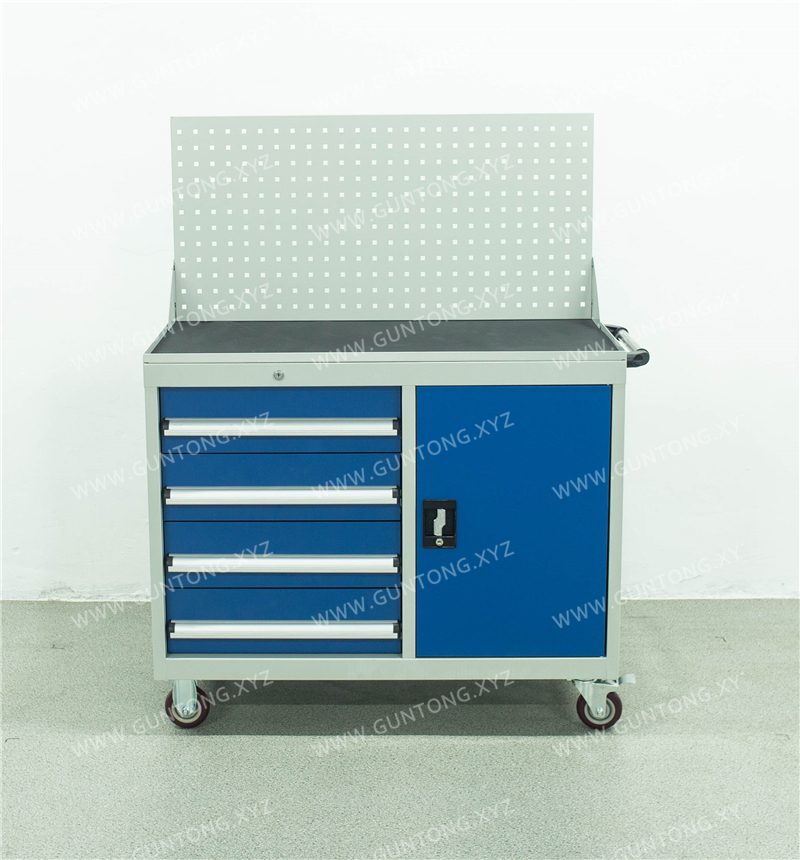
- Standard vs. Heavy-Duty Gauges:*
- A budget-friendly cabinet might use thinner gauge steel, which is prone to warping under heavy loads. In contrast, robust industrial configurations specify that the cabinet body is constructed using 1.0 mm or 1.2 mm cold-rolled steel, while drawer panels utilize 1.5 mm cold-rolled steel for enhanced impact resistance.
- Material Grade Upgrades:*
- For specialized environments, standard cold-rolled steel is insufficient. Stainless steel is specifically selected for environments exposed to weak corrosive media like air, steam, and water, or chemical corrosive media such as acids, alkalis, and salts. The transition from cold-rolled to stainless steel significantly increases material costs but is non-negotiable for food processing, chemical testing, or high-humidity facilities.
2. Internal Layout: Shelves vs. Drawers vs. Pegboards
The internal architecture of a storage cabinet dictates its functionality and its manufacturing complexity. A cabinet with fixed shelves is fundamentally cheaper to produce than one with a mixed internal layout.
- Adjustable Shelves:*
- Standard shelf configurations are cost-effective. High-quality units feature adjustable shelves with a load capacity of 100 kg per shelf, requiring reinforced welding and precision bracket slots.
- Drawer Systems:*
- Integrating drawers introduces significant hardware costs. Drawers equipped with stamped single guide rails can support up to 80 kg per drawer, which is a critical specification for heavy tool storage. The addition of drawer panels, sliding mechanisms, and internal dividers increases both material and assembly costs.
- Pegboard Integration:*
- For facilities prioritizing 6S visual management, integrating a pegboard adds utility and cost. An inner half-pegboard structure—combining upper interior shelving with a dual pegboard layout on the cabinet doors—requires additional stamping, folding, and hardware, directly influencing the final price.
3. Hardware and Accessory Specifications
The unseen components often separate premium equipment from disposable alternatives. Heavy-duty hinges, industrial-grade drawer slides, and reinforced locking mechanisms all contribute to the final configuration cost. A drawer rated for 80 kg requires a vastly different slide mechanism than one rated for 20 kg.
The Buyer’s Decision Checklist for Accurate Quoting
To eliminate quoting ambiguities and ensure you are comparing equivalent configurations, procurement teams and facility planners should define the following parameters before requesting a proposal:
Step 1: Define Exact Load Requirements
Do not just specify "heavy-duty." Define the maximum weight per tier. If you are storing dense automotive parts or heavy molds, specify a minimum of 100 kg per shelf or 80 kg per drawer. This forces the manufacturer to quote the appropriate steel thickness and hardware.
Step 2: Map the Internal Layout
Determine the exact mix of storage types required for the specific workstation.
- Do you need bulk storage?
- Specify the number of adjustable shelves.
- Do you need secure, organized tool storage?
- Specify the number and height of drawers (e.g., two 100 mm high drawers).
- Do you need visual tool management?
- Request an inner half-pegboard or full back-panel pegboard configuration.
Step 3: Specify the Operating Environment
Clearly communicate the environmental conditions to the manufacturer. If the cabinet will be placed in a standard dry assembly area, 1.0 mm or 1.2 mm cold-rolled steel with a powder-coated finish is ideal. If it will be used in a washdown area or near chemical testing stations, explicitly request stainless steel construction.
Moving Beyond Dimension-Based Procurement
Relying solely on external dimensions like 1000×500×1800 mm or 1000×600×1800 mm when sourcing storage equipment is a procurement risk. The true value and cost of a storage cabinet are locked in its internal configurations. By taking the time to define material thickness, load capacities, and internal layouts, buyers can ensure they are investing in durable, fit-for-purpose workstation equipment that supports long-term operational efficiency.