
Guang'ErMei Supplier Quality Review Log: How We Verify Raw Materials and Accessories Before Production
Why Incoming Material Inspection Matters for Workshop Equipment
When a heavy-duty workbench fails under load or a tool cabinet drawer jams after three months of use, the root cause often traces back to raw materials and accessories that slipped through incoming inspection. For manufacturing enterprises, electronics manufacturers, and automotive parts factories that rely on workstation equipment daily, these failures translate directly into downtime, safety risks, and replacement costs.
Guang'ErMei Precision Components maintains a structured supplier quality review log to catch material defects before they reach the production floor. This article shares the practical checkpoints we apply to three critical material categories—cold-rolled steel, composite desktops, and drawer hardware—and the corrective actions we take when incoming batches fall short.
Common Failure: Drawer Slide Deformation Under Rated Load
What Happens
A batch of 4-drawer tool carts is assembled and loaded to the specified 80 kg per drawer capacity. During the load test, one or more drawer slides show visible deflection or binding, preventing smooth operation. In field use, this manifests as drawers that stick, sag, or eventually detach from their rails.
Why It Happens
Drawer slides stamped from thin-gauge or inconsistent steel lack the structural rigidity to sustain repeated loading cycles. Thickness variation of even 0.2 mm across a batch can cause some slides to pass initial inspection while others fail under sustained weight. Surface treatment inconsistencies—such as uneven zinc plating—accelerate corrosion in humid workshop environments, further degrading slide performance over time.
Corrective Actions in Our Review Log
- Thickness verification: Every incoming batch of drawer slide blanks is measured at three points using a calibrated micrometer. Slides that deviate beyond ±0.1 mm from the specified gauge are rejected at receiving.
- Load cycle sampling: A statistical sample from each batch undergoes a 5,000-cycle open-close test under rated load. Any binding, deformation, or audible grinding triggers a full batch hold.
- Surface coating check: Zinc plating thickness is verified to ensure uniform corrosion protection. Batches with visible bare spots or plating thickness below specification are returned to the supplier.
These checkpoints directly support products like our 4-Drawer 1-Door Tool Cart with Pegboard, where each drawer is rated for 80 kg and must operate reliably in demanding workshop environments.
Common Failure: Composite Desktop Delamination
What Happens
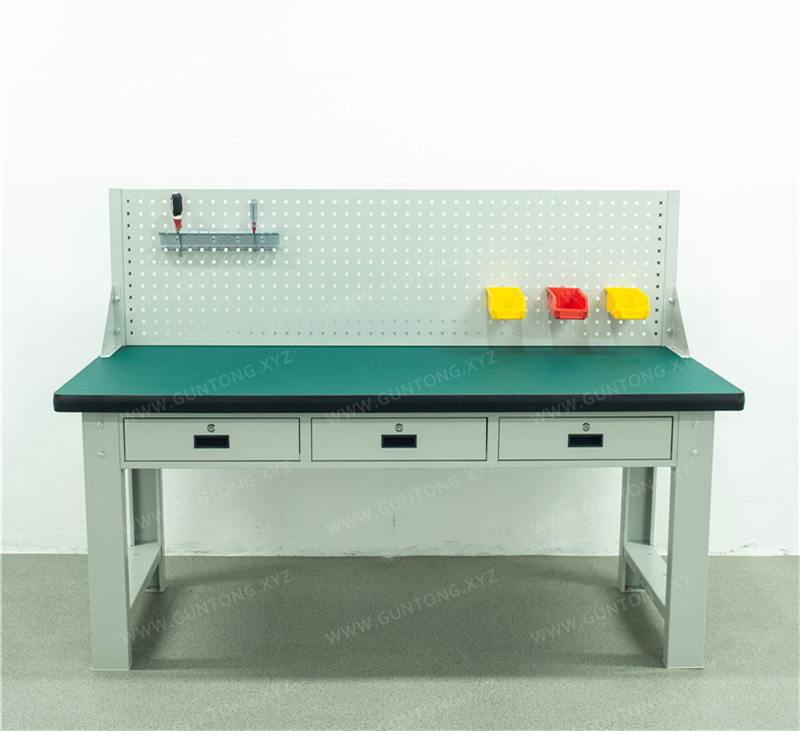
A steel plate workbench desktop shows edge separation or surface bubbling after weeks of use. The 5mm raw steel plate top layer begins to lift from the high-density fiberboard core, compromising the flat working surface and reducing load-bearing integrity.
Why It Happens
Delamination typically originates from inadequate adhesive application during the composite bonding process or from moisture ingress at poorly sealed edges. If the PVC edge banding is applied without sufficient pressure or heat activation, moisture penetrates the bond line during routine workshop cleaning or in high-humidity environments.
Corrective Actions in Our Review Log
- Bond strength sampling: Incoming composite desktop panels undergo a peel-test at the steel-to-fiberboard interface. Panels that separate below the specified adhesion threshold are rejected.
- Edge banding inspection: PVC edge banding is checked for complete adhesion around the full perimeter. Any lifting, gaps, or air bubbles result in the panel being returned for rework.
- Dimensional flatness check: Each desktop is placed on a precision flat table and measured for warpage. Panels exceeding flatness tolerance are flagged, as warpage indicates internal stress or uneven bonding that will worsen over time.
These inspections protect the long-term performance of products such as our Single Back Panel Single Door 4-Drawer Steel Plate Workbench, which uses a 5mm raw steel plate and 45mm high-density fiberboard composite structure designed for sustained heavy-duty use.
Common Failure: Cold-Rolled Steel Shelf Sagging in Storage Cabinets
What Happens
Adjustable shelves inside a pegboard storage cabinet visibly sag when loaded to their 100 kg rated capacity. Over time, the deflection becomes permanent, and stored items shift or slide toward the center of the shelf.
Why It Happens
Shelf load capacity depends on both material thickness and the forming process. If incoming cold-rolled steel sheets are below the specified 1.0 mm or 1.2 mm thickness, or if the stamping dies produce inconsistent bend angles in the shelf reinforcement ribs, the structural stiffness drops below design requirements. Yield strength variation between steel coils can also cause some shelves to perform well while others from the same batch deform prematurely.
Corrective Actions in Our Review Log
- Incoming coil thickness mapping: Steel thickness is measured at the center and both edges of each coil section. Coils with thickness variation exceeding tolerance are rejected before blanking.
- Forming die audit: Shelf reinforcement rib depth and angle are verified against the tooling specification after each die maintenance cycle. Out-of-spec forming triggers die adjustment before production resumes.
- Static load verification: A sample shelf from each production run is loaded to 100 kg and held for 24 hours. Permanent deflection beyond the allowable limit results in a production hold and root-cause investigation.
This process ensures that products like our Pegboard Storage Cabinet (Inner Half-Pegboard Type)—configured with three adjustable shelves each rated for 100 kg—deliver consistent load performance across every unit shipped.
How the Review Log Connects to On-Site Reliability
Incoming material inspection is only one layer of quality assurance. Guang'ErMei's full-chain service extends from product design and manufacturing through on-site installation and after-sales support. When our team conducts on-site workstation planning for manufacturing or warehousing clients, the equipment we install must perform reliably under the specific load conditions, usage frequency, and environmental factors of that facility.
The supplier quality review log ensures that every component entering our production line—whether it is a cold-rolled steel sheet for a mold rack, a composite panel for an anti-static workbench, or a caster assembly for a tool cart—meets the same verified standard. This consistency is what allows us to support 6S adaptation and lean manufacturing layouts without equipment failures undermining the operational improvements our clients are trying to achieve.
What Buyers Should Verify With Their Workstation Equipment Supplier
If you are evaluating workstation equipment for your facility, consider asking your supplier the following:
- Do you maintain a documented incoming inspection log for raw materials?*
- A formal review log demonstrates that quality control begins before production, not after.
- Can you share the load test protocol for drawers, shelves, and desktops?*
- Verified load ratings should be backed by repeatable test procedures, not just engineering estimates.
- How do you handle batch failures when incoming materials do not meet specification?*
- A clear rejection and corrective action process protects your delivery timeline and equipment performance.
- Do you support non-standard customization with the same material standards?*
- Custom dimensions and configurations should not mean relaxed material inspection.
Next Steps
If your facility requires workbenches, tool cabinets, tool carts, or storage systems that must perform reliably under specific load and usage conditions, contact Guang'ErMei Precision Components to discuss your workstation equipment requirements. Our team can share detailed material specifications, load test data, and customization options relevant to your application—whether you operate an electronics assembly line, an automotive parts workshop, a hardware mold factory, or a vocational training center.