
Guang'ErMei ESD Workbench Assembly Log: Grounding Verification and Configuration Checks for Electronics Workshops
Why ESD Workbench Assembly Requires a Structured Log
Electronics and electrical appliance manufacturers operate in environments where uncontrolled electrostatic discharge can damage sensitive components, compromise testing accuracy, or trigger latent field failures. An anti-static workbench is not simply a steel frame with a special mat; it is a controlled grounding node within a larger EPA (Electrostatic Protected Area).
When Guang'ErMei Precision Components deploys ESD workbenches to customer sites across Huizhou, Guangdong, and other manufacturing regions, every assembly step is documented in a field log. This log serves two purposes: it provides traceability for the customer's own quality management system, and it ensures that the workstation performs within its designed static dissipation and load-bearing boundaries.
This article walks through the typical entries in a Guang'ErMei ESD workbench assembly log, explaining the operating logic, applicable conditions, and practical limits that buyers and facility engineers should understand before specifying anti-static workstation equipment.
---
Assembly Log Entry 1: Frame and Desktop Material Verification
What Is Checked
Before assembly begins, the installation team verifies the desktop structure and frame specifications against the project order. For heavy-duty ESD workbenches, the standard configuration includes a composite desktop—typically a steel plate or high-density fiberboard core with an ESD-safe laminate surface—and a cold-rolled steel frame.
Guang'ErMei's steel plate workbenches, for example, use a 5mm raw steel plate bonded to a 45mm high-density fiberboard core with black PVC edge banding. When configured for ESD applications, the top surface is replaced or overlaid with a static-dissipative mat or laminate that meets the required surface resistivity range.
Why It Matters
The desktop must simultaneously satisfy three constraints:
- Mechanical load capacity: The C-type cold-rolled steel frame supports up to 1,000 kg total load in standard configurations. The ESD surface layer must not compromise this rating.
- Surface resistivity: The static-dissipative surface must fall within the customer's specified range (commonly 10⁶ to 10⁹ ohms for electronics assembly).
- Edge integrity: PVC edge banding must be intact to prevent delamination under repeated tool and component contact.
Boundary Condition
If the customer's EPA requires a surface resistivity below 10⁶ ohms (conductive range), a standard dissipative mat is insufficient. The assembly log flags this as a configuration mismatch, and the project team must source a conductive-grade surface before proceeding.
---
Assembly Log Entry 2: Grounding Path Installation and Continuity Test
What Is Done
The core of ESD workbench assembly is establishing a verified grounding path from the work surface to the facility's earth ground. The assembly log records the following steps:
- Grounding lug attachment: A brass or stainless steel grounding lug is mechanically fastened to the steel frame at a designated point, typically near a rear leg.
- Mat-to-frame bonding: A grounding cord with a 1 megohm current-limiting resistor connects the ESD mat surface to the frame. The resistor is a safety requirement—it prevents a direct short to ground in case the mat contacts a live voltage source.
- Frame-to-earth connection: A separate grounding wire runs from the frame lug to the facility's EPA ground bus or grounding rod.
- Continuity verification: Using a calibrated surface resistance meter and a point-to-point continuity tester, the technician measures resistance from the mat surface to the earth ground point.
Operating Logic
The 1 megohm resistor in the wrist strap or mat ground cord is not optional. It limits fault current to a safe level (typically under 0.5 mA at 250V) while still allowing static charges to dissipate within seconds. The assembly log records the measured resistance value at each connection point.
Applicable Boundary
Grounding continuity tests are valid only when the facility's EPA ground infrastructure is already installed and verified. If the customer's workshop lacks a dedicated ground bus, the assembly log notes this as a prerequisite gap. Guang'ErMei's installation team can advise on grounding infrastructure requirements, but the facility's electrical contractor must complete the earth ground connection.
---
Assembly Log Entry 3: Load Validation and Structural Stability Check
What Is Recorded
Once the ESD surface and grounding path are in place, the team performs a structural validation. For a standard 1500×750×800mm or 1800×750×800mm workbench, this includes:
- Leveling adjustment: Adjustable foot pads are set so the desktop is within 2mm of level across the full surface.
- Static load test: A distributed load (typically 50–70% of rated capacity) is placed on the desktop for a minimum dwell period. The log records any deflection, frame deformation, or fastener loosening.
- Drawer and accessory function: If the workbench includes drawers (such as the 4-drawer configuration), each drawer is loaded to its rated capacity—commonly 80 kg per drawer—and cycled open and closed to verify smooth operation under load.
Why This Step Is in the ESD Log
A workbench that flexes or shifts under load can break the grounding connection or create micro-gaps between the ESD mat and the frame. Structural stability is therefore an ESD performance requirement, not just a mechanical one.
---
Assembly Log Entry 4: Accessory Integration and 6S Alignment
Typical Accessories Documented
Electronics assembly workstations often integrate additional equipment:
- Pegboard panels: A square-hole pegboard (500mm standard height) is mounted on the back panel for tool hanging. The log records the pegboard's grounding bond to the main frame.
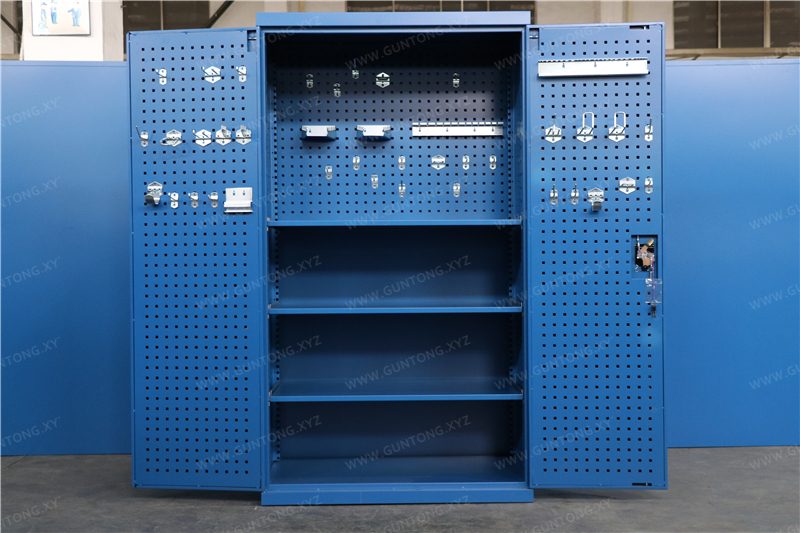
- Tool cabinets and carts: When a 4-drawer tool cart with pegboard is positioned adjacent to the workbench, the log notes its placement and verifies that its casters are locked and its frame is bonded to the same EPA ground.
- Lighting and power rails: Overhead LED task lights and power distribution rails are mounted to the back panel. The log confirms that all electrical accessories are grounded through the workbench frame.
6S Management Alignment
For customers implementing 6S workplace management, the assembly log includes a visual management checklist: shadow boards for tool placement, labeled drawer dividers, and color-coded grounding wires. Guang'ErMei supports 6S adaptation as part of its workstation planning service, and the log provides the baseline documentation for the customer's audit trail.
---
Applicable Scenarios and Limitations
Where This Assembly Process Applies
- Electronics and PCB assembly workshops
- requiring EPA-compliant workstations.
- Testing and quality inspection labs
- where sensitive measurement instruments are used.
- Automotive electronics sub-assembly
- areas within larger automotive parts manufacturing facilities.
- Vocational college training centers
- that teach electronics assembly and require documented ESD practices.
Where It Does Not Apply
- Cleanroom environments
- (ISO Class 5 or below): ESD workbenches for cleanrooms require specialized materials and particle emission testing that fall outside standard assembly procedures.
- High-voltage testing areas: Workbenches near high-voltage equipment require different grounding architectures and safety interlocks not covered in a standard ESD assembly log.
- Outdoor or humid environments: Standard ESD mats and grounding cords are rated for indoor use. Outdoor deployment requires weatherproof enclosures and alternative grounding methods.
---
Next Steps for Buyers Evaluating ESD Workbenches
- Define your EPA requirements first: Confirm the surface resistivity range, grounding architecture, and audit documentation your quality system requires before requesting a quotation.
- Request an assembly log template: Ask Guang'ErMei for a sample assembly log format so you can verify it meets your traceability needs before the project begins.
- Plan grounding infrastructure early: Ensure your facility's EPA ground bus is installed and tested before the workbench delivery date.
- Specify accessories together with the workbench: Pegboards, tool cabinets, and power rails should be ordered as part of the same workstation package to ensure integrated grounding and structural compatibility.
For technical consultation on ESD workbench configuration, on-site workstation planning, or to request a sample assembly log format, contact Guang'ErMei Precision Components through the official website inquiry form.