
How to Configure Lighting, Pegboards, and Drawers for Inspection Workbenches: A Buyer's Configuration Guide
Inspection workbenches serve as the operational center for quality control, electronics testing, and precision hardware verification. Unlike general assembly stations, inspection environments demand coordinated configuration of three elements: task lighting for defect detection, pegboards for visual tool management, and drawers for calibrated instrument storage. Misconfiguring any one of these elements creates bottlenecks—poor lighting masks surface defects, disorganized pegboards slow retrieval, and inadequate drawer layouts risk damage to sensitive gauges.
This guide addresses how manufacturing buyers and workshop planners should evaluate lighting, pegboard, and drawer configurations for inspection workbenches, with attention to ESD requirements, load boundaries, and practical trade-offs.
Who Needs Configured Inspection Workbenches
Inspection workbenches are deployed across several operational contexts:
- Electronics and electrical appliance manufacturers performing PCB inspection, component testing, and final QA checks
- Automotive parts manufacturers conducting dimensional verification and surface defect inspection
- Hardware mold factories checking mold tolerances and finish quality
- Maintenance and testing institutions handling calibration and instrument verification
- Vocational college training centers teaching inspection methodology in practical labs
Each context imposes different priorities. Electronics inspection emphasizes ESD protection and fine-detail visibility. Automotive inspection prioritizes load capacity for heavy gauges and parts. Mold inspection requires stable surfaces resistant to impact and corrosion.
Lighting Configuration: Matching Lux Levels to Inspection Tasks
Lighting on inspection workbenches is not a single specification—it varies by task precision. General workshop lighting typically delivers 300–500 lux at the work surface, but inspection tasks require higher levels:
- Visual surface inspection (scratches, discoloration, contamination): 750–1000 lux
- Fine detail inspection (solder joints, micro-cracks, engraving verification): 1000–1500 lux
- Precision measurement reading (micrometer scales, dial indicators): 1500+ lux with shadow reduction
Configuration Options
Inspection workbenches can integrate lighting through several approaches:
- Overhead light top panels mounted on the workbench frame, providing uniform downward illumination without desk clutter
- Adjustable arm lamps for directional task lighting that operators can reposition per inspection angle
- Under-shelf LED strips when upper shelving is configured, reducing shadow zones beneath storage tiers
The workbench frame must support the additional load of lighting fixtures. Guang'ErMei workbenches use C-type cold-rolled steel frames rated for substantial total loads, accommodating lighting rigs without structural compromise.
ESD Considerations for Lighting
In electronics inspection environments, lighting fixtures must not introduce static discharge risks. Light fixtures should be grounded through the workbench frame, and any plastic components near the work surface should be ESD-safe materials. Anti-static workbenches typically route grounding through the frame to a common ground point, and lighting integration must preserve this path.
Pegboard Configuration: Visual Tool Management for Inspection Stations
Pegboards on inspection workbenches serve a different function than on assembly benches. Assembly pegboards hold production tools in high-frequency rotation. Inspection pegboards hold verification instruments, reference samples, and documentation—items accessed less frequently but requiring immediate visual identification.
Pegboard Types and Layout
Guang'ErMei offers several pegboard configurations relevant to inspection stations:
- Single back panel pegboards: A vertical panel behind the work surface, suitable for hanging calipers, magnifiers, and reference charts. This configuration keeps the work surface clear for the item under inspection.
- Inner half-pegboard storage cabinets: Combining shelf storage with pegboard mounting on cabinet doors. This configuration works when inspection stations need both enclosed storage for sensitive instruments and visible hanging space for frequently used tools.
- Dual pegboard layouts: Upper interior sections plus door-mounted pegboards, maximizing vertical tool density for stations with extensive instrument sets.
Square-Hole vs. Round-Hole Pegboards
Square-hole pegboards offer higher mounting flexibility than round-hole variants. Standard 500mm square-hole pegboards allow hooks and brackets to be positioned at finer intervals, supporting custom tool holders for irregularly shaped inspection instruments.
Load Considerations
Pegboard load capacity depends on the mounting structure. Cabinet-door pegboards must account for door hinge ratings. Wall-mounted back panels distribute load to the workbench frame. For inspection stations holding heavy instruments (large micrometers, surface plates, optical comparators), verify that the pegboard mounting structure supports the cumulative weight.
Drawer Configuration: Protecting Calibrated Instruments
Inspection drawers differ from production tool drawers in one critical respect: they must protect calibration integrity. A dropped gauge or scratched reference standard compromises measurement accuracy across the entire inspection process.
Drawer Layout Strategies
- Tiered drawer heights: Configuring drawers at different heights (e.g., 100mm and 200mm tiers) allows separation of small instruments (calipers, pin gauges) from larger items (height gauges, surface roughness testers)
- Partitioned interiors: Drawer dividers prevent instruments from colliding during drawer operation
- Foam-lined inserts: Custom-cut foam cradles for high-value instruments, preventing movement and surface contact
Drawer Load Ratings
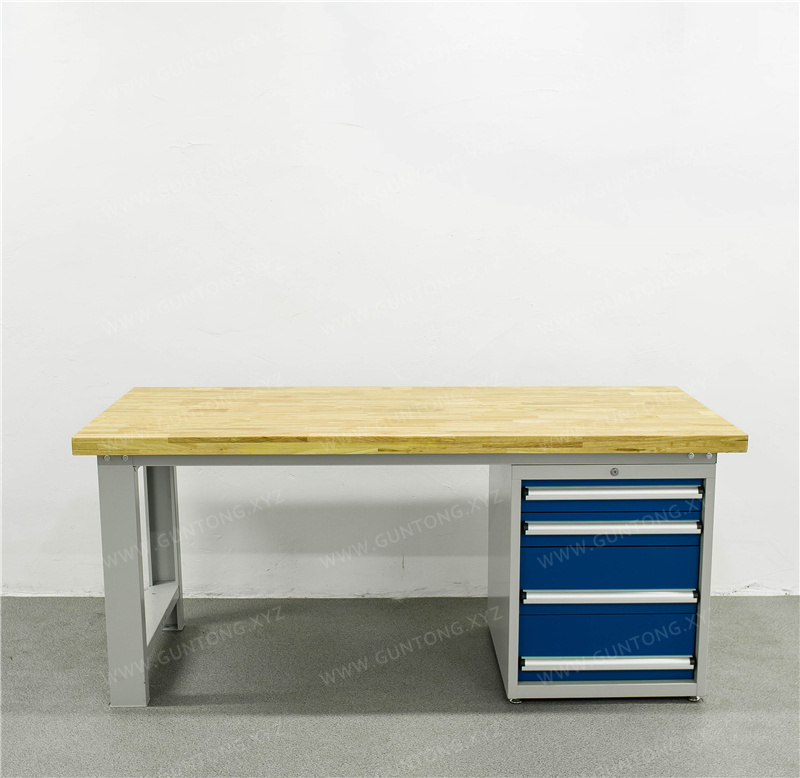
Guang'ErMei tool carts and workbench drawers are rated for specific loads per drawer—typically 80 kg per drawer for standard configurations. Inspection instruments are generally lighter than production tooling, but cumulative weight from multiple gauges, reference blocks, and fixture sets can approach these limits. Verify per-drawer ratings when configuring multi-drawer inspection stations.
Drawer Placement
Drawer placement affects operator workflow. Under-bench drawers keep instruments within arm's reach but require the operator to bend. Side-mounted drawer cabinets maintain eye-level access but consume floor space adjacent to the workbench. For inspection stations in dense workshop layouts, under-bench configurations preserve aisle clearance.
ESD Boundaries for Inspection Workbench Configuration
Electronics inspection workbenches require ESD-safe configuration across all three elements:
- Desktop surfaces: Anti-static workbenches use conductive or dissipative surfaces. Stainless steel inspection tables may require an ESD mat overlay connected to ground.
- Pegboard materials: Standard powder-coated steel pegboards are generally acceptable in ESD environments when grounded through the frame. Plastic pegboard components must be verified for static dissipation.
- Drawer slides and handles: Metal drawer components grounded through the workbench frame maintain ESD continuity. Insulated drawer pulls can break the grounding path.
Anti-static workbenches are typically rated by surface resistance and grounding path integrity. Configuration additions (lighting, pegboards, drawers) must not compromise these specifications.
Configuration Trade-Offs and Budget Factors
| Configuration Choice | Advantage | Trade-Off |
|---|---|---|
| Overhead light panel | Uniform illumination, clear work surface | Higher initial cost, fixed position |
| Adjustable arm lamp | Flexible positioning, lower cost | Desk clutter, shadow variation |
| Single back panel pegboard | Simple installation, low cost | Limited tool density |
| Inner half-pegboard cabinet | Combined enclosed and visible storage | Higher cost, deeper footprint |
| Under-bench drawers | Space-efficient, within reach | Operator bending required |
| Side drawer cabinet | Eye-level access, high capacity | Consumes adjacent floor space |
Budget allocation should prioritize the element most critical to inspection accuracy. For visual defect detection, invest in lighting first. For instrument-heavy stations, invest in drawer protection. For high-mix inspection environments with many instrument types, invest in pegboard density.
Implementation Checklist
Before finalizing an inspection workbench configuration:
- Define inspection tasks: List all inspection operations performed at the station and their precision requirements
- Inventory instruments: Catalog all instruments, gauges, and reference standards requiring storage
- Verify ESD requirements: Confirm whether the inspection environment requires anti-static configuration
- Assess load requirements: Calculate total load from instruments, lighting fixtures, and any parts being inspected
- Evaluate floor space: Determine available footprint and adjacent aisle clearance
- Specify grounding paths: Ensure all added components maintain ESD grounding continuity where required
Next Steps
Guang'ErMei Precision Components provides inspection workbench configuration services covering workbenches, tool cabinets, pegboard storage cabinets, and drawer systems. Standard dimensions include 1500×750×800mm, 1800×750×800mm, and 2100×750×800mm, with non-standard customization available for specific inspection environments. Service coverage includes manufacturing customers in Huizhou and Guangdong Province, supporting nationwide workstation equipment customization and project delivery.
Contact our team to discuss your inspection workbench configuration requirements, including lighting integration, pegboard layout, and drawer specifications for your specific inspection tasks.