
4-Drawer Tool Cart vs 4-Drawer 1-Door Tool Cart: A Practical Selection Guide for Workshop Managers
4-Drawer Tool Cart vs 4-Drawer 1-Door Tool Cart: A Practical Selection Guide for Workshop Managers
When outfitting a maintenance bay, assembly cell, or CNC machining area, the choice between a standard 4-drawer tool cart and a 4-drawer 1-door tool cart with pegboard directly impacts daily workflow efficiency. Both configurations offer mobile storage built on cold-rolled steel frames with heavy-duty stamped slides, but they serve distinctly different operational patterns. This comparison breaks down the structural differences, load-bearing boundaries, and practical application scenarios so procurement managers and workshop supervisors can specify the right equipment without over- or under-investing.
Core Structural Differences at a Glance
The fundamental distinction lies in how each cart handles tool visibility and retrieval access.
Standard 4-Drawer Tool Cart features a fully enclosed cabinet body with four tiered drawers. All tools are stored behind drawer faces, protected from dust and unauthorized access. The cabinet body and drawers are constructed from 1.0mm cold-rolled steel plate, with heavy-duty stamped guide rails that allow each drawer to extend to 85% of its depth while supporting up to 80 kg per drawer.
4-Drawer 1-Door Tool Cart with Pegboard integrates the same 4-drawer tiered storage in the lower section but adds a single-door compartment and a 500mm standard square-hole pegboard on the upper section. This configuration provides three storage modes in one mobile unit: drawer storage for small and precision tools, enclosed shelf space behind the door for medium-sized items, and visual pegboard hanging for frequently accessed hand tools and measuring instruments.
| Feature | Standard 4-Drawer Tool Cart | 4-Drawer 1-Door Tool Cart with Pegboard |
|---|---|---|
| Drawer Configuration | 4 drawers (100mm/150mm/200mm height options) | 4 drawers (100mm H × 2 + 200mm H × 2) |
| Load Capacity per Drawer | 80 kg | 80 kg |
| Upper Section | None (flat top or optional shelf) | 1-door compartment + 500mm pegboard |
| Overall Dimensions (W×D×H) | Customizable; typical 566×600×(700+150+500) mm | 1000×500×850 mm (including pegboard) |
| Tool Visibility | Low (all enclosed) | High (pegboard provides visual management) |
| Mobility | 4-inch casters (2 fixed, 2 swivel with brake) | 4-inch casters (2 fixed, 2 swivel with brake) |
| Primary Material | 1.0mm cold-rolled steel | 1.0mm or 1.2mm cold-rolled steel |
When to Choose the Standard 4-Drawer Tool Cart
The standard 4-drawer configuration is the right choice when your operational pattern meets the following conditions:
High-value or precision tool protection is the priority. In CNC machining centers or calibration labs, expensive measuring instruments, insert tooling, and precision gauges must be protected from coolant splash, metal chips, and unauthorized handling. A fully enclosed drawer system keeps these assets secure while maintaining organized separation by tool type.
Tool variety is low but weight per item is high. Maintenance teams working on heavy machinery or automotive powertrain assembly often carry fewer tool types but each tool is substantial in weight — torque wrenches, hydraulic pullers, bearing heaters. The 80 kg per drawer capacity handles these loads reliably, and the enclosed format prevents tools from shifting during cart movement across uneven shop floors.
Workspace footprint is constrained. The standard 4-drawer cart typically occupies a smaller footprint (approximately 566×600mm base), making it suitable for narrow aisles between machine tools or tight maintenance corridors where a wider cart would obstruct passage.
6S management requires uniform visual standards. Some manufacturing facilities enforce strict 6S protocols where all mobile storage must present a uniform exterior appearance. Enclosed drawer carts eliminate visual clutter from hanging tools and maintain a consistent look across the production floor.
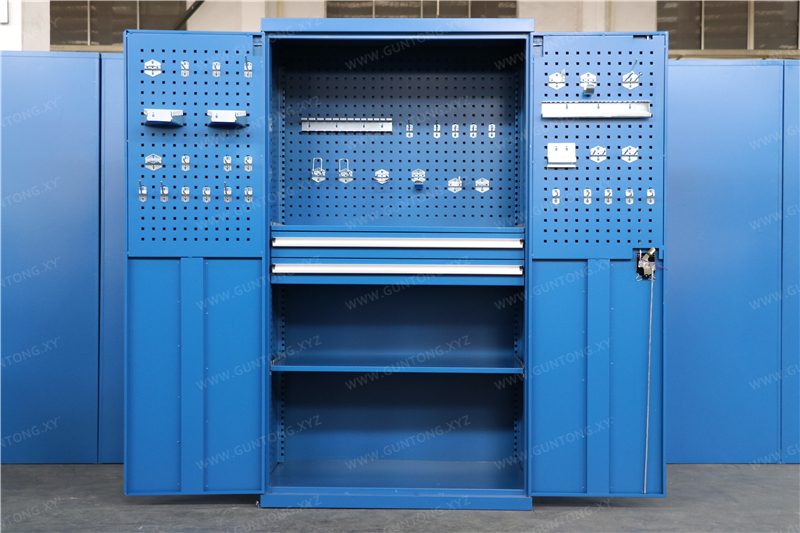
When to Choose the 4-Drawer 1-Door Tool Cart with Pegboard
The combined configuration is better suited for scenarios where retrieval speed and tool variety are the dominant requirements:
High-frequency tool changes across many tool types. Electronics assembly lines, electrical panel wiring stations, and general maintenance workshops typically require operators to access 30–60 different tools per shift. The pegboard allows the most frequently used tools — screwdrivers, pliers, wire strippers, hex keys — to be hung at eye level for instant visual identification and one-hand retrieval, while less common tools remain organized in the drawers below.
Mixed-size tool sets require flexible storage zones. The 1-door compartment behind the pegboard provides shelf space for items too large for drawers but too small for separate shelving — power drills, soldering stations, multimeters, or adhesive dispensers. This three-zone approach (pegboard + door shelf + drawers) eliminates the need for a separate tool rack beside the cart.
Visual management supports lean manufacturing. In facilities implementing lean production or TPM (Total Productive Maintenance), shadow boards and pegboard outlines make missing tools immediately visible. This supports end-of-shift tool audits and reduces tool loss — a common pain point in shared maintenance environments.
The cart serves as a mobile workstation. The 1000×500mm footprint of the 4-drawer 1-door configuration provides a wider top surface that can function as a temporary work platform for light assembly or inspection tasks, particularly when paired with the pegboard as a back panel for hanging work instructions or diagrams.
Load Capacity and Structural Boundaries
Both configurations share the same fundamental load-bearing architecture. The cabinet body and drawer panels are fabricated from 1.0mm cold-rolled steel, with heavy-duty stamped guide rails enabling 85% drawer extension at full load. Each drawer supports up to 80 kg independently.
However, buyers should observe the following boundaries:
- Total cart load should not exceed the combined drawer capacity plus the structural weight of the cart itself. Overloading the top surface or pegboard beyond the manufacturer's rated specification can compromise caster stability and tipping resistance.
- Drawer load distribution matters. Concentrating 80 kg in the center of a single drawer creates different stress patterns than evenly distributed weight. Heavy items should be placed toward the rear of the drawer, close to the cabinet body, to reduce moment arm stress on the guide rails.
- Caster specification is matched to standard loads. The default 4-inch caster configuration (2 fixed, 2 swivel with brake) is designed for typical workshop floor conditions. Facilities with uneven surfaces, ramp transitions, or outdoor yard movement should consult the manufacturer about upgraded caster options.
Configuration and Customization Options
Guang'ErMei Precision Components supports both standardized and non-standard customization for either configuration:
- Drawer height combinations can be mixed from 100mm, 150mm, and 200mm options to match specific tool dimensions.
- Color options default to gray-white or blue, with custom colors available for facilities requiring color-coded zone identification.
- Pegboard type on the 1-door configuration uses standard square-hole patterns compatible with widely available hooks and holders.
- Production lead time is typically 2–3 working days for standard configurations in stock, and 7–10 working days for non-standard custom dimensions.
- After-sales coverage includes a three-year warranty on structural components and guide rails.
Decision Summary
| Decision Factor | Choose Standard 4-Drawer | Choose 4-Drawer 1-Door with Pegboard |
|---|---|---|
| Tool protection priority | — | |
| High tool variety (30+ items) | — | |
| Retrieval speed matters most | — | |
| Narrow aisle operation | — | |
| Visual management / 6S audits | Uniform exterior | Shadow board capability |
| Mixed tool sizes | Drawers only | Drawers + shelf + pegboard |
| Mobile workstation use | Limited top space | Wider top + back panel |
Next Steps
If your facility is evaluating mobile tool storage for a new production line, maintenance department upgrade, or 6S standardization project, the choice between these two configurations should be driven by your actual tool inventory profile and retrieval patterns — not by assuming more features are always better.
Guang'ErMei Precision Components provides on-site workstation planning and load-bearing design consultation for manufacturing enterprises across electronics, automotive parts, hardware molds, maintenance and testing, and warehousing logistics sectors. Contact our engineering team with your tool list and floor layout to receive a configuration recommendation tailored to your specific operational requirements.